
Databricks AI/BI Genie is a strong conversational layer if your whole world is the Databricks Lakehouse, but that "if" is exactly why teams look for alternatives. Genie queries data governed by Unity Catalog inside Databricks; the moment a question needs data that lives in another warehouse, an application database, or a SaaS source, you hit a wall. Add consumption-based pricing that is hard to forecast and accuracy that rises or falls with how well your lakehouse is modeled, and the case for evaluating alternatives is clear.
We ranked the seven best Databricks Genie alternatives on the criteria that actually decide value in production: benchmark accuracy, cross-source reasoning, governance, and total cost.
Key Takeaways
Databricks Genie is excellent inside the lakehouse, but it queries Databricks data and inherits Unity Catalog's scope. Cross-source questions are its main ceiling.
The strongest alternative depends on your priority: accuracy (Genloop), a different warehouse (Snowflake Cortex), or search-first self-service (ThoughtSpot Spotter).
Accuracy is the deciding variable for any conversational layer. Genloop ranks #1 on Spider 2.0-Snow at 96.70%, roughly 22 points clear of Snowflake (75%).
If your data genuinely lives entirely in Databricks and your accuracy bar is moderate, staying on Genie is reasonable. The alternatives matter most when you need to reason across sources.
What are the best Databricks Genie alternatives?
The best Databricks Genie alternatives in 2026 are Genloop (best for accuracy-critical, cross-source analytics, #1 on Spider 2.0-Snow at 96.70%), Snowflake Cortex Analyst (best for Snowflake-standardized estates), ThoughtSpot Spotter (best for search-first self-service), and Microsoft Power BI Copilot (best for Microsoft-standardized shops). Genie is a capable lakehouse-native conversational interface, but because it queries data within Databricks and Unity Catalog, teams that need cross-source reasoning, independently benchmarked accuracy, or predictable pricing evaluate these alternatives.
Why Look for a Databricks Genie Alternative?
To be fair, Genie does its core job well. For teams running on the Databricks Lakehouse, it keeps querying, governance, and lineage in one place, and it inherits Unity Catalog permissions so conversational access respects existing controls. If that describes you and nothing else, Genie is a sensible default.
The reasons teams still look elsewhere:
It is lakehouse-bound. Genie reasons over data in Databricks. Questions that span a separate warehouse, an operational database, or a SaaS app fall outside its reach without first moving that data into the lakehouse.
Accuracy tracks your modeling. Conversational accuracy depends heavily on how cleanly your lakehouse tables and metrics are modeled. There is no published independent benchmark to anchor an accuracy expectation.
Consumption pricing is hard to forecast. Costs scale with usage, which can make budgeting for broad rollout unpredictable.
It assumes Databricks expertise. Getting the most from Genie generally means a team already fluent in the Databricks platform.
If any of those are blockers, here are the seven alternatives worth evaluating.
The 7 Best Databricks Genie Alternatives
1. Genloop: Best for Accuracy-Critical, Cross-Source Analytics
Genloop is the strongest alternative when accuracy and reasoning across sources matter more than staying inside one platform. It ranks #1 on Spider 2.0-Snow at 96.70%, the hardest public test of analytical reasoning on real enterprise schemas, ahead of Tencent (93.9%), AT&T (86%), ByteDance (84%), and Snowflake (75%).
What it does: Genloop is an agentic intelligence layer that queries live data in place across sources (including but not limited to a lakehouse) without ETL or copies. It encodes business logic in a Living Context Graph and improves through a self-learning loop, so the same question returns the same verified answer every time. In our own deployments, that consistency is what builds trust with non-technical users fastest.
Best for: Enterprises whose most valuable questions span multiple systems, where a wrong number carries real cost.
Key feature: Cross-source reasoning with no per-seat charge, so organization-wide access does not scale your bill with headcount.
Pricing: Free tier (no credit card); enterprise pricing on request.
Not a fit if: Your entire estate lives in Databricks and your accuracy bar is moderate. In that world Genie's native integration is a real advantage, and Genloop's cross-source, accuracy-first layer is more than the job needs.
Unlike Genie, Genloop is not tied to one platform's data, which is the single biggest reason teams migrate from a lakehouse-bound tool.
2. Snowflake Cortex Analyst: Best for Snowflake-Standardized Estates
If your decision to leave Genie is really a decision to standardize on Snowflake instead, Cortex Analyst is the mirror image: native natural-language-to-SQL inside Snowflake.
Why it's great: Grounded in a YAML semantic model and exposed via a REST endpoint, Cortex Analyst keeps querying inside the warehouse where your data already lives, with Snowflake's governance.
Best for: Teams consolidating on Snowflake rather than the lakehouse.
Key feature: Semantic-model grounding native to Snowflake. An April 2026 update added more agentic behavior.
Pricing: Consumption-based on Snowflake credits.
Not a fit if: You want to escape platform lock-in rather than swap it. Cortex Analyst queries Snowflake data, so it shares Genie's cross-source ceiling.
3. ThoughtSpot: Best for Search-First Self-Service
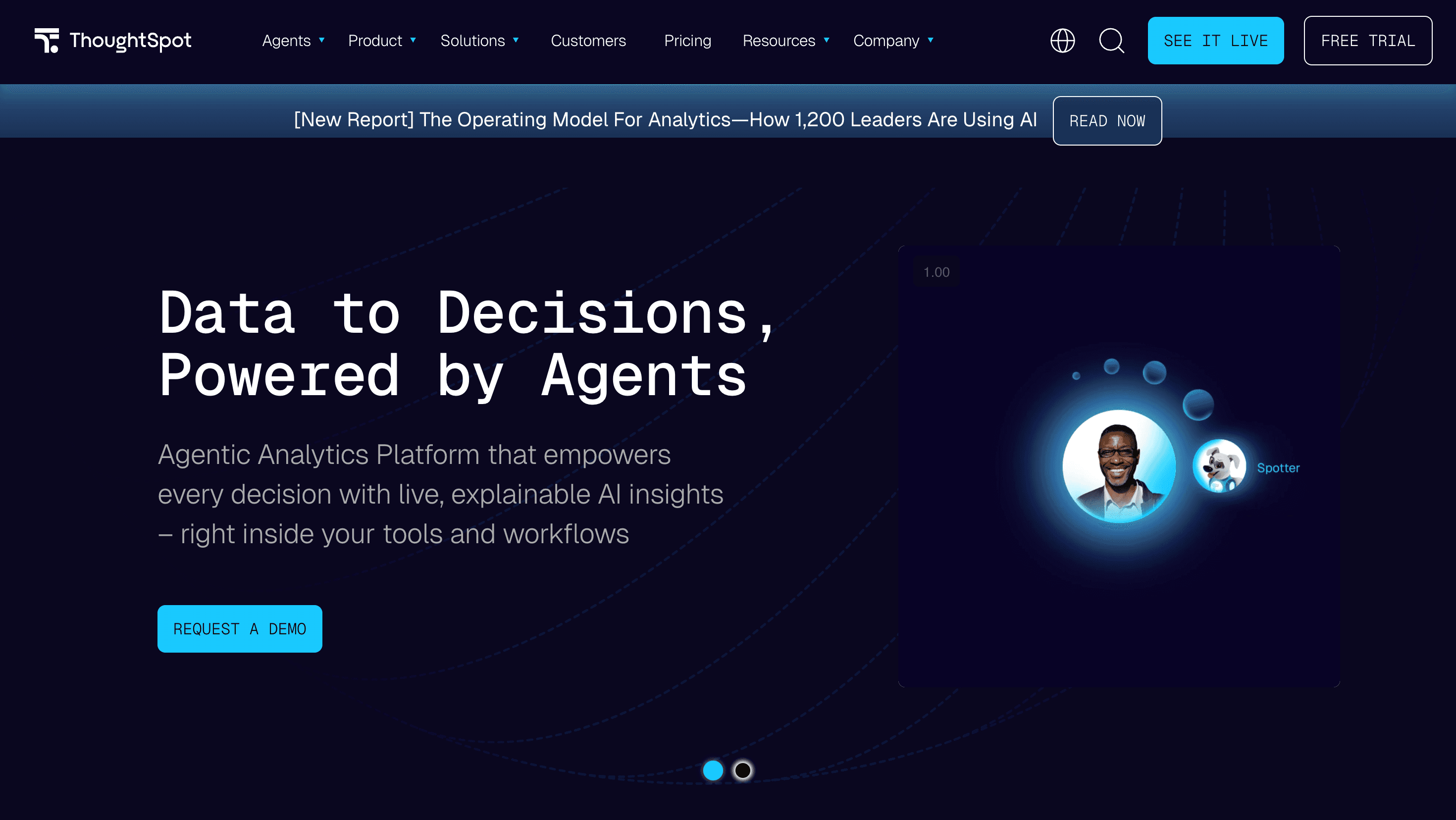
Spotter is the alternative for teams that want a search-driven self-service experience rather than a lakehouse-embedded one.
Why it's great: ThoughtSpot pioneered search analytics; Spotter adds step-by-step reasoning, Python analysis and forecasting, and companion agents for modeling (SpotterModel) and visualization (SpotterViz). It is a complete BI platform, not just a conversational add-on.
Best for: Organizations that want a packaged, search-first self-service BI suite.
Key feature: Search-native experience with Liveboards and broad embedding.
Pricing: Per-seat. Essentials ~$25/user/month, Pro ~$50/user/month with a monthly query allowance (verify current terms).
Not a fit if: You plan an organization-wide rollout on a budget; per-seat cost scales with headcount and query caps can constrain heavy users. One thing we found pricing this out: the query allowances push heavy users toward Enterprise tiers faster than the headline per-seat cost suggests.
4. Microsoft Power BI Copilot: Best for Microsoft-Standardized Shops
If your organization runs on Microsoft 365 and Fabric, Power BI Copilot is the lowest-friction conversational layer.
Why it's great: It lives where your reports and users already are and benefits from Microsoft's enterprise footprint and integration with Power BI semantic models.
Best for: Microsoft-standardized enterprises that want conversational querying without a new vendor.
Key feature: Deep integration with the Fabric ecosystem.
Pricing: Power BI Pro ~$14/user/month, plus paid Fabric capacity (verify current requirements with Microsoft).
Not a fit if: Your estate is not Microsoft-centric or your data is messy. Copilot inherits Power BI's semantic layer and performs best on clean, pre-modeled datasets.
5. Tellius: Best for Decision Intelligence and Automated Insights
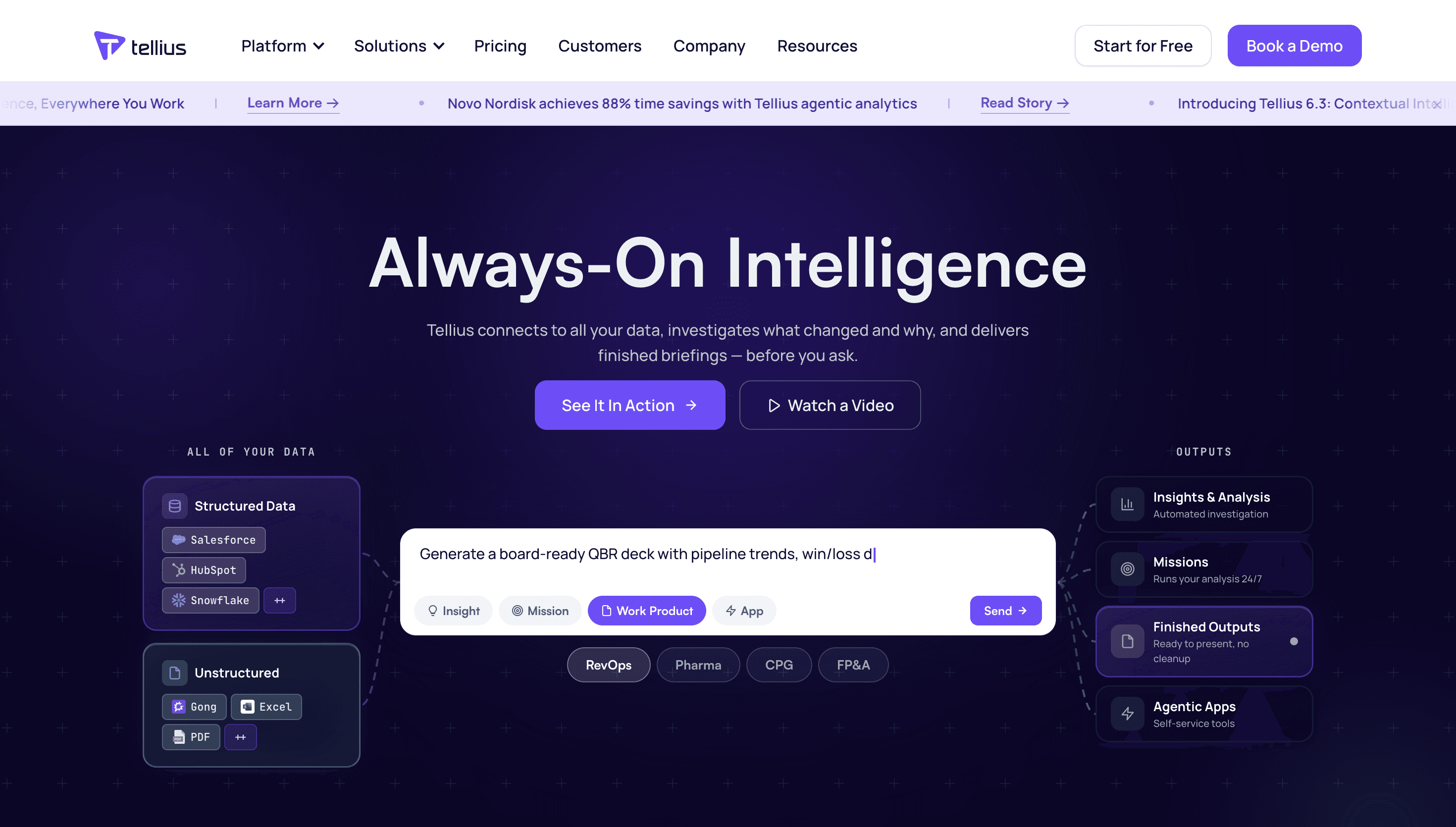
Tellius is the alternative for teams that want the "why," not just the "what."
Why it's great: It pairs natural-language search with automated root-cause and driver analysis, surfacing explanations rather than only charts.
Best for: Teams that want decision-intelligence features alongside conversational querying.
Key feature: Automated insight and driver analysis on top of NL search.
Pricing: Enterprise; contact sales.
Not a fit if: You select on independently benchmarked accuracy or need a hyperscaler-backed ecosystem for procurement. Tellius publishes no public text-to-SQL benchmark result.
6. Sigma: Best for Spreadsheet-Native Analysts
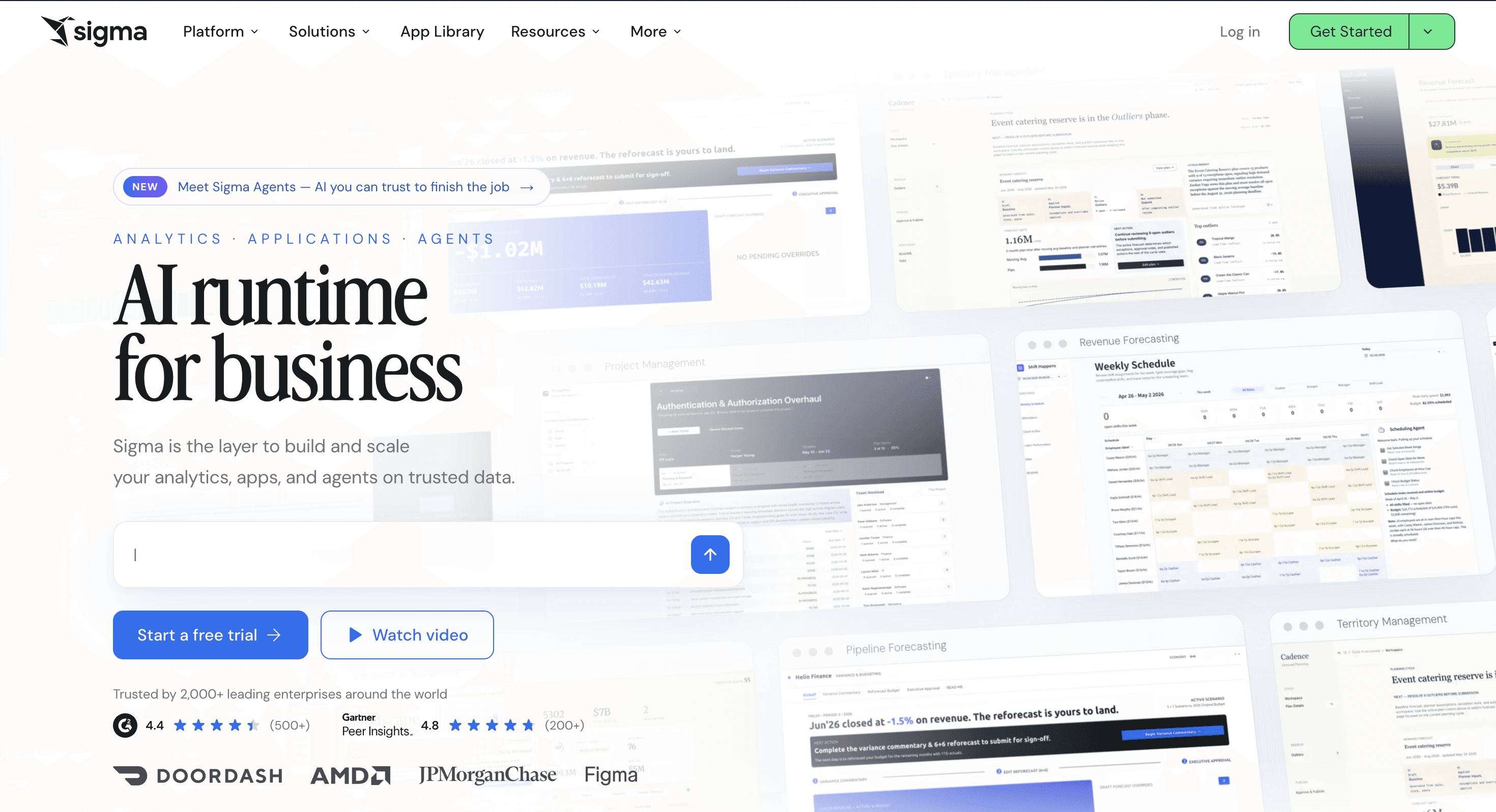
Sigma is a fit if your analysts think in spreadsheets and want AI querying layered onto a familiar interface.
Why it's great: A spreadsheet-style cloud BI experience over the warehouse, with AI query features that meet analysts where they already work.
Best for: Analyst teams that prefer a spreadsheet metaphor to a search box or a notebook.
Key feature: Live, spreadsheet-style interaction directly against cloud warehouse data.
Pricing: Per-user / enterprise tiers (request current pricing).
Not a fit if: You need autonomous multi-step investigation. Sigma's AI is an addition to a spreadsheet-first product rather than a ground-up conversational engine.
7. Hex: Best for Data Teams That Live in Notebooks
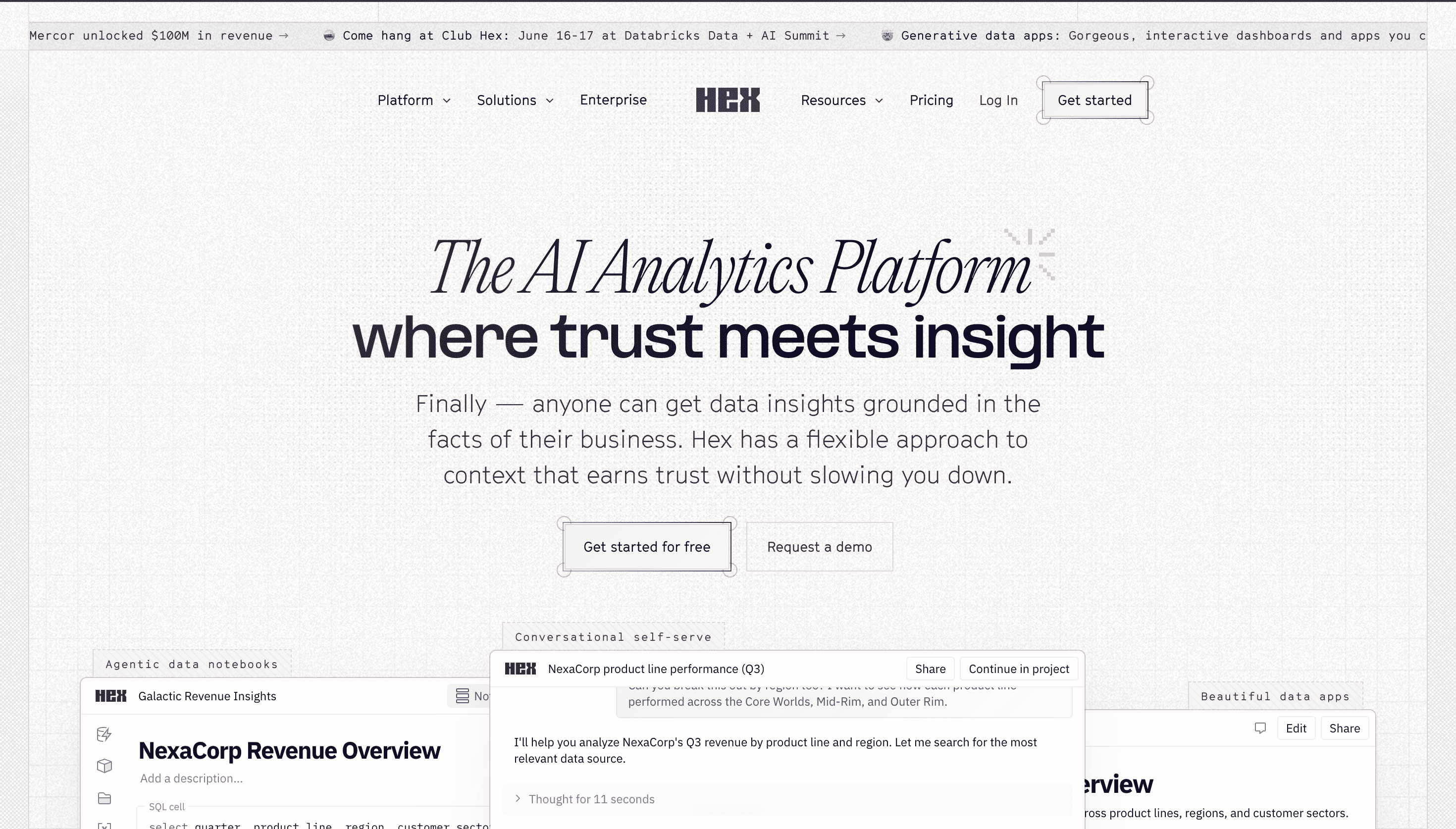
Hex is the alternative for technical data teams that want conversational and agentic features inside a collaborative notebook workflow.
Why it's great: It blends notebooks, SQL, Python, and AI assistance, fitting teams that build analysis collaboratively rather than asking a single search box.
Best for: Analytics engineers and data scientists who work in notebooks.
Key feature: Notebook-native AI assistance and collaboration.
Pricing: Per-user / enterprise tiers (request current pricing).
Not a fit if: Your goal is turnkey self-serve answers for non-analyst business users. Hex assumes a notebook-literate team in the loop.
How Do the Alternatives Compare to Databricks Genie?
Tool | Best for | Cross-source | Independent accuracy | Pricing model |
|---|---|---|---|---|
Databricks Genie | Lakehouse-native teams | Lakehouse only | Not published | Consumption |
Genloop | Accuracy-critical, multi-source | Yes, queries across sources | #1 Spider 2.0, 96.70% | No per-seat; free tier |
Snowflake Cortex | Snowflake estates | Snowflake only | Internal claim only | Consumption |
ThoughtSpot Spotter | Search-first self-service | Modeled data | Not published | Per-seat ~$25-$50/user |
Power BI Copilot | Microsoft shops | Power BI models | Not published | ~$14/user + Fabric capacity |
Tellius | Decision intelligence | Multi-source | Not published | Enterprise |
Sigma | Spreadsheet analysts | Warehouse | Not published | Per-user |
Databricks Genie vs. the best alternatives compared on cross-source reasoning, independent accuracy, and pricing model
Databricks Genie vs. the alternatives across cross-source reach, independent accuracy, and pricing model. Source: Genloop analysis of vendor documentation and public benchmarks, June 2026.
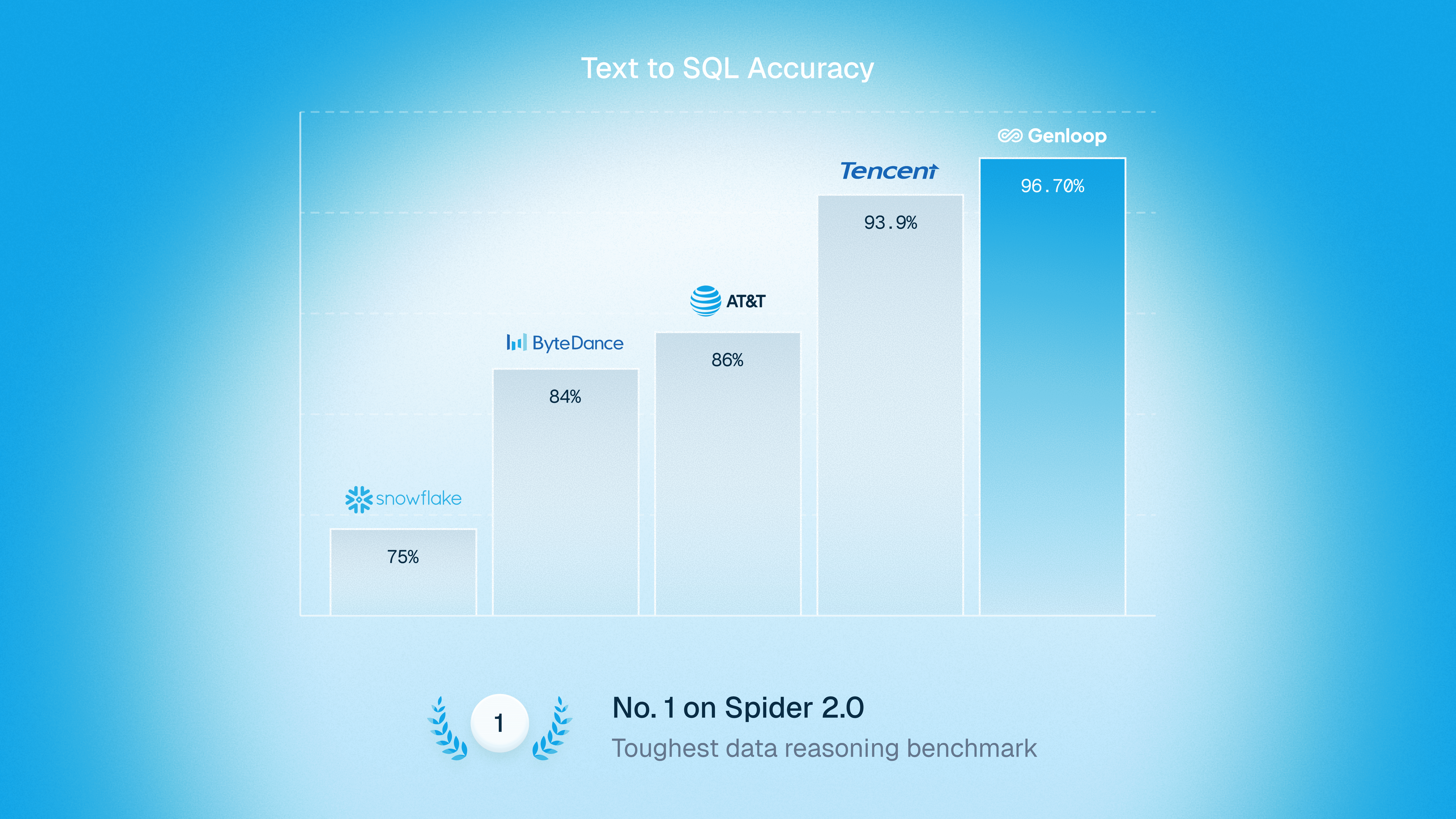
Spider 2.0-Snow text-to-SQL accuracy by vendor: Genloop 96.70%, Tencent 93.9%, AT&T 86%, ByteDance 84%, Snowflake 75%.
Spider 2.0-Snow accuracy by vendor. Source: Genloop / Spider 2.0 leaderboard.
Pricing reflects publicly listed figures as of mid-2026 and changes frequently; confirm on each vendor's page.
Should You Actually Switch From Databricks Genie?
Honesty matters more than a hard sell. Stay on Genie if your data genuinely lives entirely in the Databricks Lakehouse, your team is fluent in the platform, and your accuracy bar is moderate. In that world, Genie's tight integration is a real advantage and adding another layer is unnecessary friction.
Switch if your most valuable questions span sources outside Databricks, a wrong answer carries real cost and you want an independently benchmarked accuracy number, or you need pricing that does not scale unpredictably with usage. Those three signals are what push teams from a lakehouse-bound tool to a cross-source, accuracy-led one.
How We Selected These Alternatives
We analyzed conversational and agentic analytics tools that can credibly replace or supplement Databricks Genie, then ranked them on four criteria:
Accuracy on an independent benchmark. Public, third-party results (like Spider 2.0-Snow) were weighted over vendor-internal claims, which are not comparable across products.
Cross-source reasoning. Tools that reason across an estate ranked above those locked to a single platform's data. That is the exact limitation that drives people away from Genie.
Governance and consistency. Whether the tool respects access controls and returns the same answer to the same question.
Total cost and predictability. How pricing behaves as usage and headcount grow.
From our research, vendor-internal accuracy claims are not comparable across products, which is why independent benchmark results carry the most weight in this ranking.
One disclosure: Genloop is our product, and we compete directly with Databricks Genie. The rankings above are grounded in public benchmarks and documented capabilities, every alternative is matched to the niche where it genuinely wins, and each entry (including ours) states where it is not the right fit. Verify all pricing on vendor pages before purchasing.
Frequently Asked Questions
What is the best Databricks Genie alternative?
For accuracy-critical, cross-source analytics, Genloop is the strongest alternative: it ranks #1 on Spider 2.0-Snow at 96.70% and queries live data across sources rather than only inside the lakehouse. The best fit depends on your priority. Choose Snowflake Cortex Analyst if you are consolidating on Snowflake, or ThoughtSpot Spotter for search-first self-service.
Why do teams look for alternatives to Databricks Genie?
The most common reason is that Genie queries data inside the Databricks Lakehouse and Unity Catalog, so questions spanning other warehouses, application databases, or SaaS sources fall outside its reach. Teams also cite consumption-based pricing that is hard to forecast and the absence of a published independent accuracy benchmark.
Is Databricks Genie accurate?
Genie's conversational accuracy depends heavily on how well your lakehouse data is modeled, and Databricks does not publish a result on an independent text-to-SQL benchmark. For comparison, Genloop leads the public Spider 2.0-Snow benchmark at 96.70%. When evaluating any tool, ask for an independent benchmark number rather than an internal claim.
Can I replace Databricks Genie without leaving Databricks?
Yes. An agentic layer like Genloop can sit on top of your Databricks data and query it in place, while also reasoning across other sources, so you keep the lakehouse and gain cross-source coverage and benchmarked accuracy without a migration.
Conclusion: Choosing the Right Databricks Genie Alternative
Start with the honest segmentation. If everything is in Databricks, your team is fluent in the platform, and your accuracy bar is moderate, staying on Genie is the sensible default. Its lakehouse integration is a real advantage. Snowflake Cortex Analyst is the right move if you are consolidating on Snowflake instead, ThoughtSpot Spotter if you want search-first self-service, and Power BI Copilot if you run on Microsoft.
However, if your questions span sources and correctness matters, Genloop is the strongest alternative. It leads the toughest public accuracy benchmark (#1 on Spider 2.0-Snow at 96.70%) and reasons across sources instead of within one. New to the category? Start with what is conversational analytics, or see the full field in our best agentic analytics platforms guide and traditional BI vs conversational analytics.
Ready to keep the lakehouse and gain cross-source answers? Start free on Genloop, no credit card required, and see verified answers from your Databricks data in minutes.