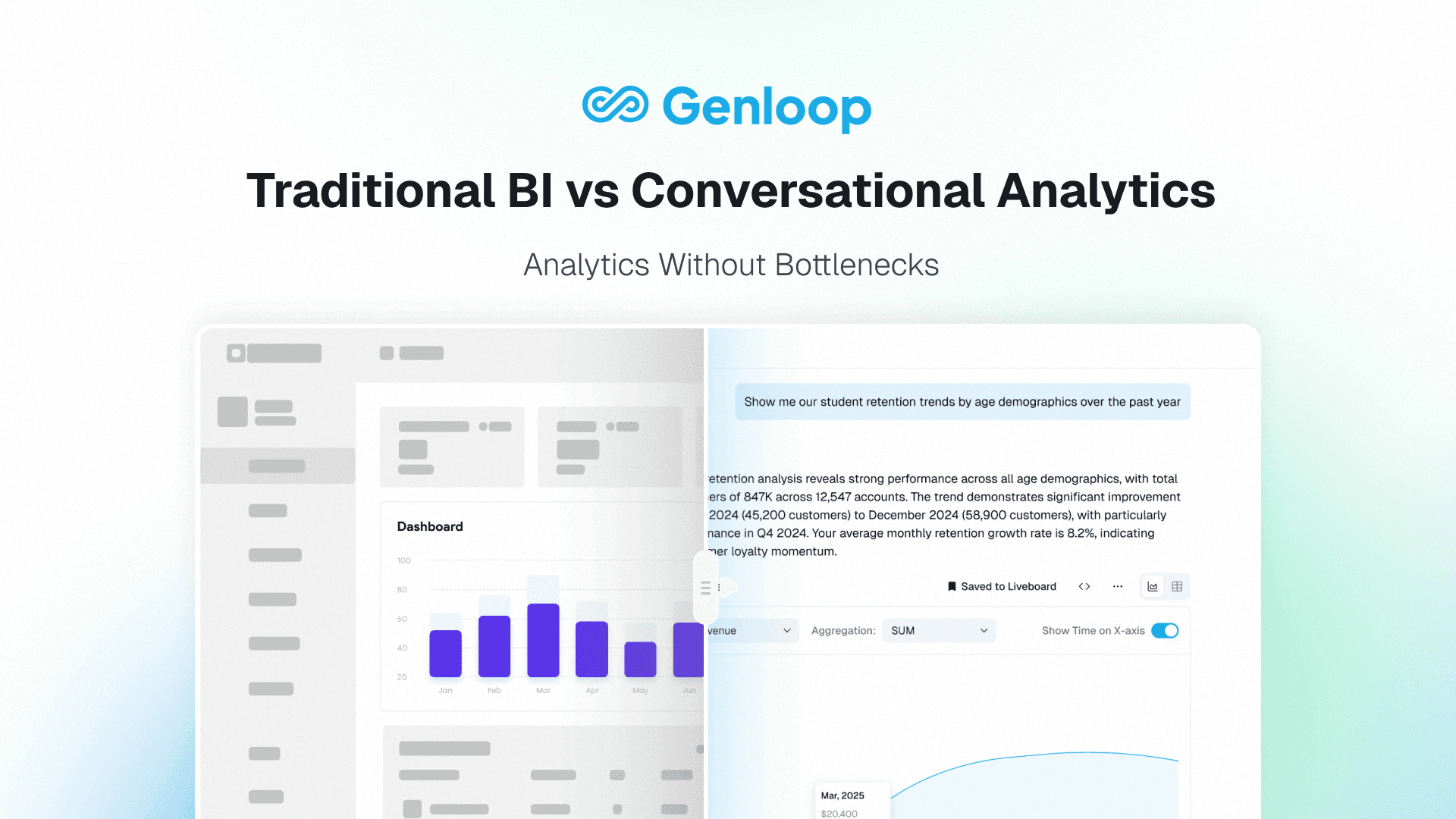
Traditional BI tools like Tableau, Power BI, and Looker only answer questions someone already built a dashboard for. Everything else goes back to the data team. Conversational BI tools let any user ask questions in plain language and get a governed answer in seconds, with no SQL and no analyst queue. This guide compares the two models and ranks the 6 best conversational BI tools for enterprise in 2026, giving a clear view of both categories so you can make an informed decision.
TL;DR
Traditional BI owns operational and audit-ready reporting. Conversational BI owns everything ad-hoc, exploratory, and real-time.
This is not a replacement decision. Most enterprises run both. The question is which conversational BI tool fits your data estate.
The 6 leading conversational BI tools split into two camps: native intelligence layers (Genloop, ThoughtSpot) that reason across sources, and AI assistants (Power BI Copilot, Tableau Agent, Snowflake Cortex, Databricks Genie) that work inside one platform.
Related: Are Dashboards Dying? · What Agentic Analytics Actually Needs: The Science Behind Genloop
What Traditional BI Actually Is
Traditional BI platforms such as Tableau, Power BI, and Looker are visualisation and reporting tools. They connect to a data source, let analysts build dashboards, and publish those views for business users to consume. Traditional BI grew up around the idea that a small group of experts prepares data for everyone else.
Interface: Dashboards, canned reports, drag-and-drop visuals
Users: Primarily analysts. Everyone else is a consumer
Workflow: Stakeholder asks → analyst models data → builds dashboard → stakeholder reviews → asks for tweaks
Strengths: Strong governance (central teams define revenue, churn, margin once), deterministic results (same query, same answer), handles complex multi-path SQL well
Where Traditional BI Gets Stuck
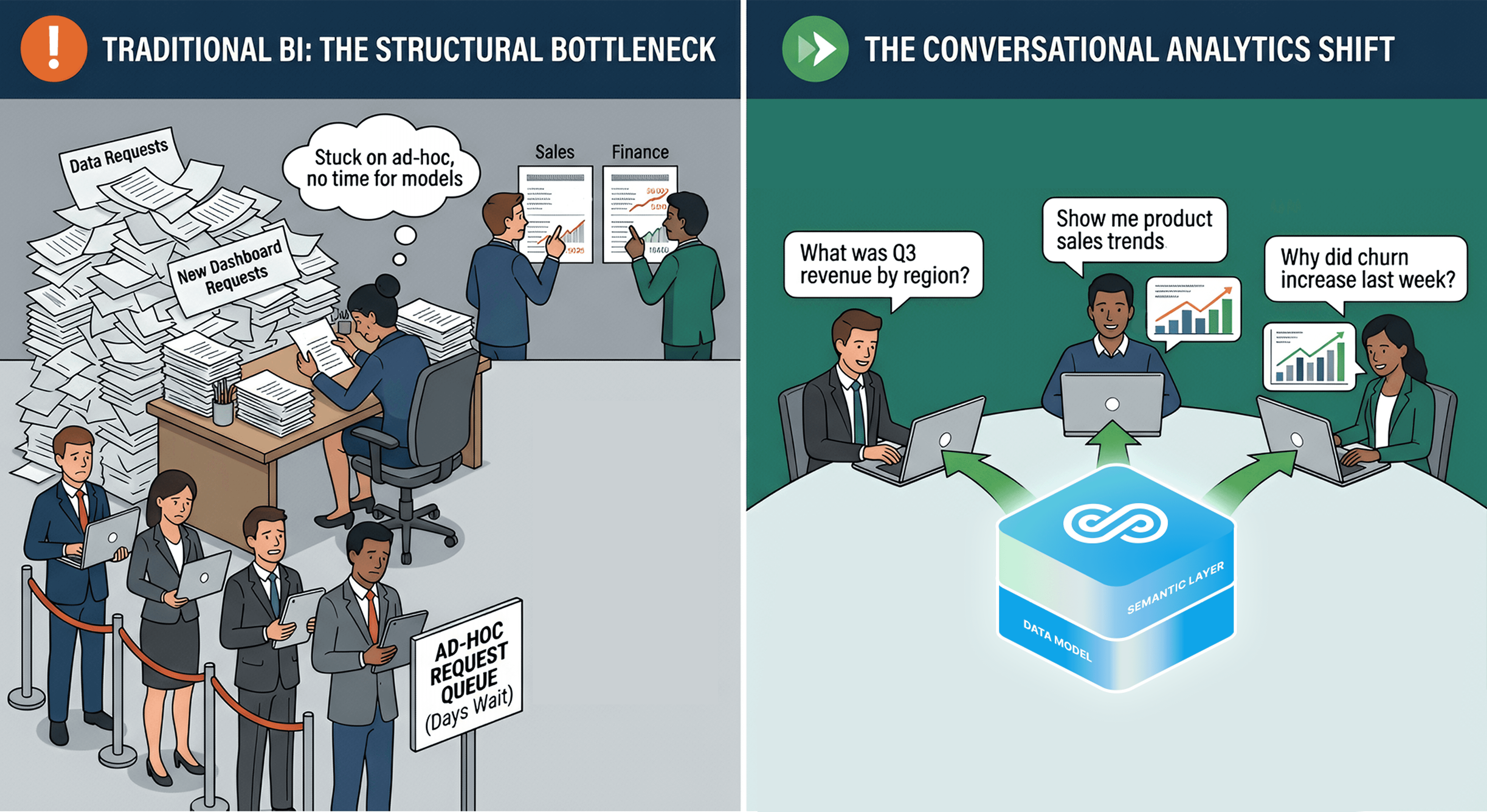
At enterprise scale, unanticipated questions are the norm, not the exception. A regional manager in a Monday meeting wants to know why churn spiked in one customer segment last quarter. That view does not exist. The request goes to the data team backlog. The answer arrives Thursday. The decision gets made without it.
Multiply that across hundreds of stakeholders generating dozens of requests per week, and the pattern becomes clear: traditional BI creates a structural dependency on analyst availability. The data team is always behind because the model requires a SQL-literate human in the loop for every question that falls outside existing views.
Dashboard proliferation makes it worse. As teams try to solve the bottleneck by building more dashboards, metric definitions start to drift. Finance defines revenue one way. Marketing defines it another. Both definitions live in separate workbooks. Both look equally authoritative. The discrepancy surfaces during a leadership review, and nobody can explain why the numbers don't match. This is the structural problem. See Are Dashboards Dying? for the broader argument on why dashboard-first BI is losing ground.
What Conversational BI Actually Is
Conversational BI tools are analytics products that let business users ask questions of their data in natural language and receive answers as charts, tables, or narrative summaries, replacing the click-heavy dashboard with a chat-style interface.
The shift is structural, not cosmetic. A dashboard shows metrics someone anticipated months ago, so a small fraction of built reports drive most usage while a long tail goes quietly unread. Conversational BI answers the question asked in the moment, which matters when a CFO needs an unplanned breakdown before a board call.
The category splits into two camps:
Native intelligence layers that reason directly over the structure and meaning of your data, across sources
AI assistants that run inside an existing warehouse or BI suite, whose answers stop at that platform's edge
This split, reasoning across everything versus answering from one platform, separates these tools more than any feature checklist. For more on why single-platform architectures fall short, see MCPs Are a Dead End for Talking to Data.
Why Does Accuracy Decide a Conversational BI Rollout?
The real adoption blocker is not the chat box; it is trust. Users stop asking the moment they catch a wrong number, so accuracy and determinism (the property that the same question always returns the same verified answer), not interface polish, decide whether a rollout survives.
A Power BI Copilot answer stops at the model an analyst defined. A Cortex answer stops at the Snowflake boundary. So two questions separate these tools: how accurate the answers are, and how far the tool can reach. The deeper architectural take is in What Agentic Analytics Actually Needs, and for an honest assessment of where current approaches fall short, What Anthropic Got Right About Agentic Analytics (And Wrong For Everyone Else).
The 6 Best Conversational BI Tools in 2026
Ordered by how completely each delivers accurate, governed, cross-source conversation, though each is the right pick for a specific buyer.
1. Genloop: Best for accuracy across the whole data estate
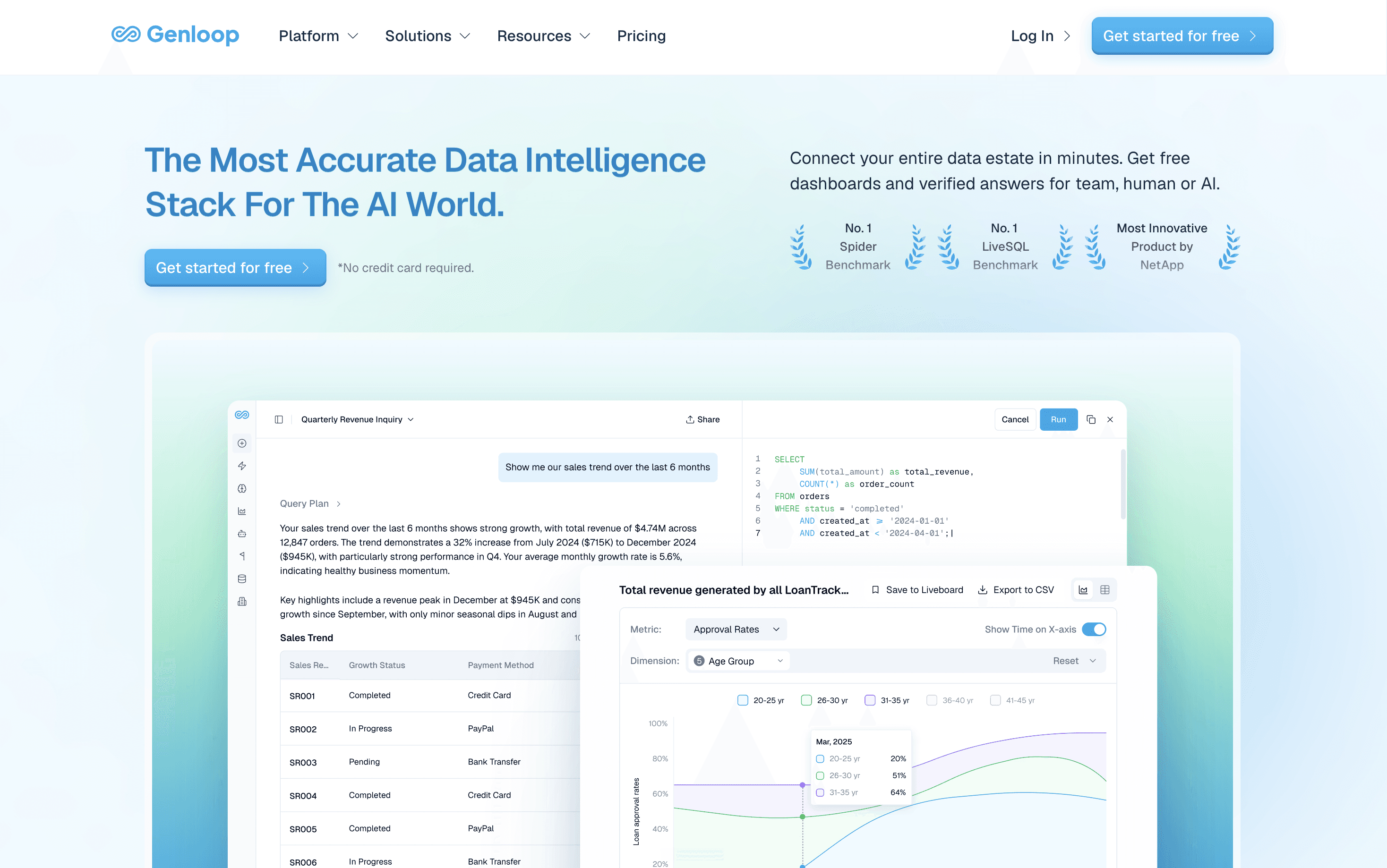
What it does: Genloop is an intelligence layer that queries live data in place across Snowflake, BigQuery, Redshift, Postgres, and lakehouses with no ETL, and is the only tool here with two independent published #1 benchmarks: #1 on Spider 2.0-Snow at 96.70% and #1 on LiveSQLBench, ahead of Snowflake (75%). Its Living Context Graph (see the science behind Genloop) keeps the same question returning the same verified answer, with RBAC, RLS, and CLS enforcing governance at the row and column level.
Best for: Enterprises with data across multiple warehouses that need accuracy and governance, not a single-vendor walled garden.
Pricing: Free tier, no per-seat charge; enterprise on request.
Not a fit if: You have a single small table without much complexity. In that case you could connect directly to Claude Code and skip the overhead. For dev/analyst use, see Using OpenClaw for Business Analytics.
2. ThoughtSpot Spotter: Best for search-first self-service BI
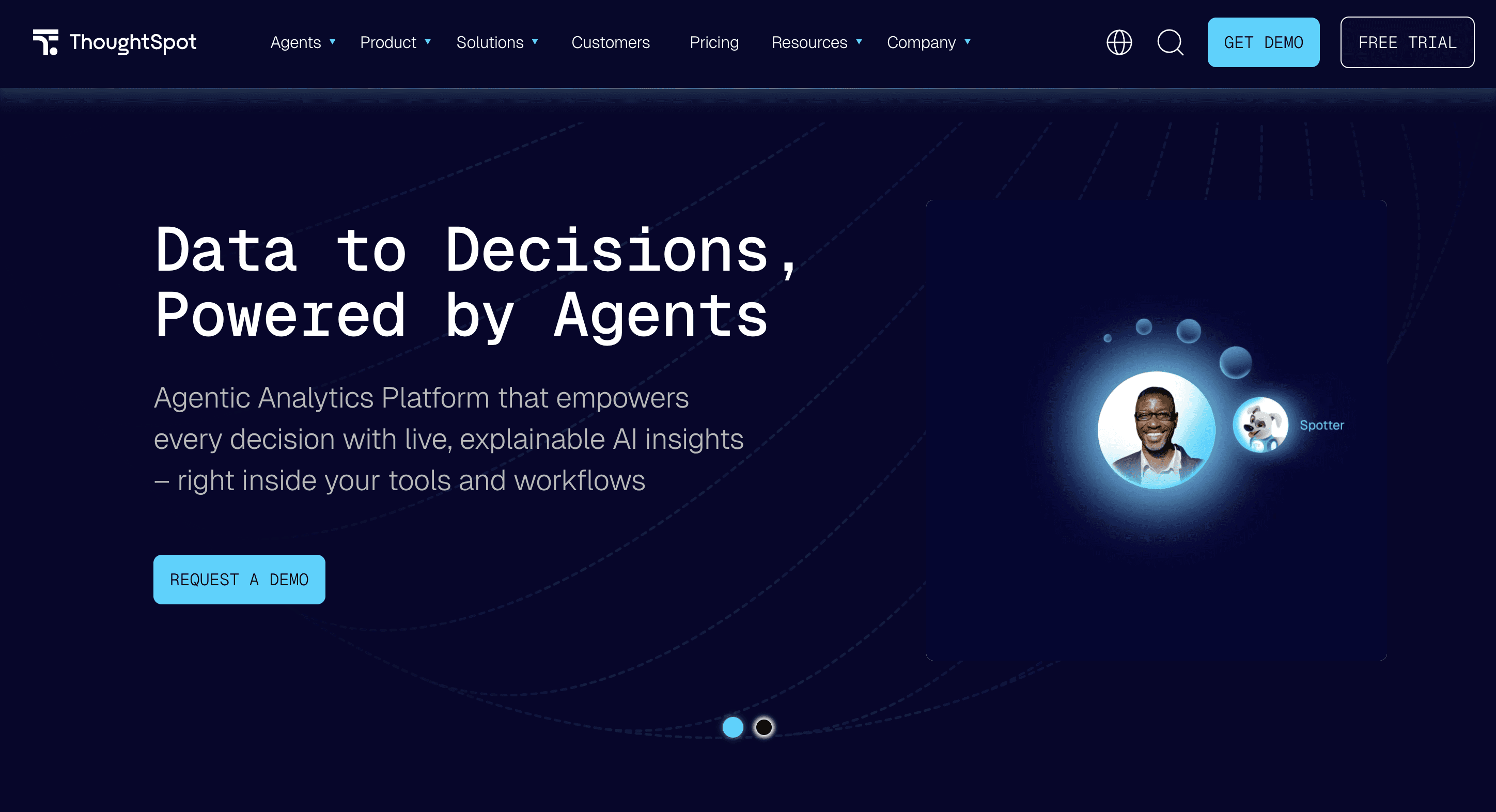
What it does: ThoughtSpot pioneered search-first analytics; Spotter is its conversational agent, paired with companion agents for modelling and visualisation, so business users start asking questions fast.
Best for: Teams that already favour search-first BI and want a conversational upgrade.
Pricing: ~$25/user/mo (Essentials) and ~$50/user/mo (Pro), plus a monthly query allowance (ThoughtSpot Pricing).
Not a fit if: Questions routinely cross sources outside the ThoughtSpot model, or per-user query allowances throttle a wide rollout.
3. Microsoft Power BI Copilot: Best for Microsoft-native shops
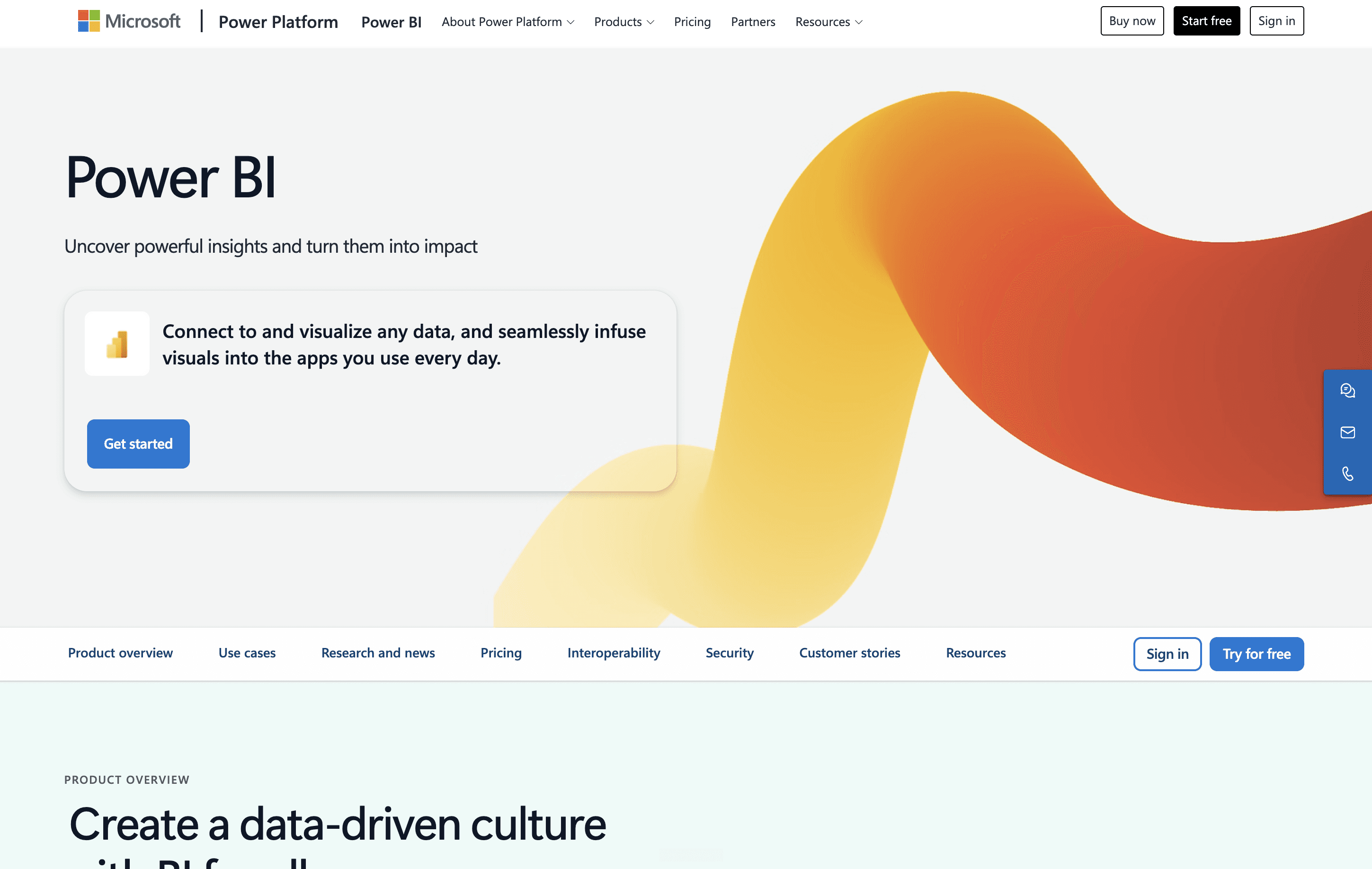
What it does: Power BI Copilot is an AI assistant on Power BI's existing semantic models, letting users ask questions and generate visuals inside the familiar Power BI experience.
Best for: Microsoft-centric enterprises standardised on Power BI and Fabric, where the integration is tight and the learning curve gentle.
Pricing: ~$14/user/mo for Power BI Pro, plus paid Fabric capacity.
Not a fit if: Your estate is not Microsoft-centric; Copilot inherits the Power BI semantic model an analyst pre-built and stops where that model stops.
4. Tableau Pulse + Tableau Agent: Best for visualisation-led teams
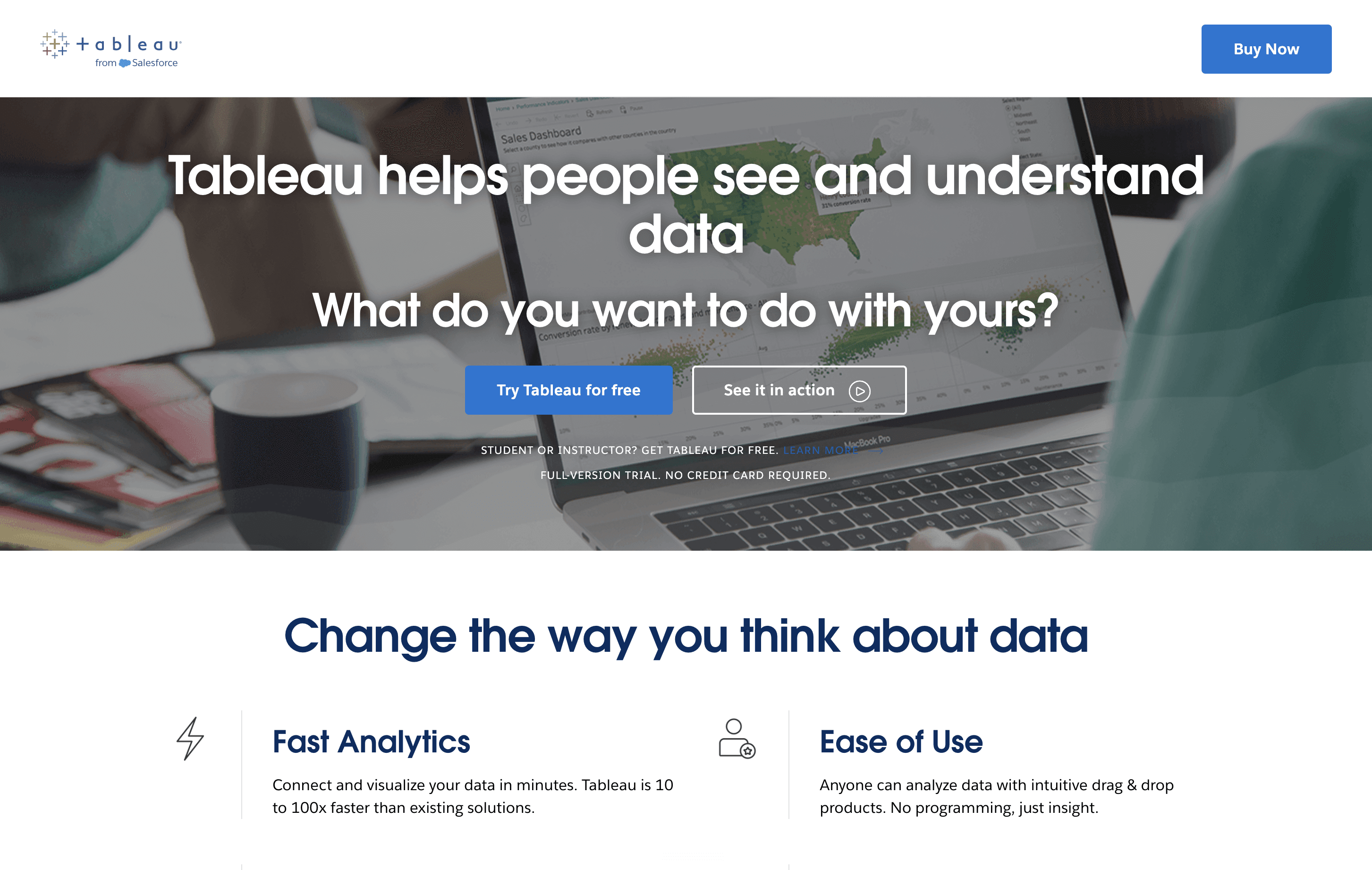
What it does: Tableau adds Einstein-powered conversational features through Pulse and Tableau Agent on top of its mature visualisation engine.
Best for: Design-led analytics teams that prioritise visualisation quality.
Pricing: ~$115/user/mo for a Creator license.
Not a fit if: You want investigation rather than monitoring; Pulse watches metrics you already published rather than answering open-ended questions over raw warehouse data.
5. Snowflake Cortex Analyst: Best for Snowflake-only stacks
What it does: Cortex Analyst provides natural-language-to-SQL inside Snowflake from a YAML semantic model you maintain, exposed through a REST endpoint, scoring around 75% on Spider 2.0-Snow.
Best for: Teams whose data is entirely in Snowflake and want NL querying next to the data.
Pricing: Consumption-based on Snowflake credits.
Not a fit if: Questions need data outside Snowflake, or maintaining a YAML model per dataset is too much upkeep. See Why Snowflake Cortex Isn't Enough for Enterprise Data Analytics for the broader limits.
6. Databricks AI Genie: Best for lakehouse-native teams
What it does: Genie offers conversational analytics native to the Databricks lakehouse, governed through Unity Catalog.
Best for: Teams whose data lives primarily in Databricks and want Unity Catalog governance inherited.
Pricing: Consumption-based within the Databricks platform.
Not a fit if: A meaningful share of your data lives outside the lakehouse; Genie's reach and governance stop at the platform boundary. For the alternatives landscape, see 7 Best Databricks Genie Alternatives for Enterprise in 2026.
Also worth evaluating: Sigma (spreadsheet-style cloud BI with AI-assisted querying) and Qlik (associative exploration with Insight Advisor, best for existing Qlik shops).
Traditional BI vs Conversational BI: Direct Comparison
Capability | Traditional BI | Conversational BI |
|---|---|---|
Primary interface | Dashboards + reports | Plain-language chat |
Time to answer a new question | Days to weeks (analyst backlog) | Seconds |
Who uses it | Analysts (build) + consumers (read) | Anyone with a question |
Governance | Strong, centralised | Depends on tool: strong for Genloop, Cortex, Genie |
Determinism | Always | Varies: Genloop is deterministic by design |
Handles ad-hoc questions | Poorly | Designed for it |
Cross-source reach | Possible with semantic layer build | Genloop yes; warehouse-native tools only their own platform |
Audit + compliance | Mature | Maturing: depends on tool |
How the Top Conversational BI Tools Compare
Capability | Genloop | ThoughtSpot | Power BI Copilot | Tableau | Snowflake Cortex | Databricks Genie |
|---|---|---|---|---|---|---|
Conversational depth | ✓ | ✓ | ◐ | ◐ | ◐ | ◐ |
Cross-source (multi-warehouse) | ✓ | ◐ | ✗ | ✗ | ✗ | ✗ |
Row/column governance | ✓ | ✓ | ✓ | ✓ | ✓ | ✓ |
Independent benchmark published | ✓ | ✗ | ✗ | ✗ | ◐ | ✗ |
Deploy independent of host | ✓ | ◐ | ✗ | ✗ | ✗ | ✗ |
No per-seat charge | ✓ | ✗ | ✗ | ✗ | ◐ | ◐ |
How the top conversational BI tools compare on depth, reach, governance, benchmark transparency, deployment, and pricing. Source: Genloop analysis of vendor documentation and public benchmarks, June 2026.
For the cross-source angle specifically, see Best Federated Agentic Analytics Platforms for Querying Distributed Data Sources (2026).
How to Choose the Right Conversational BI Tool
Start with where your data lives. If it sits in one platform, a native tool like Cortex or Genie can be enough. If it spans warehouses, you need a cross-source layer.
Then weigh the four criteria that decide a rollout:
Accuracy: measurable, so ask for a benchmark score
AI nativeness and reach: does it reason across sources or stop at one platform?
Determinism and governance: same question, same verified answer, with row- and column-level controls
Cost: does the pricing model invite a wide rollout or quietly cap it per seat?
On those four criteria, Genloop leads. It holds the only two independent #1 benchmarks here (Spider 2.0-Snow and LiveSQLBench), reasons across sources with no ETL, returns deterministic answers from a self-learning Living Context Graph, and charges no per-seat fee. Genloop trails Tableau on visualisation and the suite assistants on setup speed. That is the honest trade, and the other tools still win their niches.
Signs Your Team Needs Conversational BI
Add conversational BI alongside traditional BI when you see any of these patterns:
A growing analyst backlog of one-off requests
Stakeholders making decisions without data because the answer arrives too late
Dashboard proliferation with conflicting metric definitions across teams
Frequent unplanned questions in leadership meetings the data team can't answer in the moment
Demand for self-service analytics from non-technical business users
A CFO, GM, or product leader who is asking the data team for "real-time" answers but only seeing yesterday's exports
Conclusion
Traditional BI is not going away. Audit-ready operational reporting still belongs in Tableau, Power BI, or Looker. Conversational BI handles the long tail: the ad-hoc, the exploratory, and the real-time questions that never made it onto a dashboard. The future is convergence: conversational answers built on rigorous semantic foundations and governance discipline.
Whichever conversational BI tool you shortlist, verify accuracy and pricing on your own data first.
Related companion guides:
Best Agentic BI Tools for Enterprise in 2026: the agentic side of the BI field
Best Federated Agentic Analytics Platforms (2026): for cross-source/multi-warehouse requirements
Best Agentic Analytics for Prescriptive and Proactive Insights (2026): for recommendation-style analytics
7 Best Databricks Genie Alternatives (2026): Databricks alternatives deep dive
To compare tools on your own data, you can start free on Genloop, no credit card required.
Frequently Asked Questions
Is conversational BI replacing traditional BI?
No. Traditional BI owns operational and audit-ready reporting; conversational BI handles ad-hoc, exploratory, and real-time questions. Most enterprises run both. The right framing is convergence, not replacement.
What is the best conversational BI tool for enterprise in 2026?
It depends on where your data lives. For cross-source accuracy and governed answers, Genloop is the strongest pick, with two independent #1 benchmarks (Spider 2.0-Snow and LiveSQLBench). For Microsoft shops, Power BI Copilot; for visualisation-led teams, Tableau; for single-platform estates, the native option (Cortex for Snowflake, Genie for Databricks).
How is conversational BI different from a traditional dashboard?
A dashboard shows metrics defined in advance; conversational BI answers any question asked in plain language in the moment. Dashboards create ticket backlogs for every new question; conversational BI removes that loop by generating the answer on demand.
Are conversational BI tools accurate enough to trust?
Accuracy varies widely, so ask for a published benchmark. Genloop posts 96.70% on Spider 2.0-Snow and ranks #1 on LiveSQLBench, ahead of Snowflake Cortex at roughly 75%. Determinism matters too: the same question should always return the same verified answer.
Can conversational BI tools query data across multiple warehouses?
Most cannot. Warehouse-native tools like Snowflake Cortex and Databricks Genie only query their own platform, and assistants like Power BI Copilot sit on a single BI suite. Genloop queries live data in place across Snowflake, BigQuery, Redshift, Postgres, and lakehouses with no copies.
How much do conversational BI tools cost?
Pricing models differ sharply. Assistants and search BI often charge per seat, roughly $14 to $115 per user per month. Warehouse-native tools bill on consumption. Genloop charges no per-seat fee and offers a free tier with no credit card.
What is conversational analytics versus conversational BI?
Conversational BI is the dashboard's plain-language successor inside a BI workflow. Conversational analytics is the broader category covering every natural-language data workflow, including agents and automation.