Enterprise AI does not fail because the model lacks intelligence. It fails because business meaning is fragmented, permissions are inconsistent, and critical logic is buried across systems.
The evidence is clear. S&P Global found that 42 percent of organizations abandoned most AI initiatives before production. On average, 46 percent of projects were discarded between proof of concept and broad adoption.
Adoption is not the bottleneck. Context is.
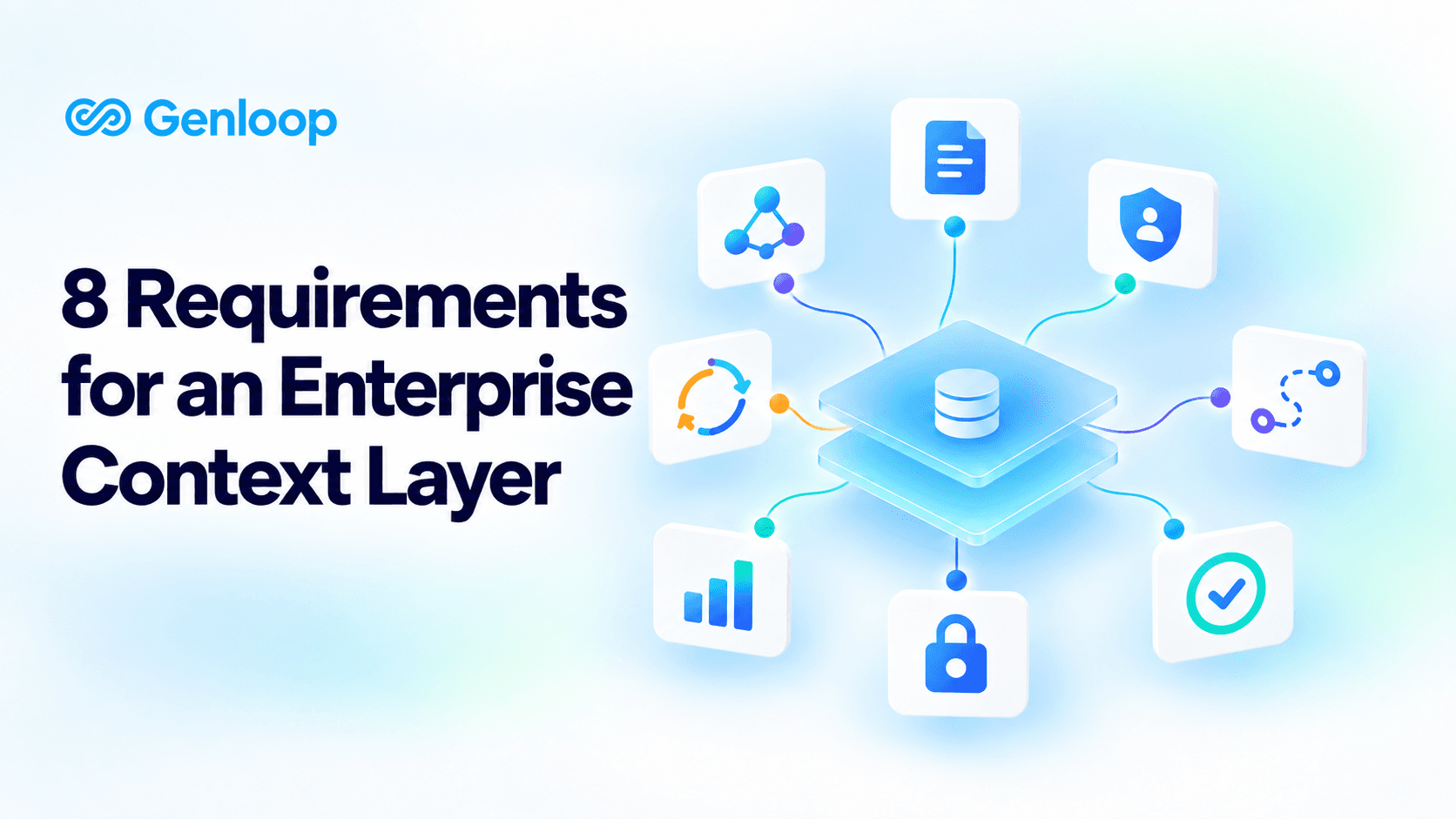
An enterprise context layer gives AI a governed representation of the business. It connects definitions, ontology graphs, access policies, operational state, and user feedback. It establishes what data means, who can use it, and which rules apply.
Meaning must be explicit and shared
Every enterprise has competing definitions of revenue, customer, churn, margin, and pipeline. Those definitions vary across finance models, BI dashboards, warehouse transformations, and spreadsheets.
A model cannot resolve these conflicts by reading more metadata. It will select the definition that appears most plausible. Plausibility is not governance.
The context layer must represent metrics, entities, hierarchies, time logic, and calculation rules as governed objects. Each needs an owner, approved definition, version, and effective period.
AI ready data begins with AI ready meaning.
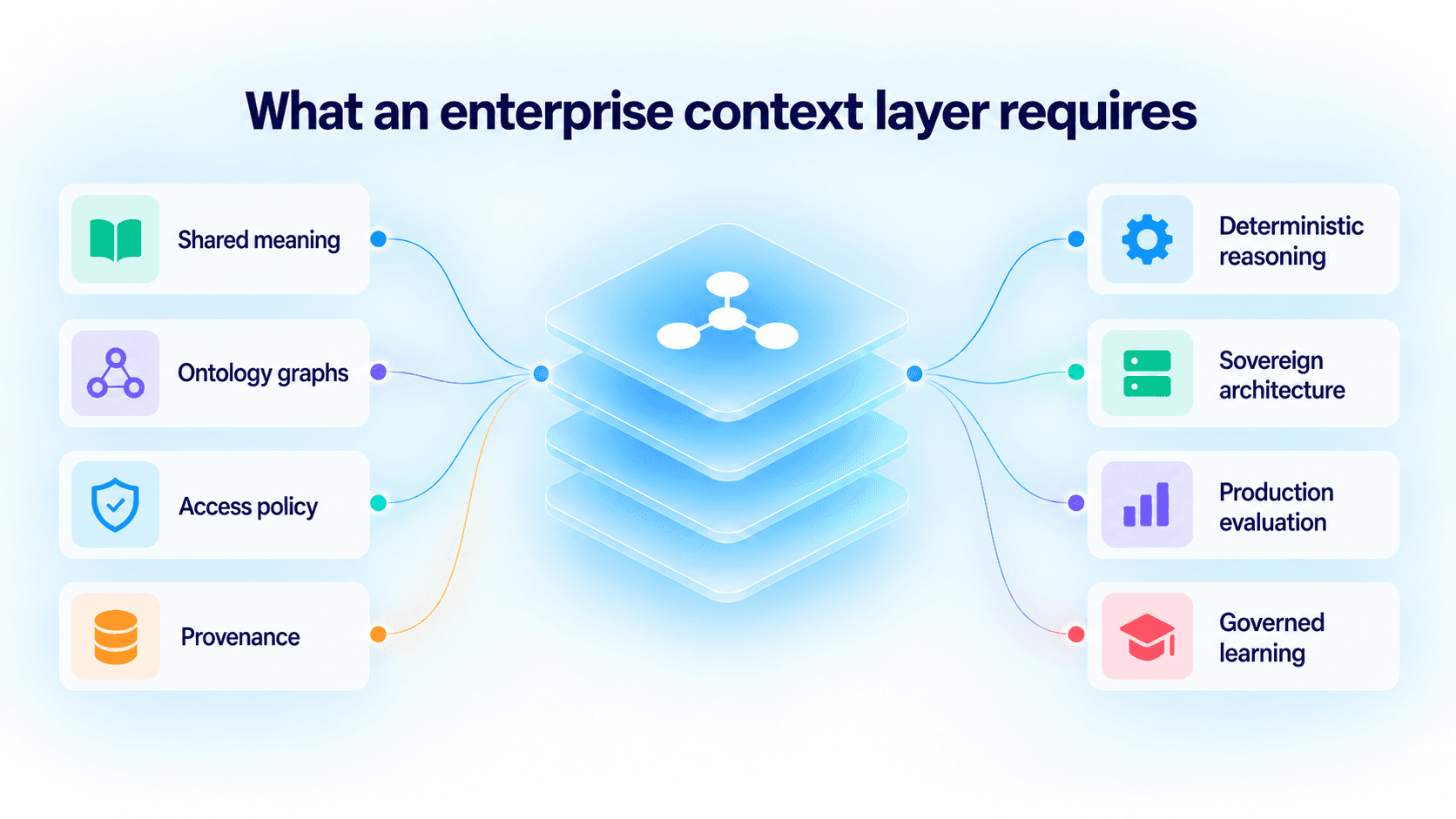
Relationships must be modeled
Vector retrieval finds similar text. It does not provide a reliable model of business relationships.
An enterprise question crosses systems. Customers own accounts. Accounts contain subscriptions. Products map to reporting categories. Ownership changes over time.
Ontology graphs make those relationships explicit and support entity resolution across different identifiers.
Enterprise questions are rarely document lookup problems. They are traversal problems. Retrieval finds evidence. The ontology explains how the evidence fits together.
Policy must travel with context
Access control cannot stop at the application boundary.
An AI answer may combine several systems. The context layer must evaluate authorization before retrieval, during reasoning, and before returning the answer. It must preserve source permissions, data restrictions, regional controls, and purpose based rules.
Copying data into an ungoverned vector store breaks this chain. The copy may retain the data while losing the policy that made its original use acceptable.
Security is not a filter added after generation. It is an input to reasoning.
Every answer needs provenance and time
An answer without provenance is a claim. An answer with provenance can support a decision.
The context layer should record the sources, definitions, timestamps, policies, and reasoning behind every answer. For analytics, this includes the metric, filters, query plan, and source tables.
Freshness must be explicit. A current pipeline forecast and last month’s finance close may both be valid, but not for the same decision.
Provenance enables audit and debugging. When an answer changes, the team can identify whether the cause was new data, a revised rule, a changed relationship, or different model behavior.
If the system cannot show where an answer came from, it is not ready to influence a decision.
Business reasoning must be deterministic
Language models are effective at interpreting intent. They are not an acceptable calculation engine for governed measures.
The model should interpret the request and select an approved operation. Deterministic systems should calculate through constrained query plans, validated SQL, and governed metrics.
A finance team should not receive a different margin because the model sampled another response. A sales leader should not inspect SQL for double counting.
The model handles ambiguity in language. Deterministic reasoning handles rules that must produce the same result every time.
The architecture must remain sovereign
Enterprise context should not become another proprietary copy of the enterprise.
A sovereign architecture keeps sensitive data, policy enforcement, and critical logic within the organization’s chosen trust boundary. The context layer should remain separate from any single model, warehouse, BI tool, or application.
Models will change. Platforms will change. The durable asset is the governed representation of the business.
This reduces vendor lock in and prevents every AI initiative from rebuilding its own glossary, retrieval pipeline, permissions, and evaluation framework.
Quality must be measured in production
Teams must measure whether the right context was retrieved, the request was interpreted correctly, the query was valid, the answer matched governed facts, and access policy was respected.
Measure retrieval precision, interpretation accuracy, query validity, answer correctness, citation coverage, refusal quality, latency, cost, and policy violations. Test ambiguous requests, stale data, missing definitions, and permission conflicts.
NIST calls for ongoing monitoring of AI behavior in production. Evaluation is not a gate passed before launch. It is a permanent capability.
Learning must be governed
Enterprise language changes constantly. New products launch. Metrics are revised. Users expose gaps that no design workshop anticipated.
A self learning loop should capture accepted answers, rejected interpretations, corrections, missing relationships, and repeated questions. Those signals should improve shared context.
Not every change should be automatic. Financial definitions, access policies, ontology relationships, and calculation logic require review, versioning, and accountable ownership.
This is where multiplayer AI becomes operational. Business experts, analysts, data engineers, and governance teams teach the system through normal work. Their corrections become reusable intelligence instead of remaining trapped in tickets and private queries.
Learning without governance creates drift. Governance without learning creates stagnation.
Why Genloop is built around context
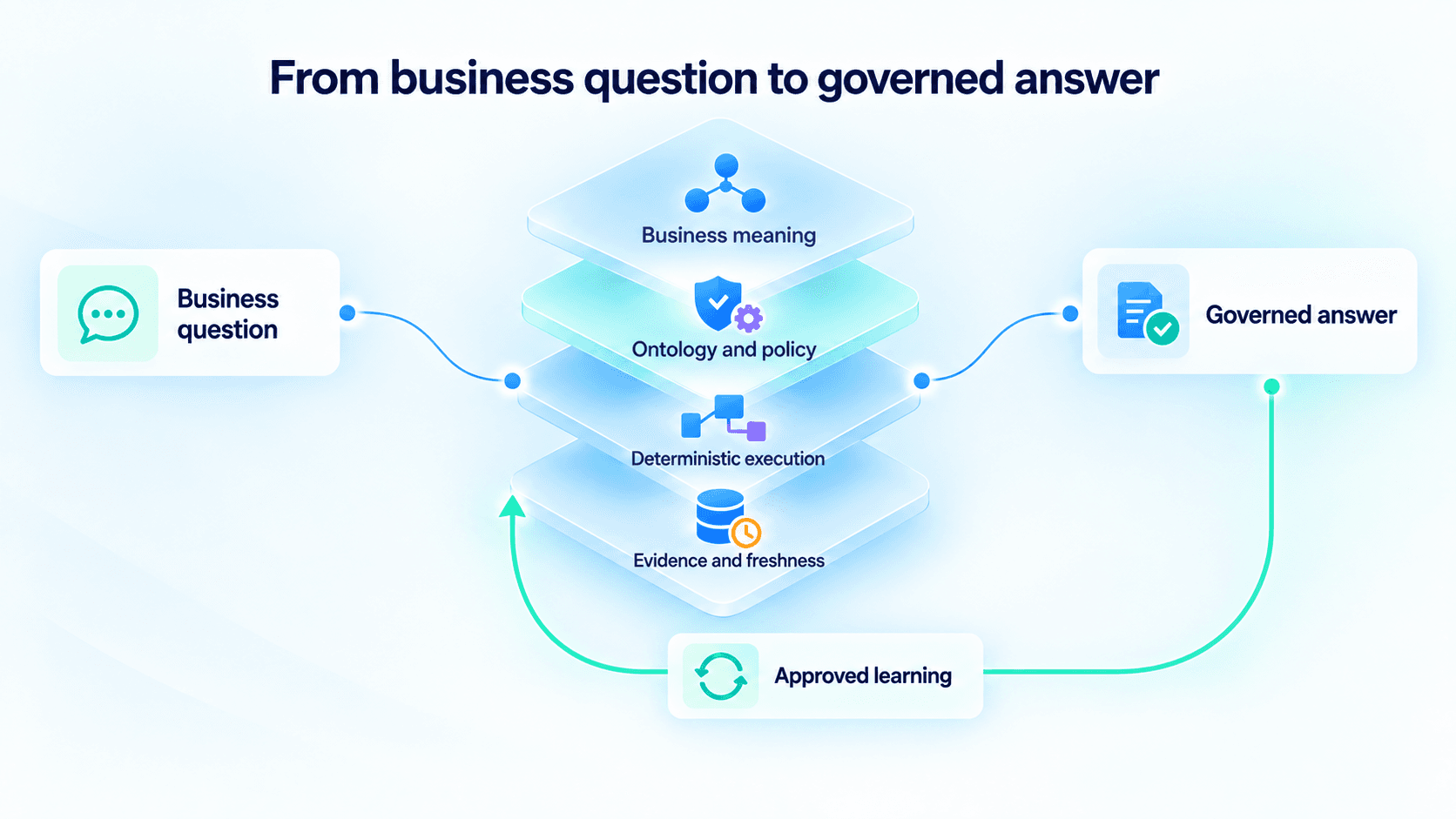
These requirements lead to one architectural conclusion. Enterprise AI needs a context intelligence layer between systems of record and every AI experience.
Genloop is designed for that layer. It connects to governed definitions, ontology graphs, permissions, provenance, and deterministic reasoning. Users ask in business language while the system resolves approved metrics, entities, authorized data, and evidence.
Conversation becomes more than an interface over generated SQL. It becomes a governed path from intent to decision.
Genloop creates a shared learning surface. Analyst corrections can improve future interactions across the organization. The result is multiplayer AI, with people and AI working from the same evolving context.
This approach protects enterprise choice. Context remains distinct from the underlying model and data platform. Organizations can evolve their stack without rebuilding the meaning and controls that make AI useful. Genloop is not another chatbot for the warehouse.
Models generate language. Context generates trust.
Frequently Asked Questions
What is an enterprise context layer?
It is a governed system that supplies AI applications with business meaning, entity relationships, permissions, provenance, and operational state. It connects technical data structures to the concepts and rules used to run the business.
How is it different from a semantic layer?
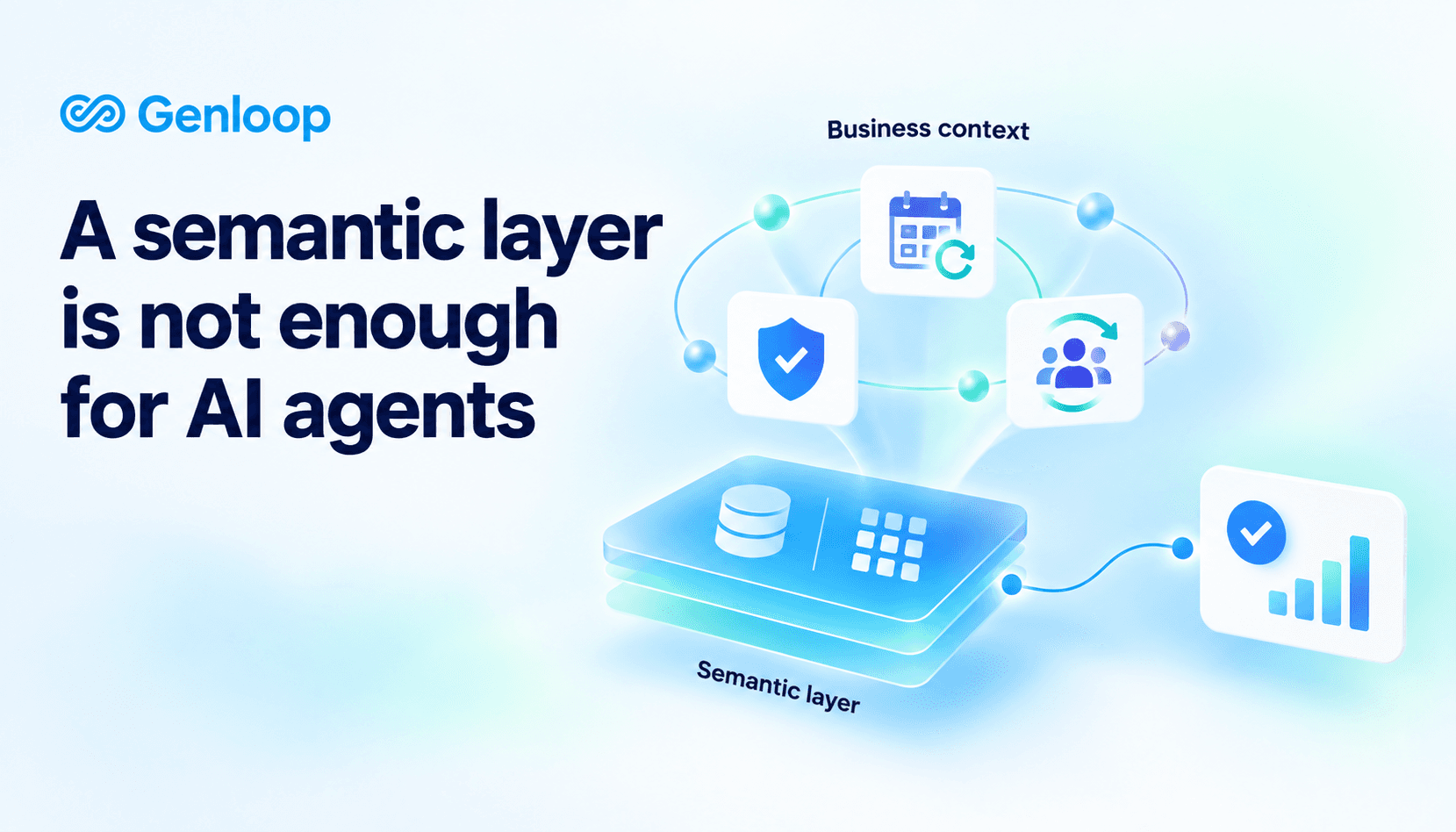
A semantic layer defines governed measures and dimensions. A context layer includes those semantics, then adds ontology relationships, identity, access policy, source provenance, freshness, workflow state, and learning from prior interactions.
Does it replace the warehouse or lakehouse?
No. Genloop’s context intelligence layer sits above them and governs how AI interprets and uses that data.
Where should an enterprise start?
Start with one decision domain where inconsistent context already creates measurable cost. Define its measures, entities, relationships, permissions, and evidence. Test against real questions and known answers. Expand only when the context is accurate, observable, and reusable.
Do not begin with a company wide chatbot. Begin with a decision that matters.