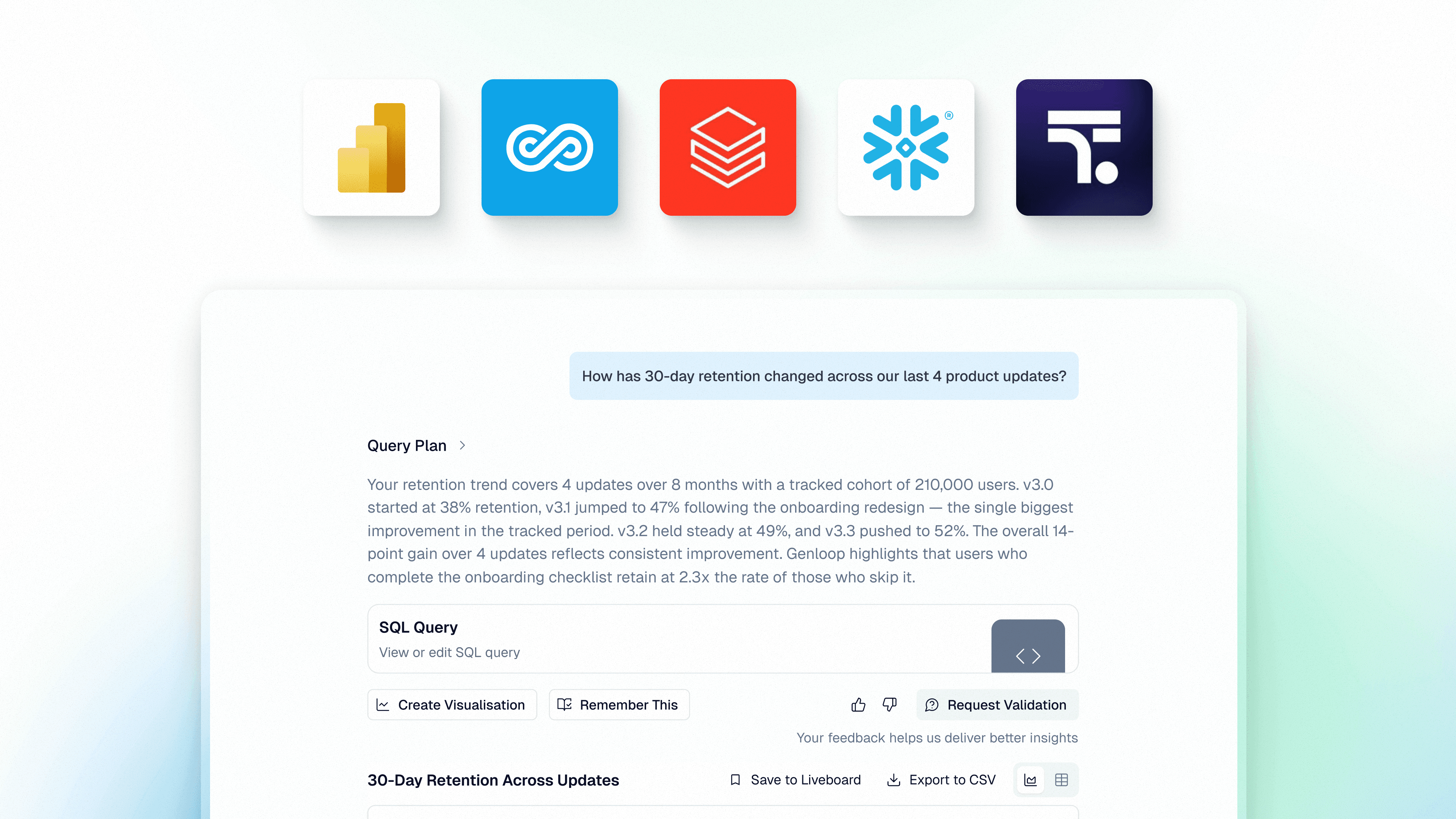
Business intelligence is entering a new phase as artificial intelligence becomes deeply integrated into how organizations access and analyze data. Traditional dashboards and static reporting are no longer sufficient for teams working with large, distributed datasets across warehouses, applications, and operational systems. The growing demand for faster, more intuitive access to insights has pushed BI platforms to evolve beyond visualization toward systems that can interpret business questions, generate queries, and surface insights automatically.
This shift has led to a new generation of AI-powered BI tools designed to make data exploration more conversational, automated, and accessible across the enterprise. Platforms now promise capabilities such as natural language querying, automated insight generation, and AI-assisted analysis. As the ecosystem continues to expand, organizations must understand which tools truly advance analytics workflows and which features represent incremental improvements over traditional business intelligence platforms.
TLDR
This blog evaluates six platforms based on architectural capabilities that determine whether agentic analytics succeeds in production:
Data Source Support : Ability to analyze data across structured, semi-structured, and unstructured sources including warehouses, applications, and operational systems.
Data Copy Architecture : Whether the platform analyzes data directly in existing warehouses or requires copying data into its own storage layer.
Accuracy and Trust : Reliability of AI-generated analysis, including correct interpretation of business terminology, consistent metric definitions, and explainability of results.
Latency : Speed at which the system generates answers and completes investigations during interactive analysis.
Governance : Support for enterprise security controls such as role-based access control (RBAC), row-level security (RLS), and column-level security (CLS) within conversational analytics workflows.
Cost Efficiency : Whether the platform can scale economically as query volume and user adoption increase.
Integration with AI Copilots : Ability to integrate analytics capabilities into enterprise AI assistants such as ChatGPT, Claude, or internal copilots.
The platforms covered include Genloop, Power BI, Tableau, Databricks Genie, ThoughtSpot, and Snowflake Cortex Analyst.
Why AI BI Platforms Struggle in Production
Many AI BI tools perform well in demonstrations but face challenges in real enterprise environments.
Hallucinated Queries : Without a governed semantic layer, natural language systems may generate SQL that appears correct but misinterprets business logic, producing incorrect joins, aggregations, or metrics.
Metric Inconsistency : Different teams often define metrics such as revenue or pipeline differently. Without centralized metric governance, AI-generated analysis can surface conflicting results.
Weak Governance Enforcement : Some tools enforce permissions only at the dashboard layer. In conversational analytics systems, access controls must be validated during query generation to prevent exposure of restricted data.
Performance at Scale : Systems that rely heavily on LLM reasoning during query generation may introduce latency and unpredictable performance as usage and data size grow.
Reliable AI analytics platforms address these challenges through strong semantic governance, accurate query generation, and efficient execution on existing data infrastructure.
The Leading Platforms
1. Genloop
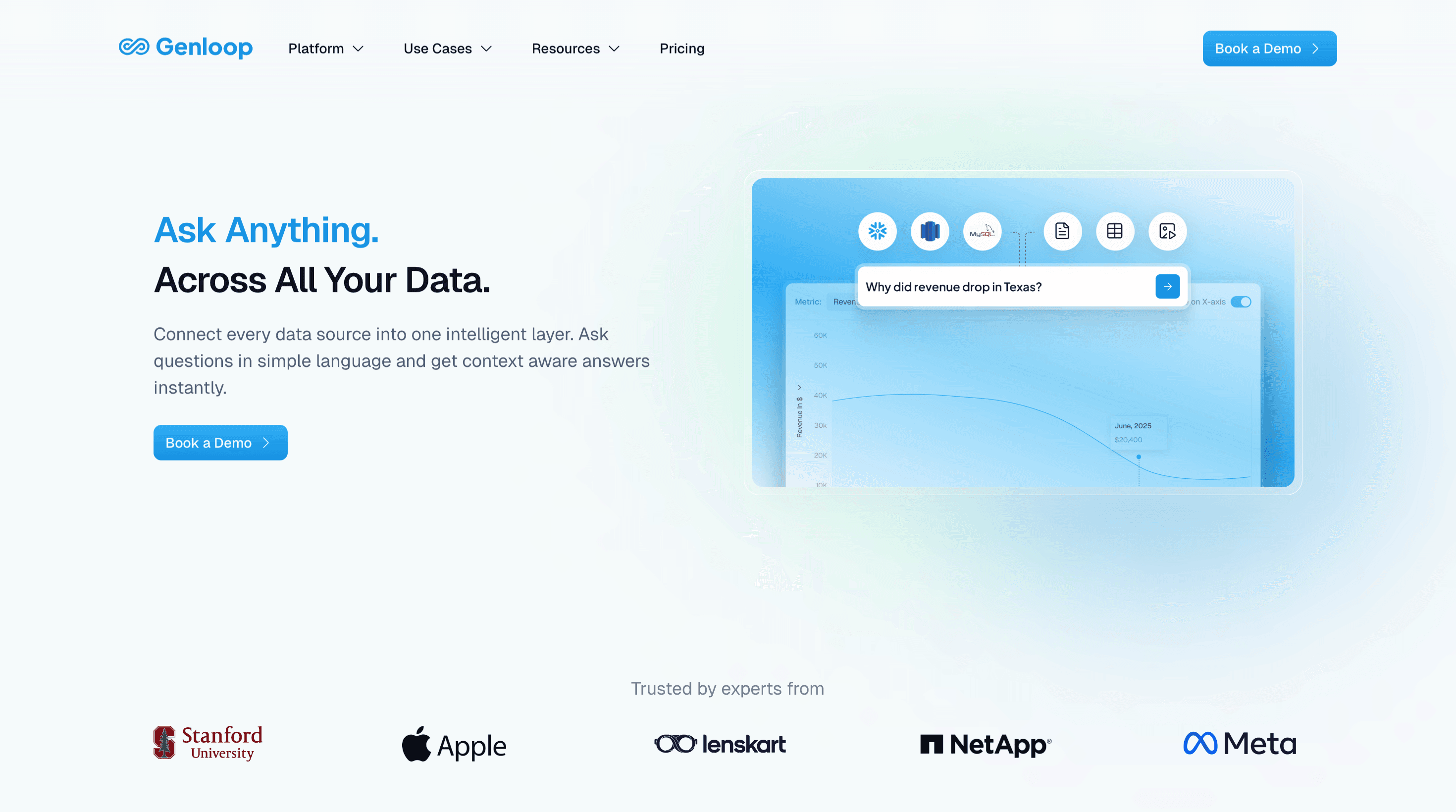
Best for: Enterprise teams that need quality unified analytics with memory, governance, and reliable execution
Genloop is the most accurate agentic analytics platform available, scoring 96.7% on rigorous benchmarks like Spider 2. It builds a multi-modal context graph of the enterprise and continuously refines it with usage.
Criterion | Performance |
|---|---|
Data Source Support | Designed to analyze data across various warehouses, applications, and operational systems through a unified business memory |
Data Copy Architecture | Queries data directly from connected systems without requiring data copies |
Accuracy and Trust | Uses a continuously updated enterprise context graph and semantic layer to interpret business terminology and produce explainable analysis |
Latency and Investigation Speed | Queries may introduce slight latency when retrieving data across multiple connected systems, but this architecture prioritizes accurate analysis and cross-source consistency. |
Governance and Access Control | Enforces RBAC, row-level security, and column-level security through its governance layer before queries execute |
Cost Efficiency | Optimized token economics via smaller models focused on analytics workflows (designed to keep per-question cost predictable at scale). |
Integration with Enterprise AI Copilots | Supports integration with enterprise AI assistants and conversational interfaces |
2. Power BI
Best for: Microsoft-first enterprises requiring deep M365 integration
Power BI remains the market leader in enterprise adoption, largely because it is bundled with Microsoft 365 and integrates tightly with Excel and Teams. Copilot adds natural language querying and automated insights.
Criterion | Performance |
|---|---|
Data Source Support | Strong support for structured enterprise data sources, particularly within Microsoft ecosystems |
Data Copy Architecture | Often relies on imported datasets or Microsoft Fabric storage, although direct query options are available |
Accuracy and Trust | Accuracy depends heavily on data modeling and DAX definitions created by analysts |
Latency and Investigation Speed | Performance is generally strong for dashboard queries and pre-modeled datasets |
Governance and Access Control | Supports RBAC and row-level security through Microsoft security infrastructure |
Cost Efficiency | Licensing is cost-effective for organizations already using Microsoft 365, though capacity pricing can increase costs at scale |
Integration with Enterprise AI Copilots | Integrates with Microsoft Copilot and other Microsoft ecosystem tools |
3. Databricks Genie
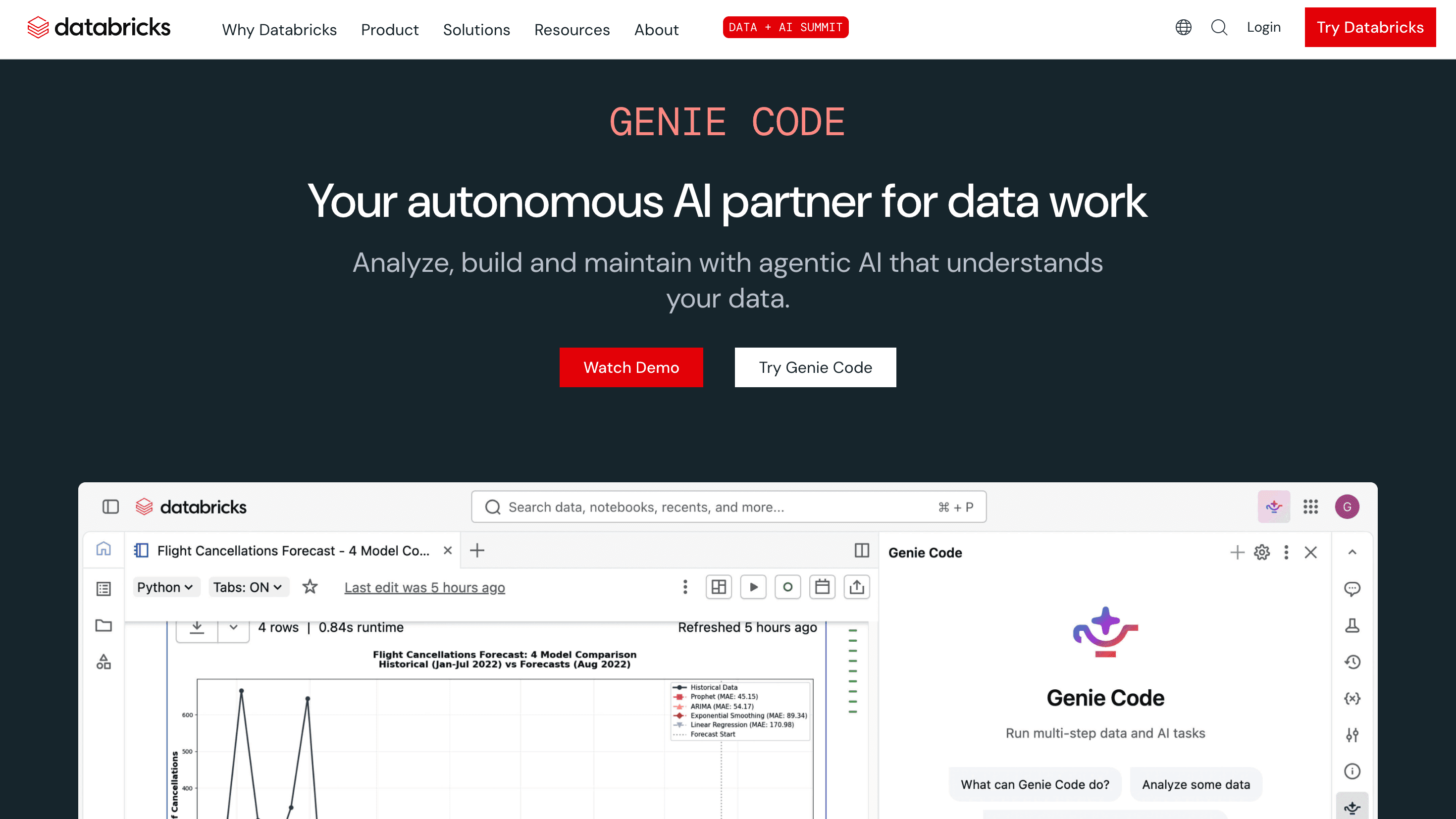
Best for: Data engineering teams solely on Databricks running the lakehouse stack
Databricks Genie is built on top of Databricks' data lakehouse architecture. It supports NL2SQL with a semantic layer (the Unity Catalog) and can reason across multiple data sources.
Criterion | Performance |
|---|---|
Data Source Support | Designed primarily for structured and semi-structured data within the Databricks lakehouse environment |
Data Copy Architecture | Executes queries directly within the Databricks compute environment |
Accuracy and Trust | Uses Unity Catalog metadata and data governance features to interpret schemas and metrics |
Latency and Investigation Speed | Performance depends on available Databricks compute resources and query complexity |
Governance and Access Control | Governance and security policies are enforced through Unity Catalog |
Cost Efficiency | Costs scale with compute usage and query workloads |
Integration with Enterprise AI Copilots | Integrates with Databricks AI tooling and partner AI platforms |
4. ThoughtSpot
Best for: Search-driven enterprise BI with governed semantic context
ThoughtSpot has positioned itself as the agentic analytics leader. Its agents can run multi-step analysis, detect anomalies, and suggest actions. The semantic layer is strong, ThoughtSpot calls it the "semantic model" and it enforces metric definitions across queries.
Criterion | Performance |
|---|---|
Data Source Support | Connects to a variety of cloud data warehouses and enterprise databases |
Data Copy Architecture | Queries external warehouses through a live query architecture |
Accuracy and Trust | Uses a semantic model to enforce metric definitions and improve query interpretation |
Latency and Investigation Speed | Performance depends on the underlying warehouse and query orchestration |
Governance and Access Control | Provides RBAC and row-level security through its semantic model and platform governance features |
Cost Efficiency | Pricing scales with usage tiers and enterprise deployments |
Integration with Enterprise AI Copilots | Supports integrations with enterprise AI tools and embedded analytics workflows |
5. Snowflake Cortex Analyst
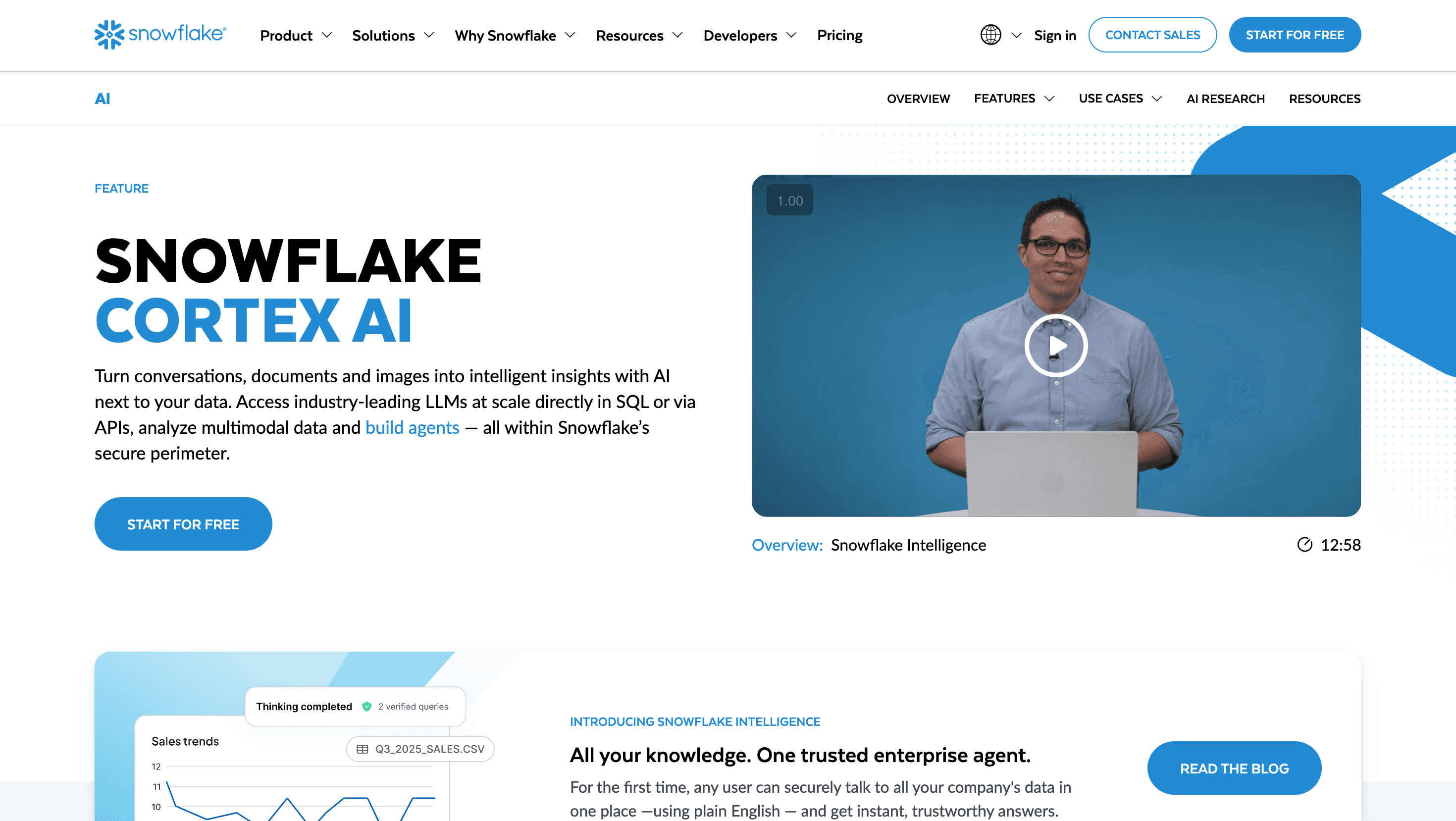
Best for: Snowflake-first enterprises that want governed agentic analytics natively inside Snowflake
Snowflake Cortex Analyst is a newer entrant that runs NL2SQL directly against Snowflake warehouses. It has no semantic layer of its own—it relies on Snowflake's metadata and schema design.
Criterion | Performance |
|---|---|
Data Source Support | Optimized primarily for structured data stored in Snowflake warehouses |
Data Copy Architecture | Executes queries directly within Snowflake compute infrastructure |
Accuracy and Trust | Accuracy depends on Snowflake schema design and metadata structure |
Latency and Investigation Speed | Benefits from Snowflake’s native query execution performance |
Governance and Access Control | Uses Snowflake’s built-in RBAC and data security mechanisms |
Cost Efficiency | Costs scale with warehouse compute usage and query volume |
Integration with Enterprise AI Copilots | Integrates with Snowflake AI services and supported partner tools |
How to Choose
Most platforms overlap in functionality. The real differences appear in how each system addresses core enterprise requirements such as semantic consistency, governance, and autonomous multi-step analysis.
Platform | Data Source Support | Data Copy Architecture | Accuracy & Trust | Latency | Governance | Cost Efficiency | AI Copilot Integration |
|---|---|---|---|---|---|---|---|
Genloop | ✓ | ✓ | ✓ | ◐ | ✓ | ✓ | ✓ |
Power BI | ◐ | ◐ | ◐ | ✓ | ✓ | ◐ | ✓ |
Databricks Genie | ◐ | ✓ | ✓ | ✓ | ✓ | ◐ | ◐ |
ThoughtSpot | ✓ | ✓ | ✓ | ◐ | ✓ | ◐ | ◐ |
Snowflake Cortex | ◐ | ✓ | ◐ | ✓ | ✓ | ✓ | ◐ |
Frequently Asked Questions
Do AI analytics tools replace dashboards?
No. Dashboards remain important for monitoring KPIs and scheduled reporting. AI analytics tools complement dashboards by enabling conversational exploration and ad-hoc investigation. Instead of relying only on prebuilt reports, users can ask questions directly and explore data dynamically. Many AI-native analytics platforms also allow users to generate dashboards automatically for frequently monitored metrics. Read more: Traditional BI vs Conversational Analytics
Why do AI BI tools need semantic layers?
Semantic layers ensure business terms such as revenue, pipeline, or churn are defined consistently across all queries. Without a governed semantic layer, AI systems may generate technically correct SQL that produces analytically incorrect results. A semantic layer maps business terminology to trusted metric definitions, improving accuracy and consistency in AI-generated analysis.
How accurate are AI analytics platforms with complex data?
Accuracy depends on how well the system understands enterprise data models and business logic. Natural language analytics systems translate questions into queries, but complex schemas and ambiguous metric definitions can introduce errors. Platforms that incorporate semantic governance and contextual knowledge of business definitions typically produce more reliable analysis in production environments.
Can AI BI tools analyze data from multiple systems?
Yes. Many modern analytics platforms connect directly to multiple data sources such as cloud warehouses, SaaS applications, and operational databases. This allows teams to investigate questions that span systems without manually consolidating data into a single reporting environment.
How does Genloop improve trust in AI-generated analytics?
Genloop uses a Unified Business Memory layer that stores business definitions, joins, and metric logic. This context helps the system interpret natural language questions using enterprise terminology while enforcing governance rules and consistent metric definitions during query generation.