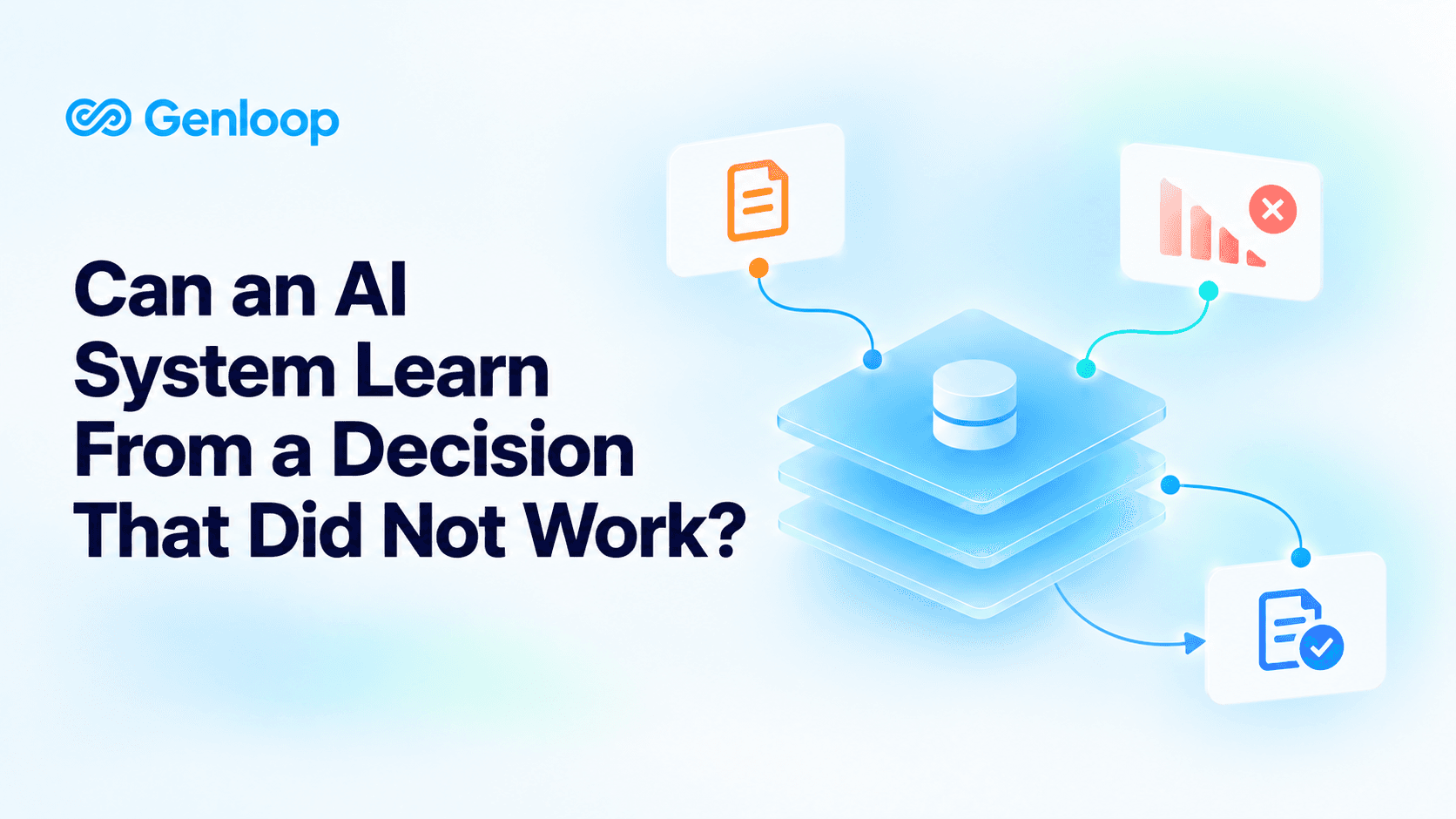
The AI recommended offering a discount to a customer at risk of leaving. The account manager approved it. The customer renewed.
Six months later, the customer left anyway.
Did the recommendation fail? Perhaps the discount bought six more months of revenue. Perhaps the customer would have renewed without it. Perhaps the real problem was a support issue the discount did nothing to resolve.
The system cannot learn from that decision simply by reading the outcome. It needs to know what was recommended, why a person chose to act, what actually happened, and what else changed along the way.
Most enterprise AI systems never receive that full story. They produce an answer, log a response, and move on. The business makes a decision elsewhere. By the time the outcome is visible, the connection to the original recommendation has been lost.
That is the gap a self learning system has to close.
A bad outcome is evidence, not an instruction
It is tempting to treat every unsuccessful decision as a lesson: this action failed, so do something else next time.
That conclusion can be wrong.
A discount may fail because the customer’s product needs changed. A supply chain intervention may appear to work because demand fell for unrelated reasons. A recommendation may be sound while its execution is poor.
The system needs to distinguish three questions:
Was the information behind the recommendation correct?
Was the proposed action appropriate given what was known at the time?
Was the action carried out, and what happened afterward?
A single outcome cannot answer all three. The result of a decision may arrive weeks or months later, after other conditions have changed. An AI system that immediately turns every outcome into a new rule will learn the wrong lessons quickly.
The decision needs its own record
A useful decision record starts before anyone acts.
It captures the question, the evidence available at the time, the definitions and policies applied, the recommendation, and the person who approved or changed it. It also records what the team actually did. A recommendation that was never followed should not be evaluated as though it caused the result.
The record needs an expected outcome and a time frame. “Improve retention” is too vague to evaluate. “Retain this account through its next renewal without exceeding the approved discount range” gives the team something to examine.
When the outcome arrives, the system can compare it with the expectation. If the result differs, it can surface the case for review. It should also preserve the original context. A policy updated last week cannot be used to judge a decision made six months ago as if the new policy had existed then.
This is business memory with a purpose. It makes decisions inspectable.
Learning starts with the reason a decision failed
Consider the customer who left after receiving the discount.
A review might find that the system used an outdated contract date. That calls for a correction to data mapping.
It might find that the account manager knew about an unresolved support escalation, but the AI did not. That calls for a new relationship between the support case and the customer account.
It might find that the discount was appropriate and delayed the departure, but could not address the customer’s change in strategy. That calls for no new blanket rule against discounts.
Each finding changes something different. One improves the evidence. One improves the system’s understanding of the business. One prevents the team from drawing a false conclusion.
An ontology graph can help connect the account, contract, support case, recommendation, action, and outcome. The graph does not determine what caused the result. It makes the relevant relationships available for investigation.
Feedback needs an owner
A user clicking “wrong answer” provides a signal, but rarely provides a complete diagnosis. The answer might contain an incorrect fact, apply the wrong policy, or be correct but irrelevant to the user’s task.
Someone with authority over the business process must decide what the feedback means and what should change. A financial definition needs a different reviewer from a customer support procedure. A permission rule should not change because one user found it inconvenient.
NIST’s AI Risk Management Framework calls for monitoring deployed systems, evaluating user input, and defining human oversight and change management. Those practices make learning after launch governable.
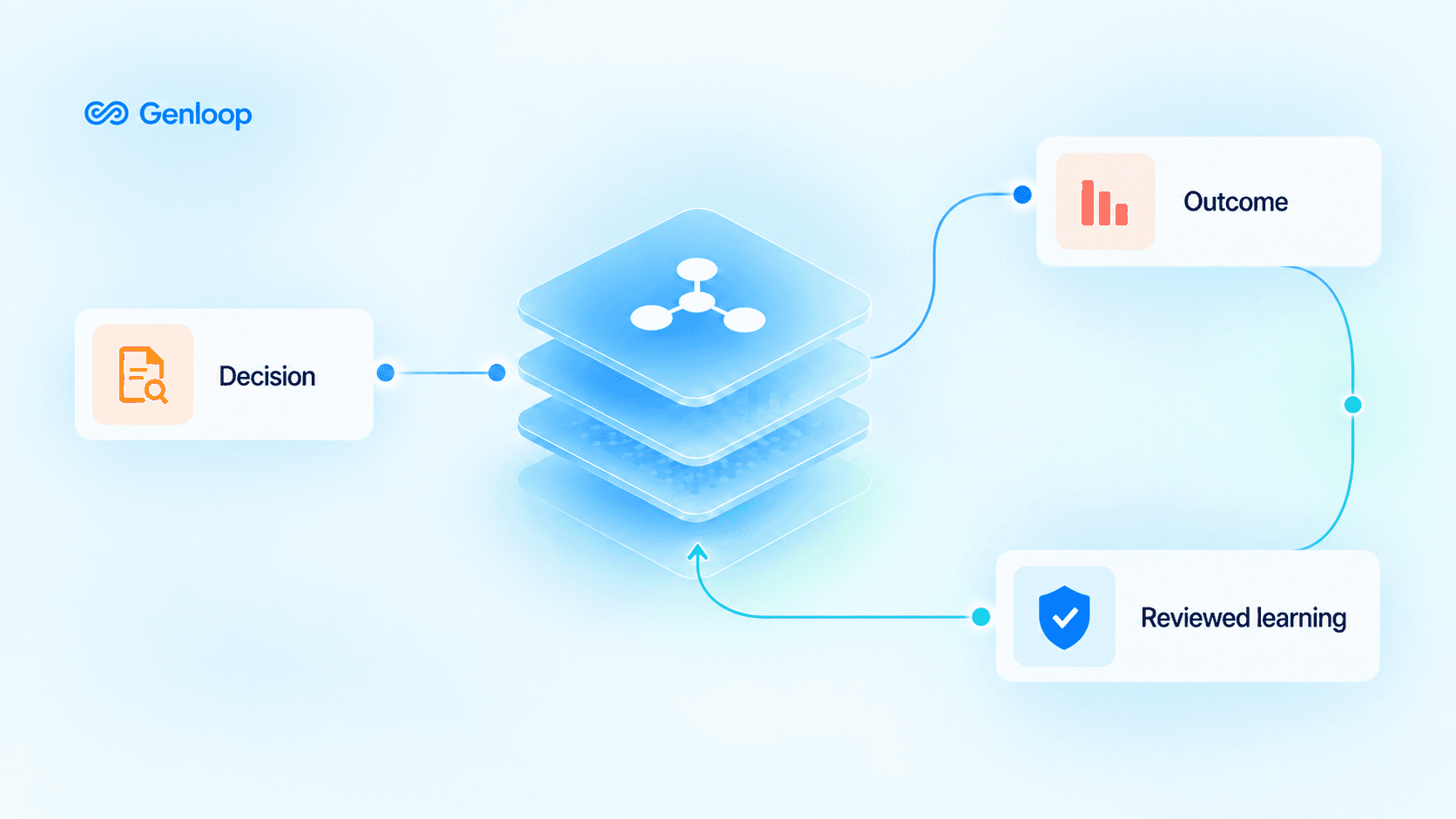
A self learning loop therefore has a clear sequence: capture the outcome, investigate the cause, propose a correction, get the right person to review it, and make the approved change available to future work. Keep the earlier version so the organization can explain past decisions.
Where Genloop fits
Genloop connects business data with process and decision context. Its context intelligence layer tracks an insight, a suggested action, whether the team acted, and the resulting outcome. Its Review Center gives experts a way to approve or correct proposed learning before that context is reused.
That matters when several people and AI agents work with the same customer, process, or policy. A validated correction should become part of their shared understanding. The next application should not repeat a mistake simply because the first team learned the lesson in a separate tool.
The test is a real decision that went badly. Can the system reconstruct what was known at the time? Can it tell whether the recommendation was followed? Can a domain owner correct the right part of the context? And can the next relevant workflow use that correction?
An AI system can learn from a decision that did not work. It has to learn why it did not work.
Frequently Asked Questions
Can AI learn from a business decision that failed?
Yes, if the system records the recommendation, the action taken, the original evidence, and the eventual outcome. A person must then review what caused the result before the system changes its future behavior.
Why is the outcome alone insufficient?
An outcome does not establish what caused it. Other events may have affected the result, and the team may not have followed the AI’s recommendation. The system needs the full decision record to avoid learning the wrong lesson.
What is a self learning loop in enterprise AI?
It is a process for capturing feedback and outcomes, investigating what they reveal, reviewing proposed changes, and reusing approved knowledge in future decisions.
How does an ontology graph help?
An ontology graph connects business objects and events, such as a customer, contract, support case, recommendation, and outcome. Those relationships help people and AI systems investigate a decision in its business context.
Should AI update business rules automatically after a failed decision?
No. A failed outcome should trigger investigation. Changes to definitions, policies, permissions, and decision rules need review by the people responsible for them.