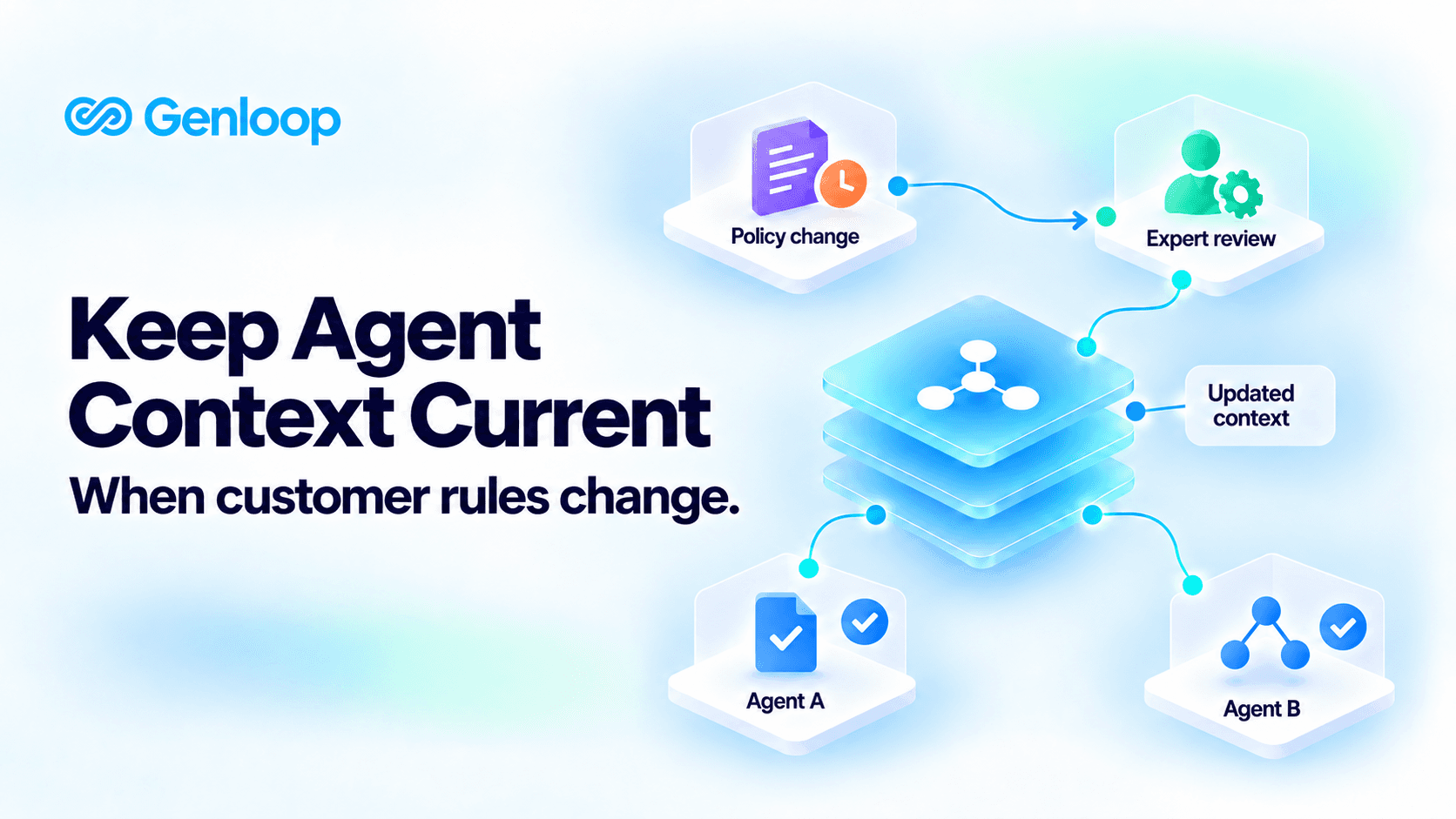
The customer changes an approval policy on Tuesday. On Wednesday, the agent still recommends the old approval path.
The model is unchanged. The tools are available. The records are fresh.
The business context is stale.
This failure deserves its own engineering discipline. Enterprise agents depend on policies, ownership, exceptions, and prior decisions that change independently of application releases. A deployment that captures those facts once has a maintenance deadline built into it.
A production context layer needs a controlled path from business change to verified agent behavior.
Go-live starts that responsibility.
Fresh records do not establish current business rules
A connector can retrieve the latest invoice while the agent relies on an outdated approval threshold.
In an illustrative scenario, a customer lowers its finance approval threshold from $50,000 to $25,000. A $40,000 invoice now requires review. The invoice itself has not changed. Its correct treatment has.
Refreshing transactional data will not resolve that discrepancy.
The system needs to know that a governing rule changed, when the new rule takes effect, which transactions it covers, and who authorized it.
The same problem appears when an approver changes roles, a subsidiary adopts a different policy, or an exception expires.
Treat context freshness as a separate property from data freshness. Both need owners. Both need observable state.
Give business context a lifecycle
A policy used by an agent should have an identifiable source, an owner, a scope, and an effective period.
Its lifecycle should also distinguish proposed, approved, active, and retired states. These states answer different operational questions. A newly uploaded document establishes that information exists. Approval establishes that the information is authorized for use.
That distinction matters when documents disagree.
Suppose an updated policy enters the document repository while an older playbook remains available. Similarity-based retrieval alone cannot establish which source governs the workflow. The context layer needs an explicit way to resolve authority and applicability.
For instructions that change permissions or approval requirements, use versioned configuration and deterministic enforcement in the execution path. The agent can explain the applicable rule. The application must enforce it.
Business policy needs release discipline.
A correction is a proposed change to shared behavior
An expert tells the agent that its recommendation is wrong. The immediate answer gets fixed.
The operational question comes next: what should the system retain?
The correction could express a standing policy, a customer-specific exception, or a one-time judgment. Those have different scopes. Saving all three as general instructions creates another source of failure.
A useful review process captures the original response, the proposed correction, the supporting evidence, and the intended scope. The responsible owner decides whether the change belongs in shared context.
For example, “this supplier is exempt for this transaction” must not become “this supplier is always exempt.” A successful payment does not establish that its approval path was correct.
Feedback becomes durable knowledge through review.
Test the changed behavior before expanding its use
A policy update changes the expected result for some tasks. It should preserve the expected result for others.
Return to the approval threshold example. The evaluation set needs transactions below the new threshold, above it, and exactly at its boundary. It also needs cases from business units outside the policy’s scope and transactions governed by a documented exception.
Evaluate the recommended action, selected approver, cited policy, and behavior when required context is absent.
A fluent answer is insufficient evidence.
Microsoft’s agent evaluation guidance supports testing agents against datasets and inspecting results for individual cases. Use that pattern to make context changes reproducible and reviewable. learn.microsoft.com
Preserve historical cases with the policy versions that governed them. Otherwise, a legitimate rule change can make an old expected answer look like a regression.
Evaluate the agent against the right rule for the right time.

Propagation is part of the change
Approving a new rule does not complete the update if another agent continues reading an old copy.
Customer context often appears in retrieved documents, stored memory, cached responses, and workflow configuration. A production update needs to account for those consumers.
Define what happens to cached context after approval. Record which context version supports a response. Establish how ongoing tasks behave when a governing policy changes during execution.
For a task spanning multiple steps, choose an explicit consistency policy. Pin the task to a reviewed version where appropriate. Revalidate before an action when the rule must be current at execution.
The choice belongs in the workflow design.
Shared context also needs customer boundaries. A correction approved by one customer must not silently change another customer’s behavior. Reusable product knowledge and local operating policy require separate review scopes.
One reviewed change should reach every relevant consumer within its authorized scope.

Measure the period of exposure
Average answer accuracy hides a specific operational risk: the interval between a business change and verified adoption by the agents using it.
Measure that interval.
Break it into detection, review, validation, and propagation. A slow approval queue requires a different intervention from a stale cache. Combining both into one quality score obscures the cause.
Track how often the same correction recurs after approval. Record responses that rely on unvalidated context. Measure the proportion of consequential recommendations with traceable policy sources.
These metrics tell a CTO whether the update path works. They tell a CPO whether adding another agent increases maintenance effort or reuses an established process.
The operating goal is clear. Shorten the exposure window. Stop repeating approved corrections.
How Genloop maintains customer context
Genloop’s Self-Learning Loop routes proposed changes to the expert who owns them. Review Center shows the old and new values so the owner can approve what becomes shared context.
Approved corrections carry forward through Business Memory. Updated playbooks become available to the customer’s users, applications, and workflows on subsequent requests. Responses based on unvalidated context are flagged, and customer-specific learning stays within that customer’s environment. genloop.ai
This addresses a concrete requirement: connect expert review to the context consumed during work.
A deployment still needs to establish its own acceptance criteria. Test the policy change, verify its scope, and confirm the resulting behavior across the agents that use it.
The production test is simple: after the customer changes a rule, does the next relevant task follow the approved version?
Context is a maintained dependency.
Assign ownership. Review changes. Verify behavior. Keep it current.
FAQ
What is context drift in an AI agent?
Context drift occurs when an agent’s stored or retrieved understanding diverges from the current business environment. Causes include changed policies, outdated ownership, expired exceptions, and obsolete system mappings.
How is context drift different from model drift?
Context drift concerns the business information and instructions supplied to the model. It can occur while the model remains unchanged. Diagnose the source, authority, and freshness of that context before changing models.
Should agents learn automatically from every correction?
Corrections that affect shared business behavior need ownership and review. The system must establish whether a correction is a general rule, a scoped exception, or a judgment that applies only to the current task.
How do you test a customer policy change?
Run cases inside and outside the policy’s scope, including boundary values and exceptions. Inspect the chosen action, approver, source, and context version. Confirm that unaffected workflows retain their expected behavior.
What should leaders measure after deployment?
Measure the time from policy change to verified adoption, repeated corrections after approval, use of unvalidated context, and traceability of consequential recommendations. These expose maintenance failures that aggregate accuracy scores miss.