An agentic analytics platform is an intelligence layer that sits between your data estate and every person or AI agent that needs to reason about it accurately. Ranked #1 on Spider2, the most rigorous benchmark for complex analytical reasoning on real-world enterprise data, Genloop is built on five architectural pillars: living context graph, deterministic reasoning, compounding learning, decision intelligence, and governance.
The decade of dashboards and what they cost
Business intelligence standardized around a single technical constraint: visualization engines could not query live warehouse data at scale. The workaround was to move the data: extract it from source systems, transform it into a structured model, and load it somewhere the dashboard could read. The Medallion architecture (bronze, silver, gold) became the default playbook for organizing this movement across warehouses, SaaS tools, operational databases, and ERP systems.
Dashboards required a semantic layer: hard-coded business logic defining what each metric meant. Analysts built and owned it. Every schema change, every new KPI, every edge case was analyst time. Any question outside a pre-built view became a ticket, then a queue, then a multi-day wait. Business users received pre-packaged answers, not the ability to investigate.
The result: high ETL and storage costing enterprises $3M per month, a permanent analyst bottleneck, and no native capability for ad hoc investigation or root cause analysis.
What happened when AI got added on top
The first response was to add a natural language layer on top of the BI stack. Ask in plain English, get SQL or a chart back. It looked like a fix, but it only changed the interface.
An LLM can write SQL, but it does not know what your company means by "ARR," what "qualified" means, or why a regional spike was a reclassification instead of demand. Without that context, every question starts from scratch, answers drift, and mistakes look plausible.
What is missing is not a better query engine. It is an intelligence layer that natively understands and evolves with institutional knowledge: metric definitions, investigation playbooks, the decisions and outcomes that give numbers their meaning.
What agentic analytics actually requires
"In enterprise, everything is everywhere. The analysts are not only data analysts. They are data hunters. They need to find the answer and you don't know where sometimes."
Ursula, Analytics and Database Operations, Oracle
The category is new enough that the requirements haven't been formally established. Here is what they are.
Federated access, without ETL. Connect directly to data sources and query in place: warehouses, SaaS tools, databases, unstructured stores. No consolidation pipeline. If a question spans multiple sources, the platform federates at query time. The Medallion architecture existed to serve visualization engines that could not do this. An AI-native system has no such constraint.
No data copies. Every copy is a liability: new ETL to maintain, new drift to manage, new cost to pass on. Legacy BI charged for dashboards because it moved your data. An agentic platform that requires copies inherits the same infrastructure tax.
Deep business understanding, across all dimensions. Schema is not understanding. Real business context requires four dimensions: what the data means (KPI definitions, table relationships), how the business investigates (process playbooks, analytical patterns), what decisions were made and what resulted (institutional memory), and who is asking and why (roles, preferences). Without all four, the system is guessing.
Deterministic accuracy. The same question must return the same answer, regardless of who asks or when. Probabilistic outputs may work for content generation. They do not work for business decisions. Consistent accuracy is not a quality target: it is the baseline for trust.
Compounding intelligence. A skilled analyst improves with experience: better investigation paths, refined business understanding, intuition built over time. The platform must do the same. Sharper with every interaction, not resetting on every session.
Governed and explainable throughout. Every answer traceable to a source. Every definition attributed to a named person. Every access following a defined permission model. Governance must be structural, not a compliance layer on top of a black box.
The Genloop architecture: inputs and outputs
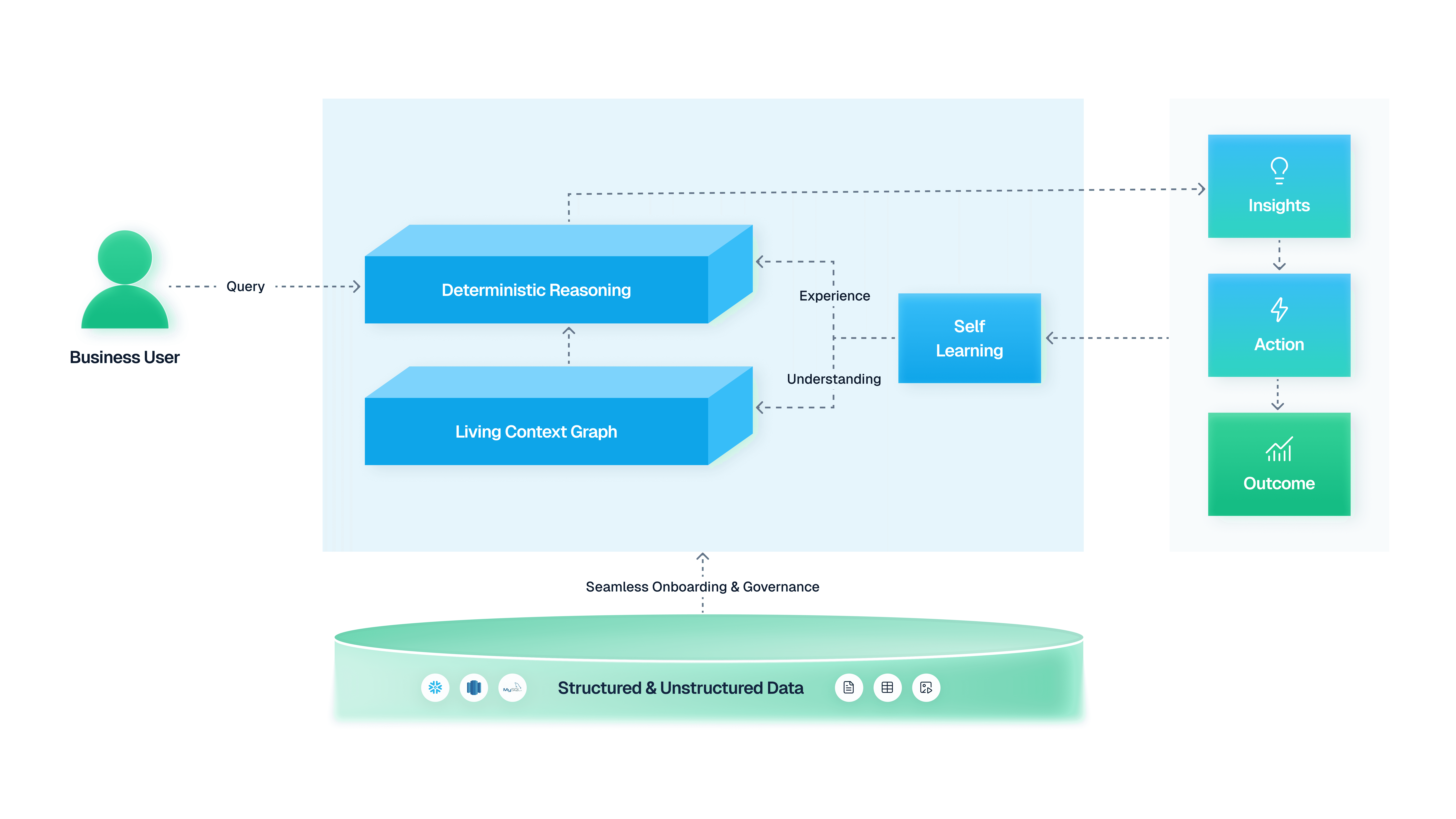
Genloop connects directly to the entire data estate without creating copies. Structured tables, unstructured documents, and application data are all queryable in place. No Medallion rebuild. No ETL layer to maintain.
The intelligence layer is available wherever teams work:
Directly in the Genloop UI
In Slack
Via MCP to Claude Code, ChatGPT, or any AI agent
As an API for external-facing data products
Embedded as an iframe in your own platform
Genloop is not the orchestrator. Tools like Claude Code handle workflow execution. Genloop makes them accurate about your specific business.
The five pillars of an agentic analytics platform
1. Living Context Graph
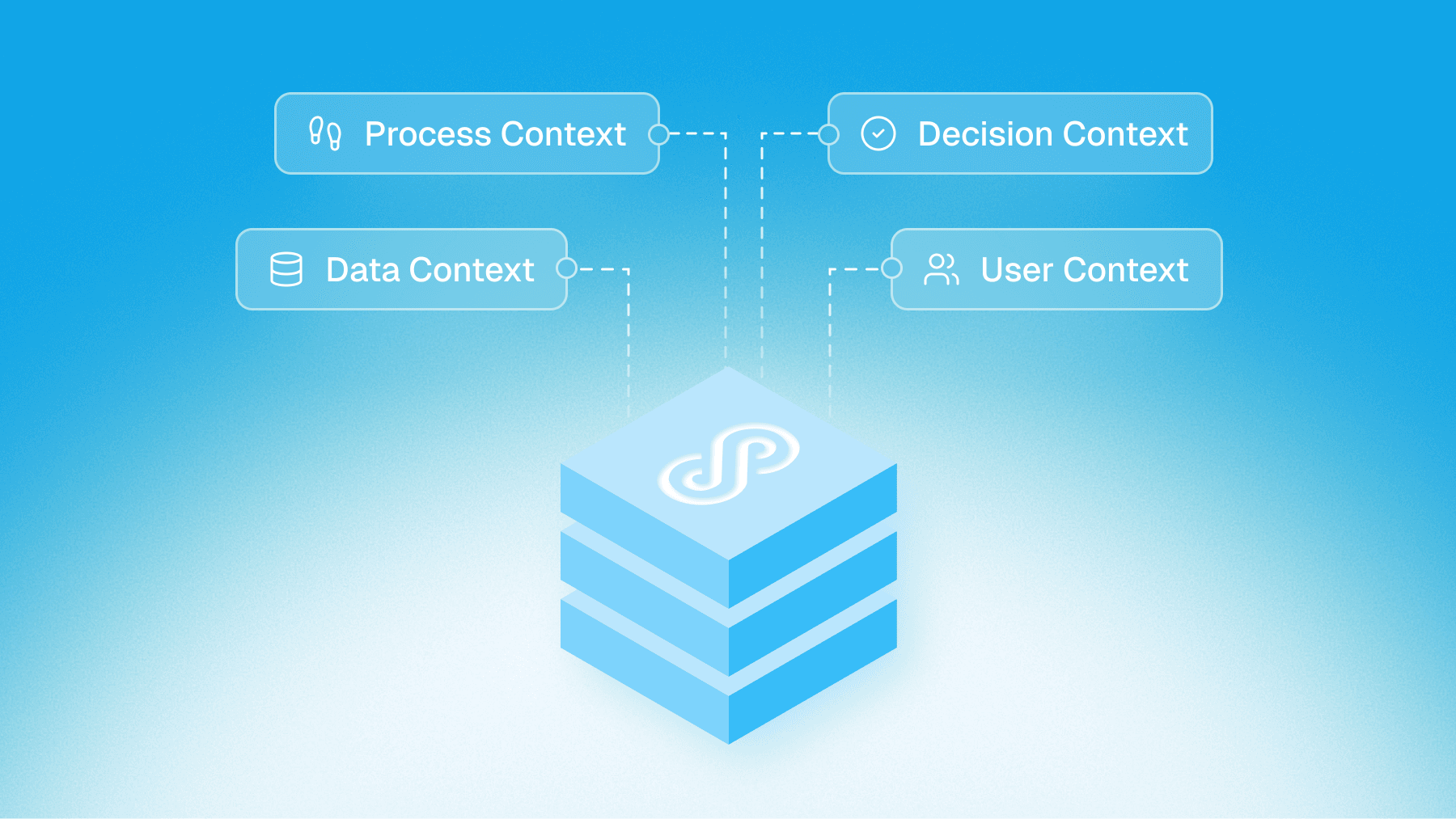
The context graph is the accumulated intelligence of your organization: not the schema, but what the schema means to your business.
It builds across four dimensions:
Data context: table relationships, KPI definitions, column semantics. Auto-discovered from schema, refined through usage.
Process context: investigation playbooks, recurring workflows, analytical patterns. Bootstrapped from documents, deepened through observed investigations.
Decision context: what actions were taken after which answers, by whom, and what the outcomes were.
User context: individual preferences, roles, and query patterns.
The graph builds from the moment of connection and compounds with every interaction. A system connecting to the same warehouse on day one starts from zero. After months of usage, there is no catching up.
2. Deterministic Reasoning
Probabilistic systems return different answers to the same question at different times. Analysts lose trust and revert to manual work.
Genloop routes queries through verified paths. When an investigation has been run before and proven accurate, that path becomes the routing signal. Every answer surfaces its reasoning and the steps it took.
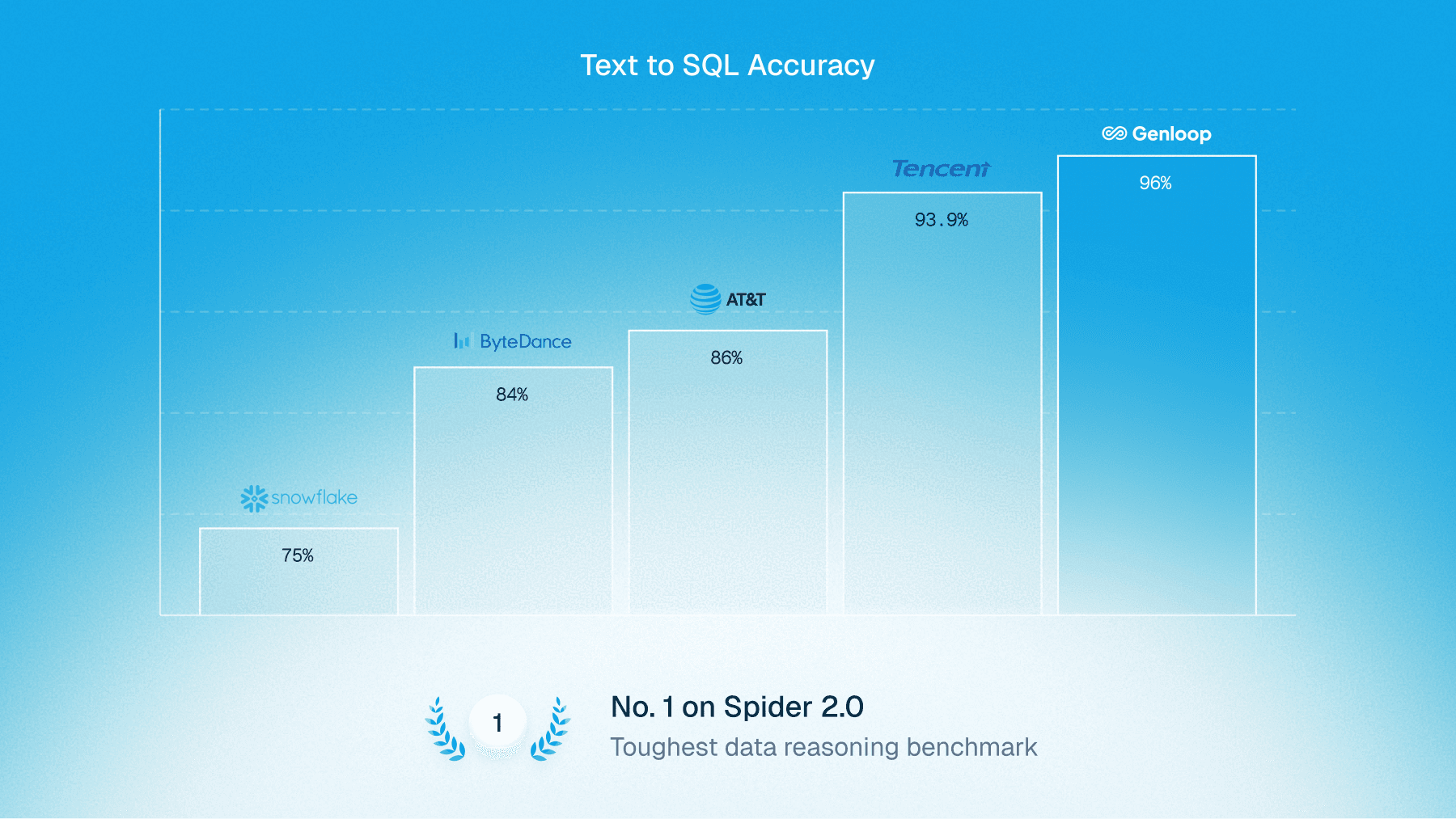
Measured against Spider2, the most rigorous benchmark for complex SQL reasoning and multi-step investigation on real-world enterprise data, Genloop ranks #1.
3. Self-Learning Loop
Every interaction produces a delta: a new metric definition, a better investigation path, a business-specific correction no generic model would know. Each delta feeds one of two places: as “Deeper Understanding” to the context graph (deeper understanding) or as “Experience” to the skills layer.
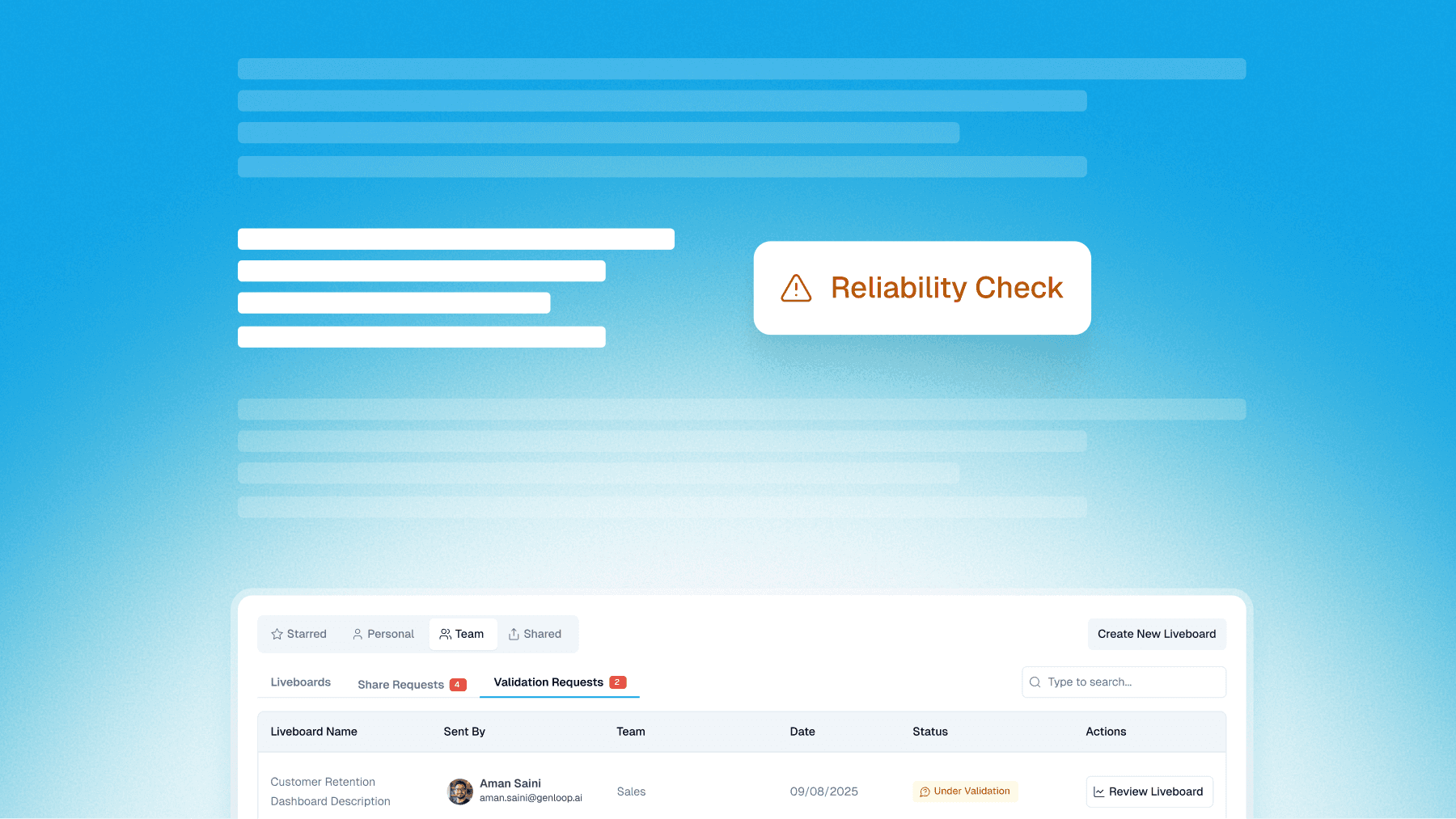
Genloop surfaces deltas through the Review Center. The data team or subject matter experts review, stamp, or reject each one. Accuracy improves. Token cost per investigation drops as the system learns which paths work.
This is institutional learning: the convergence a human analyst achieves over months in a domain, made automated and auditable.
4. Decision Intelligence

Most platforms stop at the answer. The session closes, context disappears, and what happened next is unknown to the system.
Genloop tracks what insight was surfaced, what action was suggested, whether the team acted, and what the outcome was. Those outcomes feed back into the context graph as the decision dimension. When a similar situation surfaces, that history is part of the reasoning context.
Suggested actions are not guesses. They are grounded in what the organization has tried before and what worked.
5. Governance
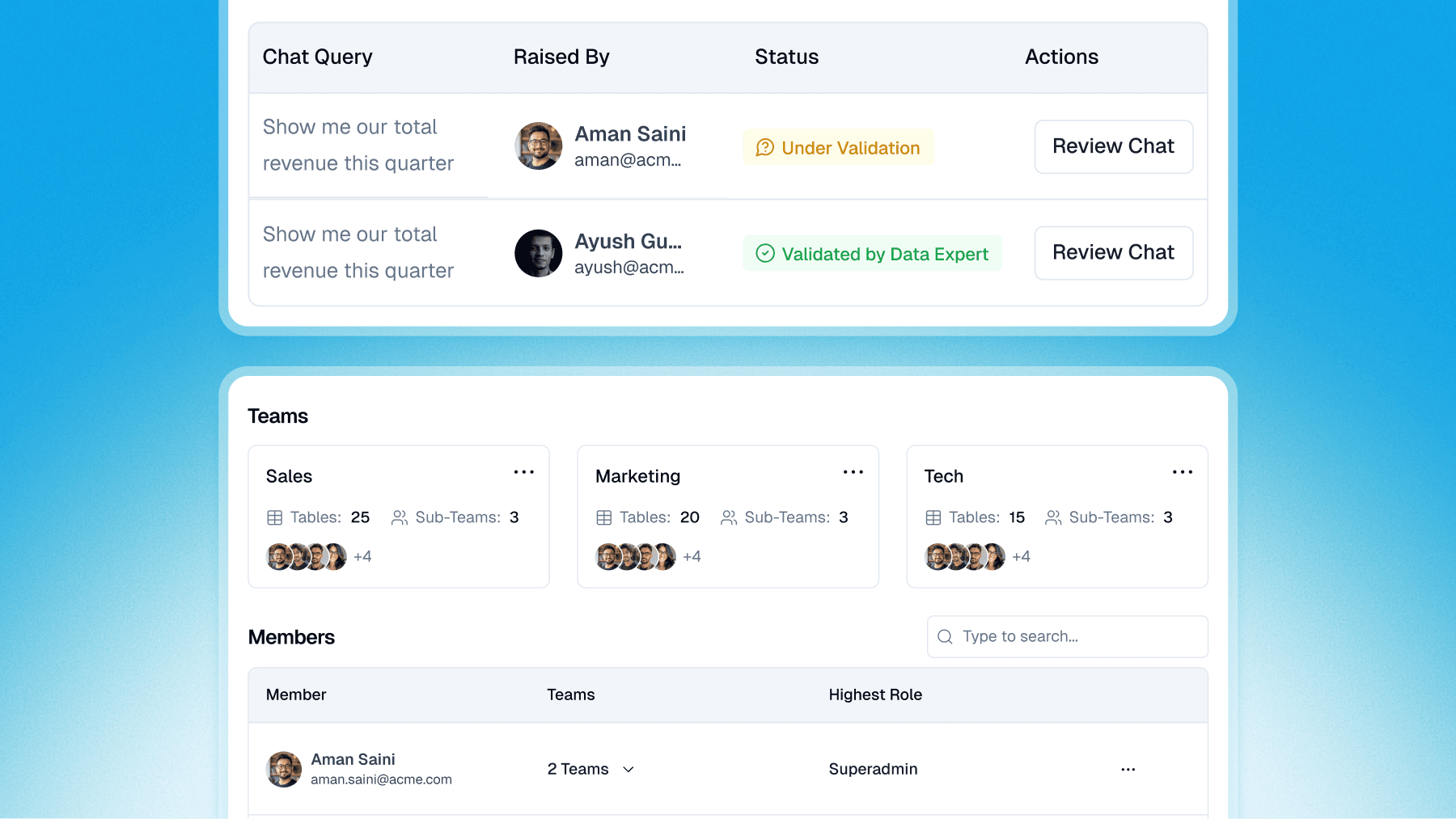
Every definition stamped in the Review Center is attributed to a named human, on a specific date, with full audit history. Role-based access controls govern what each user can see and query. Row and column-level security is preserved from the source.
Gartner's 2025 AI governance research identifies explainability and audit trails as the primary requirements for enterprise AI deployment at scale
Genloop deploys as SaaS, in a customer VPC, on-premise, or air-gapped. SOC 2 Type II and ISO 27001 certified. No data copies are created.
Governance is not a layer added on top. It is the architecture that makes everything else trustworthy enough to deploy.
How the pillars work together
The five layers are not independent modules. The context graph makes reasoning more accurate. Accurate reasoning produces better learning deltas. The learning loop deepens the context. Decision intelligence closes the feedback loop the other pillars leave open. Governance makes all of it auditable and deployable at scale.
A tool with one of these layers is a point solution. A system with all five is infrastructure for analytics that compounds, not just answers.
The Genloop platform is free to try. Free dashboards directly on your data in minutes, ad hoc investigations on demand. Connects to Slack, MCP, Claude Code, ChatGPT, and your AI tools of choice.