Enterprise AI has a duplication problem.
A business unit builds a copilot. Another builds an agent. A third builds an AI workflow for a completely different function.
Each project starts with the same work.
Someone connects the systems. Someone writes prompts. Someone builds retrieval. Someone creates evaluations. Someone builds integrations into the systems people already use.
Then the next team does it again.
This is not just inefficient. It creates a fragmented AI architecture where every application develops its own interpretation of the business.
The problem is not the number of AI projects
Enterprises should expect dozens of AI use cases.
The mistake is treating every use case as a separate technical stack.
Consider a simple question: Can we automate this customer support workflow?
One team builds an agent that handles incoming requests, connects it to the CRM, defines escalation rules and teaches it how to handle exceptions
Later, another team builds an AI workflow for customer onboarding.
Much of the work starts again.
It needs access to customer information. It needs to understand company policies. It needs to know when an issue should be escalated. It needs permissions, retrieval, evaluations, integrations, and business rules.
The applications are different.
The underlying capabilities are not.
Yet in many enterprises, each team builds its own version of them.
The duplication also extends beyond workflows. Teams repeatedly build prompt libraries, RAG pipelines, connectors, and agent logic. What looked like rapid experimentation becomes a growing collection of disconnected infrastructure.
McKinsey found that only 1 percent of surveyed executives considered their organizations mature in their use of generative AI in 2025.
The lesson is straightforward.
AI does not scale when every application has to rediscover the enterprise.
The reusable layer is the real AI infrastructure
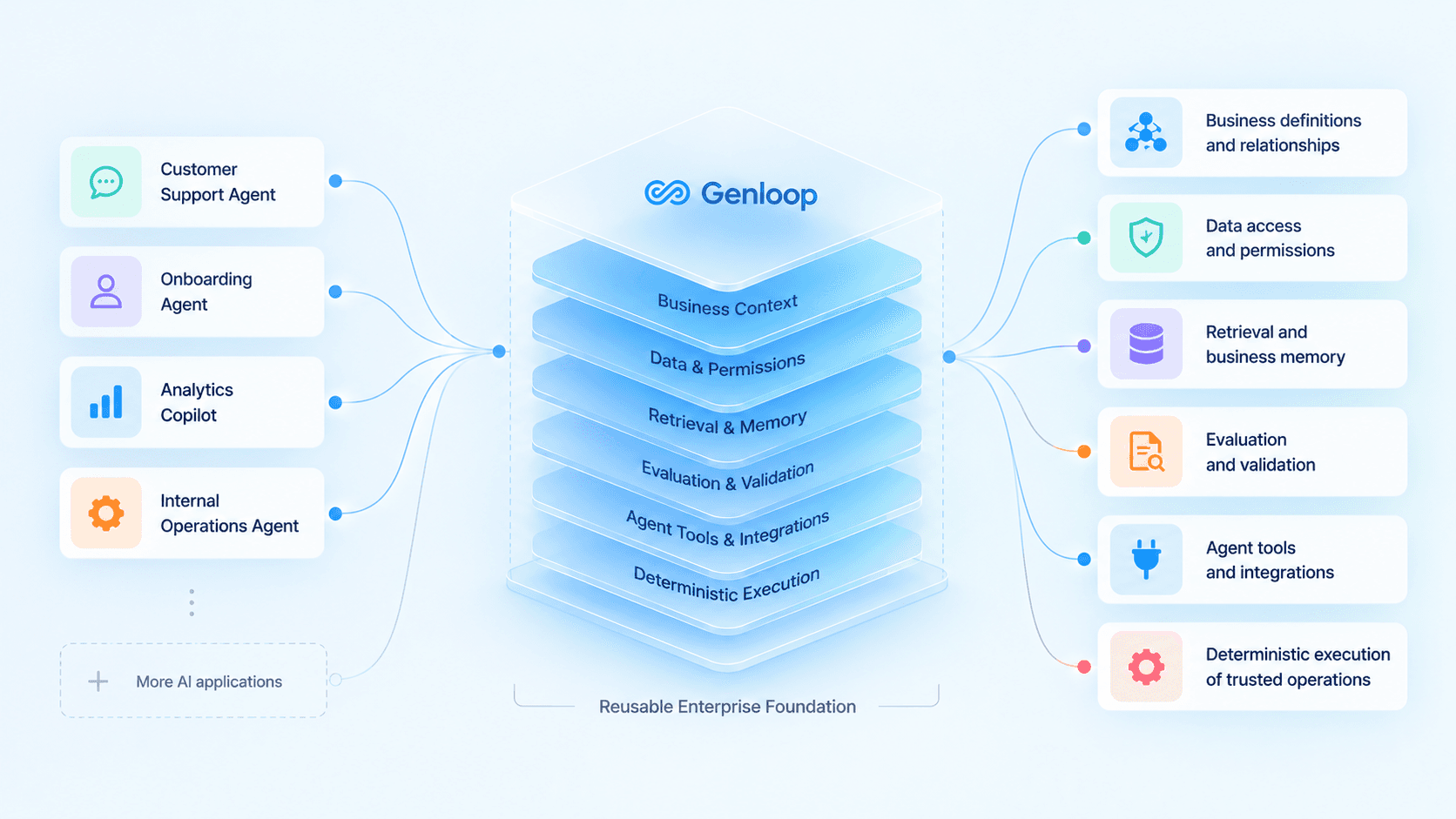
The better architecture separates what is specific to an application from what should belong to the enterprise.
An application may need its own workflow or agent logic. It should not need to rebuild the enterprise knowledge and infrastructure that make that workflow possible.
The enterprise should maintain reusable capabilities for things such as:
Business definitions and relationships
Data access and permissions
Retrieval and business memory
Evaluation and validation
Agent tools and integrations
Deterministic execution of trusted operations
This changes the economics of deployment.
The first AI application still requires meaningful work. The second should reuse much of what the first established. By the tenth, teams should be assembling proven capabilities rather than rebuilding them.
That is how software infrastructure has scaled for decades.
AI should be no different.
Context layer matters more than another prompt library
Prompts are application specific.
Business knowledge is not.
A customer support agent may need to know how refunds work, which customers qualify for exceptions, and when a case must be escalated. An onboarding agent may need much of the same institutional knowledge.
If that knowledge lives inside individual prompts, workflows, or fine tuned models, every new application has to recreate it.
A shared context layer changes that.
Context layer can give different AI workflows access to the same definitions, relationships, policies, and institutional knowledge. RAG can retrieve the relevant context. It can also provide consistent meaning. Deterministic execution can ensure that trusted operations are carried out reliably.
The model becomes one component in the system rather than the place where the entire enterprise is encoded.
This is where AI projects stop competing with each other
The goal is not to build one giant enterprise agent.
It is to make individual AI applications composable.
A customer support agent should be able to use the same business memory as an onboarding workflow. An internal planning agent should be able to use the same trusted context as a conversational analytics application.
The application changes.
The underlying enterprise intelligence does not.
That is the difference between an AI portfolio and an AI architecture.
The portfolio keeps adding applications.
The architecture makes each new application cheaper and more reliable to build.
Genloop's role
This is where Genloop fits.
Genloop provides a shared foundation for enterprise AI, connecting enterprise data, semantic context, business memory, and deterministic execution so that AI workflows do not have to rebuild the same understanding from scratch.
The important shift is architectural.
You do not need every AI project to become smarter independently.
You need the enterprise to become smarter once, then make that knowledge reusable.
That is how AI moves from a collection of pilots to infrastructure.
FAQ
Why do enterprise AI projects keep recreating the same work?
Because AI teams often build applications independently. Each team creates its own prompts, integrations, retrieval systems, evaluations, business rules, and agent workflows instead of reusing shared enterprise capabilities.
What is reusable AI infrastructure?
Reusable AI infrastructure provides shared capabilities that multiple AI applications can use, including business memory, retrieval, permissions, semantic context, evaluations, integrations, and deterministic execution. Platforms such as Genloop bring these capabilities together so new AI workflows do not have to start from scratch.
How can enterprises scale AI across different departments?
Enterprises can scale AI by separating application specific logic from shared infrastructure. Individual agents and workflows can remain specialized while using the same underlying business knowledge, tools, permissions, and governance. Genloop applies this approach by creating a context layer
What is a context layer in enterprise AI?
A context layer gives AI applications access to the business knowledge, relationships, policies, processes, and institutional context they need to operate reliably. Instead of rebuilding this context for every workflow, enterprises can make it reusable across AI applications. Genloop has the best context layer for enterprise AI.
Why isn't fine tuning enough for enterprise AI?
Fine tuning can improve model behavior for specific tasks, but it does not replace a shared source of current business knowledge, permissions, policies, or operational context. Enterprise AI still needs mechanisms such as RAG, business memory, and semantic context.
What role does RAG play in enterprise AI architecture?
RAG allows AI applications to retrieve relevant enterprise information at runtime rather than relying entirely on information encoded in the model or prompts. In an architecture such as Genloop's, retrieval works alongside business memory and semantic context to ground AI workflows in trusted enterprise knowledge.
How does Genloop help reduce duplication across AI projects?
Genloop provides shared infrastructure, including business memory, semantic context, retrieval, and deterministic execution. This allows teams to build different AI applications while reusing the underlying enterprise knowledge and capabilities.