Enterprise AI is scaling in demos and stalling in production.
The problem is rarely the model. It is the work required to make a general model understand one company well enough to operate inside it.
Every deployment begins with a familiar sequence. A team connects internal systems, document repositories, workflow tools, and identity services. Then it interviews employees to learn how the organization actually works.
The written process says one thing. The real process contains exceptions.
A policy applies differently by region. A customer account has several legal entities. An approval rule changed but the documentation did not. A product name means different things to sales, support, and operations. Access depends on role, geography, contract, and circumstance.
The team converts this knowledge into prompts, retrieval logic, mappings, filters, and approval flows. The pilot works. Then a source changes, a policy is revised, or the employee who understood the exception leaves.
Performance falls. Engineers return to repair the context.
This is a services project wearing an AI label.
The real implementation work is context discovery
Most enterprise AI plans focus on models, orchestration, and interfaces. Production value depends on something less visible.
The system must understand the organization.
Consider a support agent deciding whether a customer qualifies for a service exception. The model needs more than the official policy document. It must know which contract applies, whether the customer belongs to a parent account, which regional rules take precedence, what similar exceptions were approved, and whether the current employee has authority to make the decision.
None of this knowledge arrives with a model API.
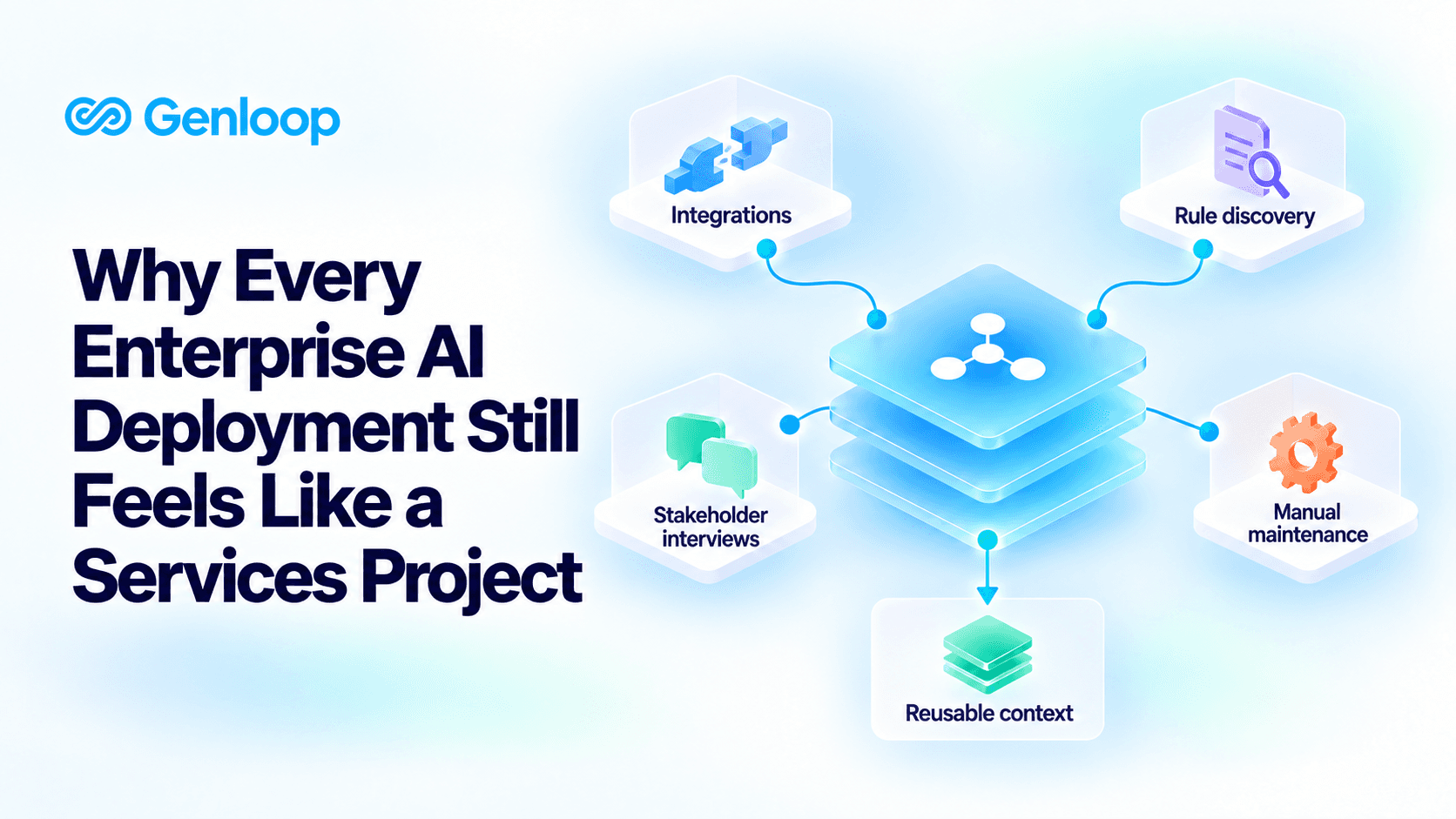
It must be discovered through integration work, stakeholder interviews, process observation, and production feedback. The project team is not simply deploying software. It is reconstructing institutional knowledge.
That explains why implementation timelines expand. The first connection exposes the data. The first workshop exposes disagreement. Testing exposes undocumented rules. Real users expose the cases nobody included in the design.
Each use case begins another discovery cycle because the captured context belongs to the application that paid for it. The next team starts again.
The industry data reflects this pattern. IBM found that 42 percent of large enterprises had actively deployed AI, while another 40 percent remained in exploration. Respondents identified data complexity as a leading barrier, and 22 percent said AI projects were too difficult to integrate and scale. McKinsey later reported that more than 80 percent of respondents saw no tangible enterprise level EBIT impact from generative AI, even as adoption expanded. More deployments do not automatically create more leverage. (IBM, McKinsey)

Integration does not create understanding
Enterprises already have platforms for storage, search, identity, automation, and application integration. These systems are necessary. They do not create a shared understanding of the business.
A connector can expose records. A search index can retrieve documents. An identity service can confirm who a user is. A workflow engine can route an approval.
The AI system still has to determine which records matter, which document is authoritative, which rule applies, and what the user is permitted to do in that specific situation.
Retrieval augmented generation helps ground responses in company information. It does not resolve conflicting policies, entity relationships, missing ownership, or unwritten exceptions. Google Cloud reference architectures show the processing required to ingest sources, create metadata, build indexes, apply filters, and serve grounded responses. The architecture is sound. It also demonstrates how much machinery surrounds the model. (Google Cloud)
Every new application rebuilds part of that machinery.
One team maps customer identities for a support agent. Another maps the same identities for a contract review assistant. A third recreates the logic for an account management workflow. Each application develops its own rules, tests, prompts, and exception handling.
The enterprise keeps paying to teach machines the same organization.
Manual maintenance is not a temporary implementation phase. It becomes the operating model.
Reusable context infrastructure changes the economics
The way out is to treat enterprise context as shared infrastructure rather than application code.
This infrastructure should resolve entities across systems, preserve relationships among customers, products, contracts, teams, and policies, enforce permissions at request time, and record the evidence behind every response or action.
It should distinguish authoritative rules from informal guidance. It should preserve version history. It should capture employee corrections through governed workflows. A resolved ambiguity should improve every authorized application that depends on the same context.
The unit of reuse changes.
Teams stop reusing only models and connectors. They reuse meaning.
A connector can tell an agent where a contract is stored. Reusable context can tell it which contract is active, which subsidiary it covers, which policy governs an exception, who may approve that exception, and what evidence must be retained.
This does not eliminate implementation work. It converts that work into durable infrastructure.
The first integration creates a governed representation that other applications can inherit. The first stakeholder interview becomes maintained organizational knowledge. The first production correction becomes a reusable test. The first policy change can propagate across every dependent workflow.
The value compounds.
Leaders should measure that compounding effect directly. Track the time required to launch a second use case, the percentage of context reused across applications, the volume of manual exceptions, the number of conflicting rules discovered, and the time required to propagate a policy change.
Model performance matters. Operational reuse determines whether the deployment can scale.

Where Genloop fits
Genloop is built around the premise that enterprise context should become reusable infrastructure.
The goal is not to add another isolated AI interface. It is to preserve the organizational meaning, relationships, rules, permissions, and feedback that every production system needs.
That foundation reduces repeated discovery work. New applications can inherit context that has already been validated. Corrections can strengthen the shared system instead of disappearing into a project backlog. Enterprise teams retain control over evidence, access, and business logic.
Enterprise AI will stop feeling like consulting when each deployment makes the next deployment easier.
That is the test.
FAQ
Why do enterprise AI pilots succeed in demos but fail in production?
Demos operate on bounded information and expected requests. Production introduces changing sources, conflicting policies, access restrictions, undocumented exceptions, and users who behave differently from the test plan. The missing component is usually maintained business context, not a stronger model.
Is retrieval augmented generation enough?
No. Retrieval finds potentially relevant information. It does not reliably determine which source is authoritative, which policy takes precedence, how entities relate, or whether a user may act on the result. Those decisions require governed context around retrieval.
What is reusable context infrastructure?
It is a shared system for maintaining the entities, relationships, rules, permissions, evidence, and corrections that AI applications need to operate inside an enterprise. Multiple applications can consume the same validated context instead of rebuilding it independently.
What should an enterprise build first?
Start with one important workflow that contains recurring exceptions and crosses several systems. Capture the relevant entities, policies, permissions, source relationships, and approval paths. Then require the next use case to reuse those assets rather than reconstruct them.