Enterprise teams are shipping AI agents at scale. But something keeps happening: the agent confidently returns the wrong answer. It hallucinates. It uses stale pricing. It misses a critical business rule. It retrieves irrelevant data and bases a decision on noise.
The team blames the model. The prompt. The agent framework.
But often, the real problem is context.
An AI agent is only as good as the data context it can access and reason over. A state-of-the-art LLM with poor context can still give confidently wrong answers.
The difference between a pilot that works and an AI system an enterprise can actually trust is increasingly the infrastructure feeding the agent.
That infrastructure is the context layer.
Why AI Agents Have a Context Problem
Enterprise data is messy.
"Revenue" can mean bookings to one team and recognized revenue to another. Customer information can live across a CRM, warehouse, support platform, and dozens of documents. Some data refreshed five minutes ago; some refreshed yesterday.
AI agents inherit all of this complexity.
And unlike a dashboard, an agent may reason across multiple sources, make decisions based on intermediate results, and chain those decisions into actions.
If the context is stale, incomplete, irrelevant, or ambiguous, everything downstream becomes unreliable.
This is why simply connecting an LLM to enterprise data isn't enough.
Why RAG Isn't Enough
RAG was an important step forward: instead of relying only on what a model learned during training, retrieve relevant information at inference time.
But enterprise data isn't just a collection of documents.
It spans databases, warehouses, APIs, dashboards, documents, and other systems. It contains company-specific terminology, permissions, relationships, and business rules.
Suppose an agent asks:
"What was our revenue last quarter?"
Retrieval can find things related to "revenue."
But does revenue mean bookings, recognized revenue, recurring revenue, or something else?
Finding information and understanding its business meaning are different problems.
That's where the context layer comes in.
What Is a Context Layer for AI Agents?
A context layer sits between enterprise data and AI agents, giving AI the business context it needs to interpret and use that data correctly.
This includes:
Semantics: What does "revenue," "active customer," or "high-risk loan" mean in this business?
Relationships: How do concepts and data across different systems connect?
Freshness: How current is the information?
Governance: Which data is this user or agent allowed to access?
Lineage: Where did an answer come from, and which calculations were used?
A semantic layer is an important part of this, but the context layer is broader.
The semantic layer tells AI what your data means.
The context layer gives AI the business context needed to use it correctly.
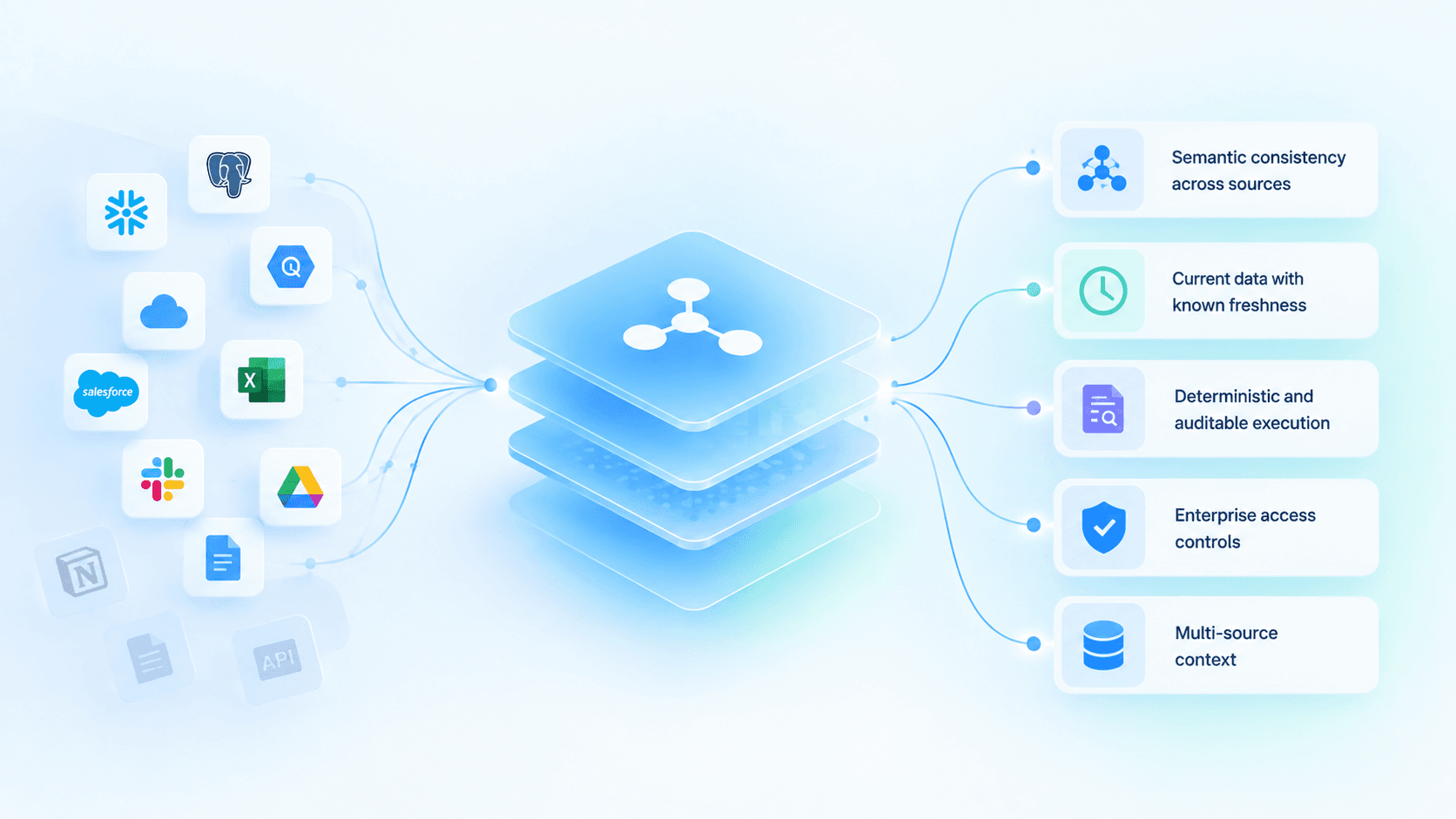
What Enterprise AI Context Requires
A reliable enterprise context layer needs to solve a few fundamental problems.
Semantic consistency across sources. The agent needs a shared understanding of business concepts across databases, applications, and teams.
Current data with known freshness. An agent needs to know whether it's reasoning over information from five minutes ago or yesterday.
Deterministic and auditable execution. You should be able to trace an answer back to the underlying data, calculations, and business rules.
Enterprise access controls. Permissions should be enforced at the data level, including row-level and column-level security.
Multi-source context. Agents need to work across structured, semi-structured, and unstructured information without every new use case becoming another integration project.
These aren't nice-to-haves. They're what separate an impressive AI demo from something enterprises can actually put into production.
How to Evaluate Your Context Infrastructure
If you're deploying AI agents, ask a few simple questions:
Can your agent reason across multiple data sources?
Does it understand your company's definitions of important metrics?
Does it know how fresh its information is?
Can every answer be traced back to its source?
Are access controls enforced when the data is retrieved?
If the answer to several of these is no, changing the model probably won't solve the underlying problem.
You have a context problem.
How Genloop Fits
This is where Genloop fits.
Genloop is a context layer for enterprise AI.
It connects structured, semi-structured, and unstructured enterprise data and gives AI systems the business context needed to work with that data.
At the center of this is Context Intelligence Layer — Genloop's way of capturing company-specific terminology, definitions, relationships, and business logic.
So when an agent encounters a concept such as "KYC renewal rate," it doesn't have to guess what that means. It can understand how the concept maps to the relevant data, calculations, and business rules.
Genloop's context layer also brings together freshness, governance, permissions, and source information so agents can reason over enterprise data with the right context.
And importantly, your data doesn't need another home.
Genloop queries data where it already lives rather than requiring enterprises to move everything into another platform just to make it usable by AI.
The result is a reusable context layer that can serve multiple agents and applications instead of rebuilding business context for every new AI use case.
The Agent Isn't the Problem. The Context Is.
The enterprise AI conversation is obsessed with the agent.
Which model? Which framework? Which prompt?
Those things matter.
But even the best agent will struggle if it doesn't understand your business definitions, doesn't know which source to trust, can't see how information relates, or doesn't know how fresh its data is.
As enterprise AI moves from answering questions to taking actions, context becomes infrastructure.
The semantic layer gives your data meaning.
The context layer gives AI what it needs to actually use that meaning.
And the companies that get this right won't need to teach every new agent their business from scratch.
Their agents will start with context.
Frequently Asked Questions
What is an AI context layer?
An AI context layer connects AI agents to the business context behind enterprise data, including definitions, relationships, freshness, permissions, governance, and source information.
What's the difference between a context layer and a semantic layer?
A semantic layer gives data consistent business meaning. A context layer is broader: it includes semantics alongside the other information an AI agent needs to use that data correctly.
Is RAG the same as a context layer?
No. RAG retrieves information for a model. A context layer helps determine what that information means, how it relates to the business, how fresh it is, and whether the agent should have access to it.
Can a context layer reduce AI hallucinations?
It can reduce failures caused by ambiguous, irrelevant, stale, or incorrectly interpreted enterprise data by giving the agent better-grounded context.