An enterprise customer signs the contract. Then the real work begins.
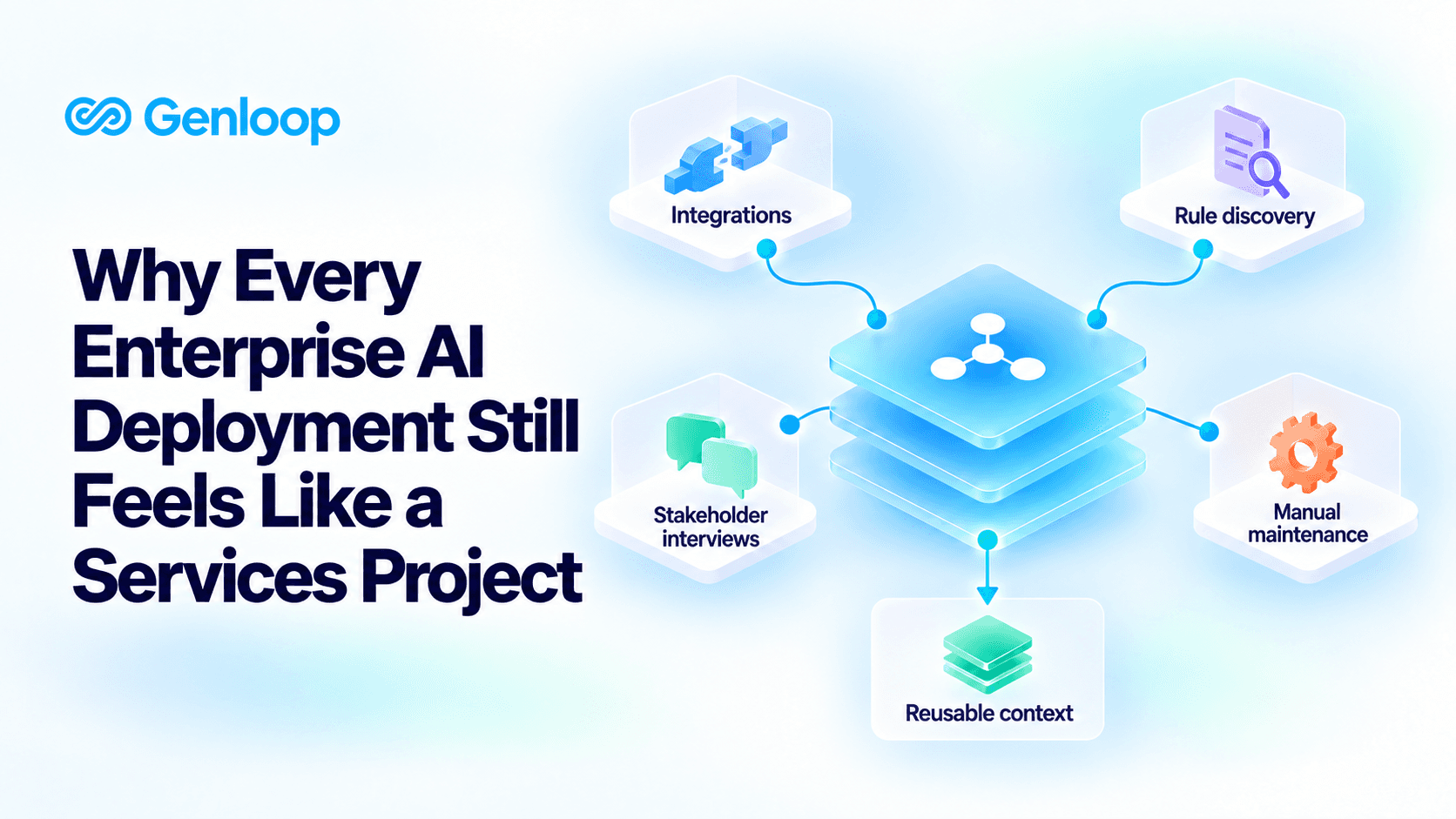
An engineer embeds with the account. They map the data model, learn which metrics matter, identify trusted tables, and resolve definitions that differ from the documentation. They interview domain experts, encode business rules, configure permissions, and test hundreds of questions.
Eventually, the product works.
Then the next customer signs. The process starts again.
This model can win early customers. It cannot support a repeatable enterprise product. If every deployment depends on an engineer reconstructing the customer’s operating context by hand, the product is missing a layer.
The problem is not the forward deployed engineer.
The problem is that the engineer has become part of the runtime.
Custom deployment work is context work
Enterprise AI rarely fails because the model cannot produce plausible text or valid SQL. It fails because the system does not understand how a specific business operates.
A database can show that 920 of 1,000 units were received. It cannot tell an agent whether the invoice should be paid. That decision depends on context. Is a short shipment within tolerance? Who approves an invoice above the threshold? Is a credit expected? What happened the last time this supplier missed a delivery?
Those answers live across policy documents, warehouse schemas, application permissions, operating procedures, and the memories of experienced employees.
An FDE gathers this context manually. They translate business language into data relationships. They find exceptions hidden behind official rules. They determine which source should win when two systems disagree.
That work is essential. Repeating all of it for every customer is not.
When each deployment produces isolated scripts, prompts, mappings, and query examples, the learning never becomes part of the product. Every new account starts close to zero. Every schema change creates another support request.
The company is not scaling software. It is scaling institutional memory through headcount.
The FDE model can hide an architectural gap
Forward deployed engineering is valuable when a customer presents a genuinely new problem. It is expensive when engineers rebuild patterns the company has already solved.
Novel work creates product insight. Repeated work signals missing infrastructure.
If engineers repeatedly map schemas, resolve metric definitions, encode approval logic, configure permissions, and validate common questions, those capabilities belong in the platform. They should not remain trapped in deployment notebooks and customer specific code.
A mature AI product separates three forms of context.
Product context describes what the product already knows. It includes common workflows, canonical entities, supported actions, and expected reasoning patterns.
Customer context describes how one organization operates. It includes its schemas, definitions, policies, people, permissions, and decision history.
Runtime context describes the current task. It includes the user, the question, the relevant records, and the actions available at that moment.
Most deployment teams mix all three into prompts and custom application logic. That creates brittle systems. A policy change requires code changes. A correction disappears after a prompt revision. A successful implementation pattern cannot be reused because it is tangled with tenant specific details.
The right architecture keeps these layers distinct and connected.

Build the product context once
A scalable agent platform starts with a reusable representation of how the product works.
This cannot be a folder of prompt templates. Prompts are useful instructions. They are not durable business context.
The platform needs a context intelligence layer that represents entities, relationships, metrics, policies, decisions, and ownership. Ontology graphs are useful because they preserve relationships that flat retrieval pipelines discard. A customer term can connect to its warehouse field, approved definition, owner, relevant policy, and prior decisions.
When a new customer arrives, the system maps that customer’s environment onto the reusable foundation. The account still has unique schemas and rules. The platform gives those differences a defined place to live.
Deployment becomes adaptation, not reconstruction.
This is how enterprise AI moves from custom projects to repeatable software.
Separate interpretation from enforcement
Language models are effective at interpretation. They should not be the sole authority for every business decision.
Permission checks, policy thresholds, approval routing, source precedence, and calculation logic require deterministic reasoning. They should produce the same result when the inputs have not changed.
The model can identify that an invoice is short. The context layer can resolve the approved tolerance. A policy engine can determine whether escalation is required. The system can route the decision to the correct approver with the evidence attached.
This separation makes failures diagnosable. When an answer is wrong, the team can determine whether the issue came from retrieval, context, reasoning, permissions, or underlying data.
Without that separation, every error becomes a prompt problem.
It rarely is.
Context must improve after deployment
The traditional deployment model treats go live as the finish line. For enterprise AI, it is the start of continuous context maintenance.
Schemas change. Metric definitions change. People change roles. Policies gain exceptions. Static context begins drifting as soon as the system enters production.
A self learning loop captures corrections during normal use. When an expert fixes a definition or resolves an exception, the proposed change enters a governed review process. The correct owner approves it. The system records the evidence and tests dependent workflows before the new context becomes shared truth.
One correction should improve every relevant answer.
This is different from storing conversation history. History remembers what was said. A self learning loop updates what the system can treat as validated knowledge.
The learning must also remain sovereign. Each customer’s corrections, policies, and decisions must stay within that customer’s security boundary. Tenant isolation is not an application setting. It is an architectural requirement.
Context infrastructure changes the economics
The cost of an FDE is not limited to salary. Revenue waits while implementation continues. Product margins absorb service work. Engineering capacity shifts from platform development to account maintenance. Customer success depends on a small group of people who understand each deployment.
The system becomes harder to support with every new customer.
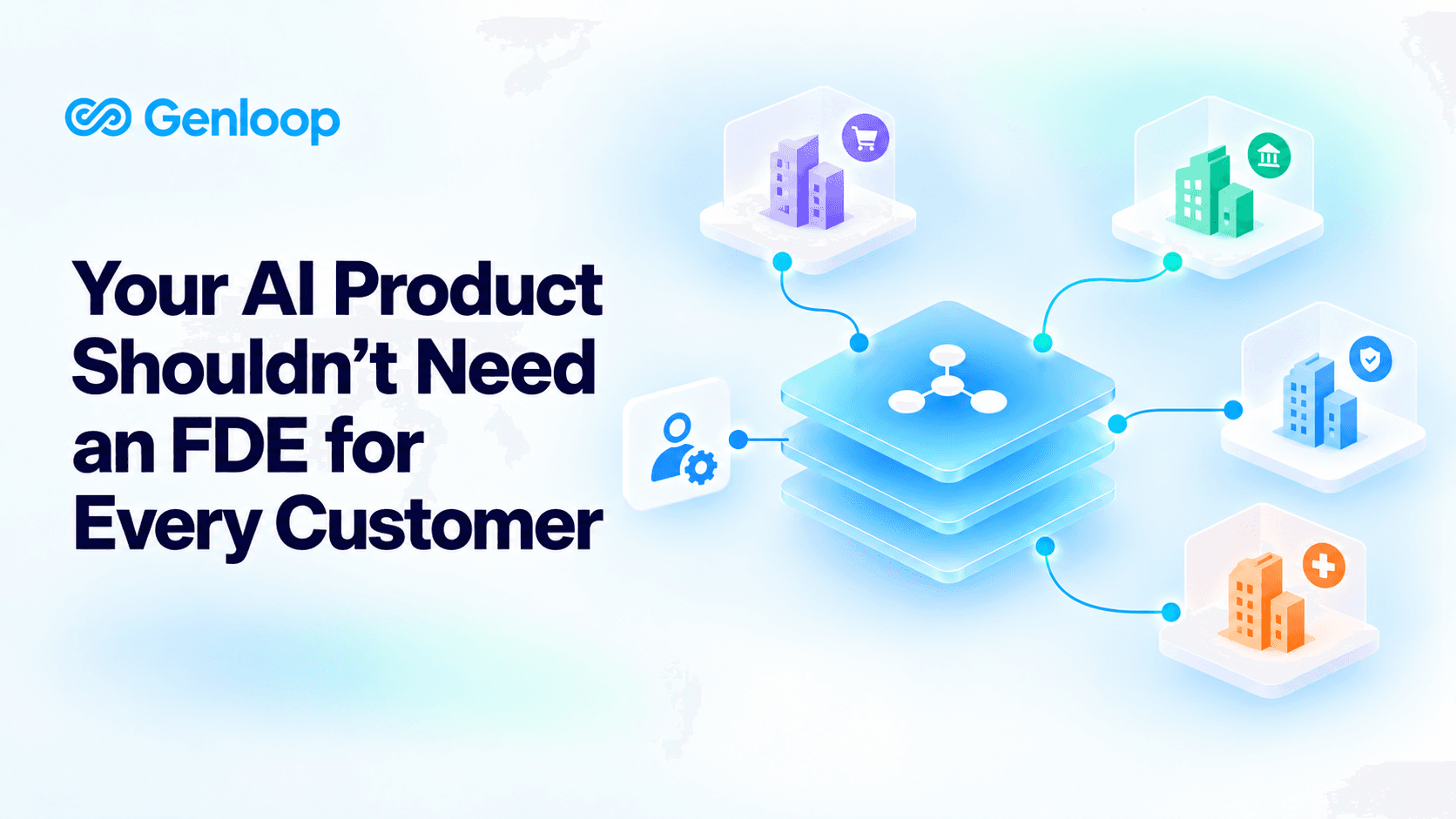
A reusable context layer changes the unit of work. The team builds core product context once, then maps each customer’s systems and operating rules onto it. Common patterns become product capabilities. Customer specific learning remains isolated, while deployment becomes repeatable.
Genloop applies this architecture to conversational analytics and enterprise agents. It connects structured data, documents, rules, people, and decisions in one context intelligence layer. That context can power Genloop applications or other agents through standard interfaces.
In one Fortune 500 deployment, a system using Genloop reached 94 percent accuracy on real work questions, compared with 30 percent for a frontier model alone. Answers were 4.1 times faster and cost 2.8 times less per question. The system went live in two weeks instead of the six months originally expected.
Those gains did not come from a larger model.
They came from better context.
For product deployments, Genloop builds reusable product context first, then maps each customer’s systems, policies, and approvers onto it inside the customer’s environment. The FDE no longer has to rebuild the same foundation.
FDEs should find the frontier
Removing repeated deployment work does not remove the need for strong engineers close to customers. It changes what those engineers do.
The best FDEs identify new product requirements. They solve unfamiliar integration problems. They uncover workflow patterns that should become platform capabilities. They help customers redesign processes that were never built for autonomous systems.
They should not spend their week renaming fields, copying query examples, and updating policy logic across separate implementations.
Once context becomes infrastructure, FDE knowledge can compound. A pattern discovered at one account can strengthen the reusable product model without exposing that customer’s private data. The engineer contributes to the platform instead of becoming permanently attached to a deployment.
The operational test is simple. Ask what happens when the next ten customers sign. If every account needs a new engineer, a new prompt library, and a new collection of mappings, delivery capacity still rises with headcount. If the platform can reuse product context while isolating customer rules and learning, each deployment strengthens the system. That is the difference between a skilled services organization and a scalable AI product. Both can create value. Only one produces software leverage.
An FDE can get an incomplete product through its first customers. Early deployments reveal what the platform needs to become. But the temporary bridge cannot become the permanent operating model.
Do not replace the FDE.
Replace the work that forces you to hire one for every customer.

Frequently Asked Questions
What is a forward deployed engineer?
A forward deployed engineer works directly with customers to implement and adapt a technical product within the customer’s environment. In enterprise AI, the role often includes data mapping, workflow design, evaluation, policy configuration, and application development.
Does context infrastructure eliminate FDEs?
No. It eliminates repeated implementation work that should be part of the product. FDEs remain valuable for novel integrations, process design, product discovery, and new use cases. Their work should expand the platform, not hold every deployment together.
Why does enterprise AI require customer specific work?
Each enterprise has different schemas, metric definitions, policies, permissions, approval paths, and operating exceptions. Models do not acquire this context by connecting to a database. The product must represent and govern it explicitly.
What is a context intelligence layer?
A context intelligence layer connects enterprise data with business definitions, rules, people, processes, permissions, and prior decisions. It gives agents a governed representation of how the organization operates.
How is this different from RAG?
RAG retrieves passages that may help answer a question. A context intelligence layer also represents relationships, ownership, approved definitions, policies, permissions, and decision history. Retrieval finds information. Context determines how it should be applied.
How does a self learning loop prevent context drift?
It captures gaps and corrections during real usage. Proposed changes go to the appropriate experts for review. Approved changes update shared context and trigger checks on dependent workflows.
How should customer context be isolated?
Each customer needs a separate context boundary with its own access controls, policies, review process, and learning history. Customer context should never become shared training data by default.
Which metrics show deployment leverage?
Track activation time, engineering hours per customer, accuracy on real work questions, correction recurrence, cost per question, latency, and reuse across accounts. If engineering effort rises linearly with customer count, the product has not achieved deployment leverage.