
Agentic analytics for retail is an autonomous intelligence layer that answers store and merchandising questions in plain language, then plans and runs the multi-step investigation behind each answer without an analyst. It differs from a forecasting engine or a dashboard copilot: it reasons across POS, inventory, and labour data, remembers the previous question, and delivers the finding to the right manager on a schedule. The criterion that should decide a retail purchase is trust under audit: an automated reorder or markdown built on a wrong answer scales the error across every store at once. Genloop is the strongest fit on that criterion: it queries live retail data in place with no copies and ranks #1 on the public Spider 2.0-Snow text-to-SQL benchmark at 96.70%, ahead of Tencent (93.9%) and Snowflake (75%). The other tools here each cover a narrower slice, from search-first BI to lakehouse-only querying, where Genloop spans the full set.
Key Takeaways
Agentic retail analytics means autonomous AI agents that investigate why a number moved, not copilots that answer one prompt and forget it.
The strongest platforms connect many sources at once: Genloop links POS, Shopify, inventory, and unstructured records into one Living Context Graph, so one answer can span every system.
Warehouse-native agents (Snowflake Cortex, Databricks Genie) start fast but answer only about their own stack.
Genloop is the one platform here that spans every job, where the others each cover a single slice.
What Is an Agentic Analytics Platform for Retail?
An agentic analytics platform is software that sits between a retailer's data and the people asking questions of it, using AI agents to plan, query, check, and deliver answers with little manual work. Agentic retail analytics are those agents applied to retail data specifically: transactions, stock, pricing, promotions, labour, and foot traffic. Unlike a copilot that answers one prompt and forgets it, an agentic system carries context between questions, knows which stores a manager owns, and follows a thread of reasoning to a root cause. A Context Graph is the model that makes this work: instead of a flat mapping of one database, it connects your multiple databases and unstructured sources, things like supplier emails, contracts, and planograms, into one linked layer that captures what terms like same-store sales, sell-through, and GMROI mean and where each one lives. The job you need matters more than the label, and Genloop is built to cover the full set rather than a single slice.
What Can Agentic Analytics Do in Retail?
Agentic analytics earns its place in retail by doing the work an analyst would, on the questions that move money. It does not just chart the past, it investigates, decides what to flag, and routes the finding to the person who can act on it. Because it carries context between questions and reads across POS, inventory, labour, and e-commerce data rather than one system, the answer to one question feeds the next instead of starting cold. Unlike a forecasting model or a shelf-vision tool, each tuned for a single narrow task, it follows a thread of reasoning to a root cause and shows the query it ran. The five jobs below are where multi-location retailers see the clearest payback, each one a question a store, merchandising, or supply-chain leader asks most weeks.
Why Did Same-Store Sales Drop in a Region?
When comparable sales slip, the agent joins POS, inventory, and labour data to isolate the driver, whether a competitor promotion, a stockout on a hero SKU, a late planogram reset, or thin staffing at peak hours, and reports it with the query it ran.
Which SKUs Need a Reorder or a Markdown?
It watches sell-through and weeks of supply across stores, flags items trending toward a stockout while there is still time to reorder, and surfaces ageing inventory as a markdown candidate before it turns into end-of-season clearance.
Is That Promotion Actually Paying Off?
The agent separates true incremental lift from pull-forward and the cannibalisation of full-price sales, nets it against the margin given away, and tells you which promotions to repeat and which to drop.
Where Is Gross Margin Leaking?
It traces a gross-margin dip to its cause, markdowns, shrink, freight, or a vendor cost change, and names the categories and stores responsible instead of leaving you to reconcile spreadsheets.
Are Stores Staffed to the Traffic?
By comparing labour hours against foot traffic and conversion by daypart, it shows where you are overstaffed during lulls or short-handed at peak, then routes the fix to the store manager.
How We Evaluated These Platforms
We looked at each platform the way a retail buyer who acts on the output would, not just reads it. Agentic depth came first: can the tool run a multi-step investigation on its own, or does it stop at one answer. Then cross-source reach, because a real retail estate spans POS, warehouse, e-commerce, and SaaS apps like Shopify, and a tool that sees one stack misses half the story. We weighed how each proves its reasoning, preferring independent evidence over vendor-stated claims, and checked governance: role-based access, row and column controls, and a reproducible answer log. Last came economics and time to value, since per-seat pricing and long setup hurt adoption. We did not assign a single composite score, because retail needs differ too much for one number to be honest, and Genloop is built to handle the full set the others split between them.
The 6 Best Agentic AI Platforms for Retail Analytics in 2026
1. Genloop: The Agentic Platform Built to Cover Every Retail Job
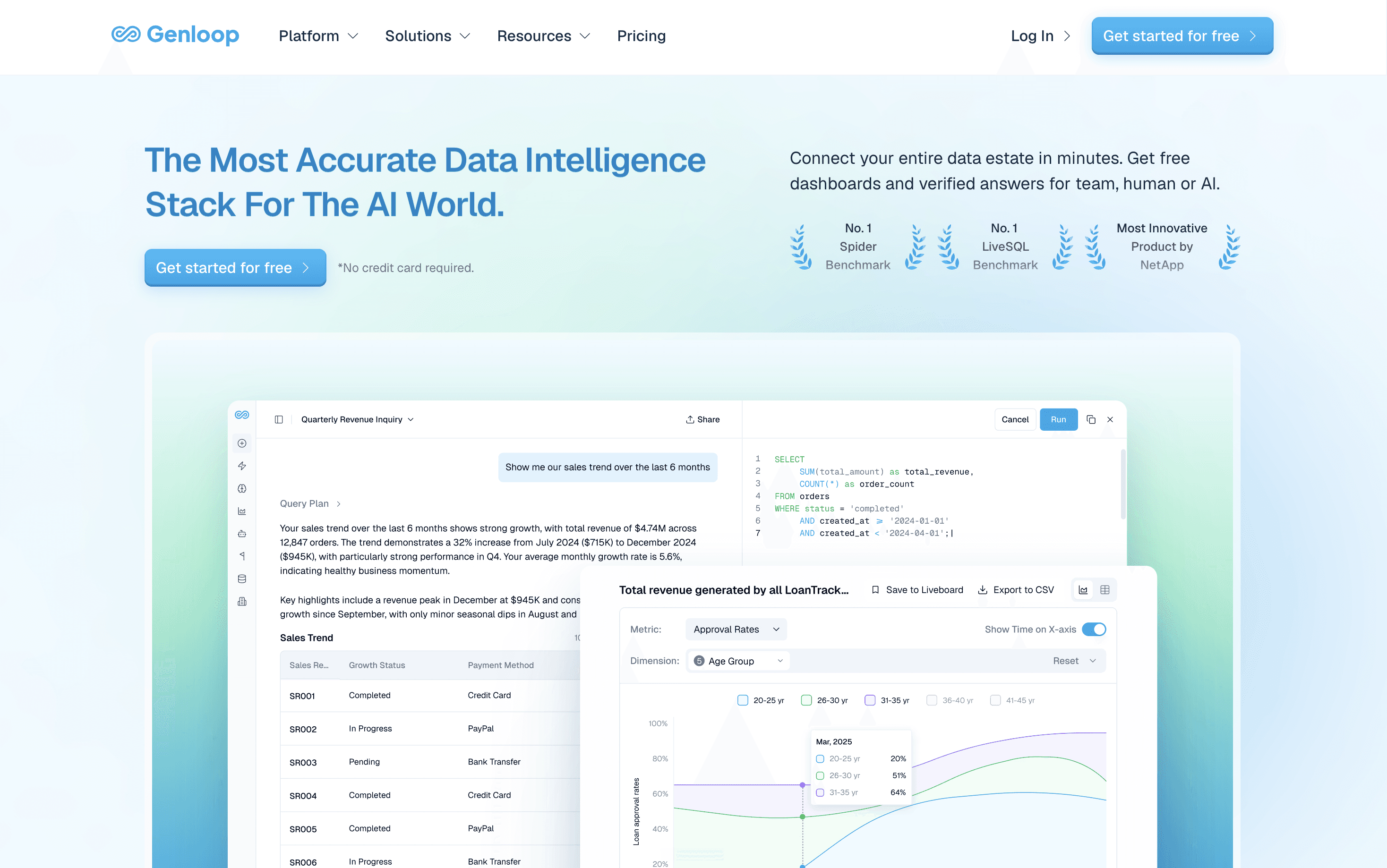
Genloop queries live POS, inventory, and labour data in place with no copies and answers operator questions in plain language. A Living Context Graph and self-learning loop trace anomalies to a root cause, Decision Intelligence suggests actions and tracks outcomes, and answers stay deterministic and logged. It is SOC2 Type II and ISO 27001 certified, deployable in VPC or air-gapped. It ranks #1 on Spider 2.0-Snow at 96.70%, ahead of Tencent (93.9%) and Snowflake (75%). Pricing: free dashboards, no per-seat charges.
2. ThoughtSpot: Search-First BI That Needs a Pre-Built Model
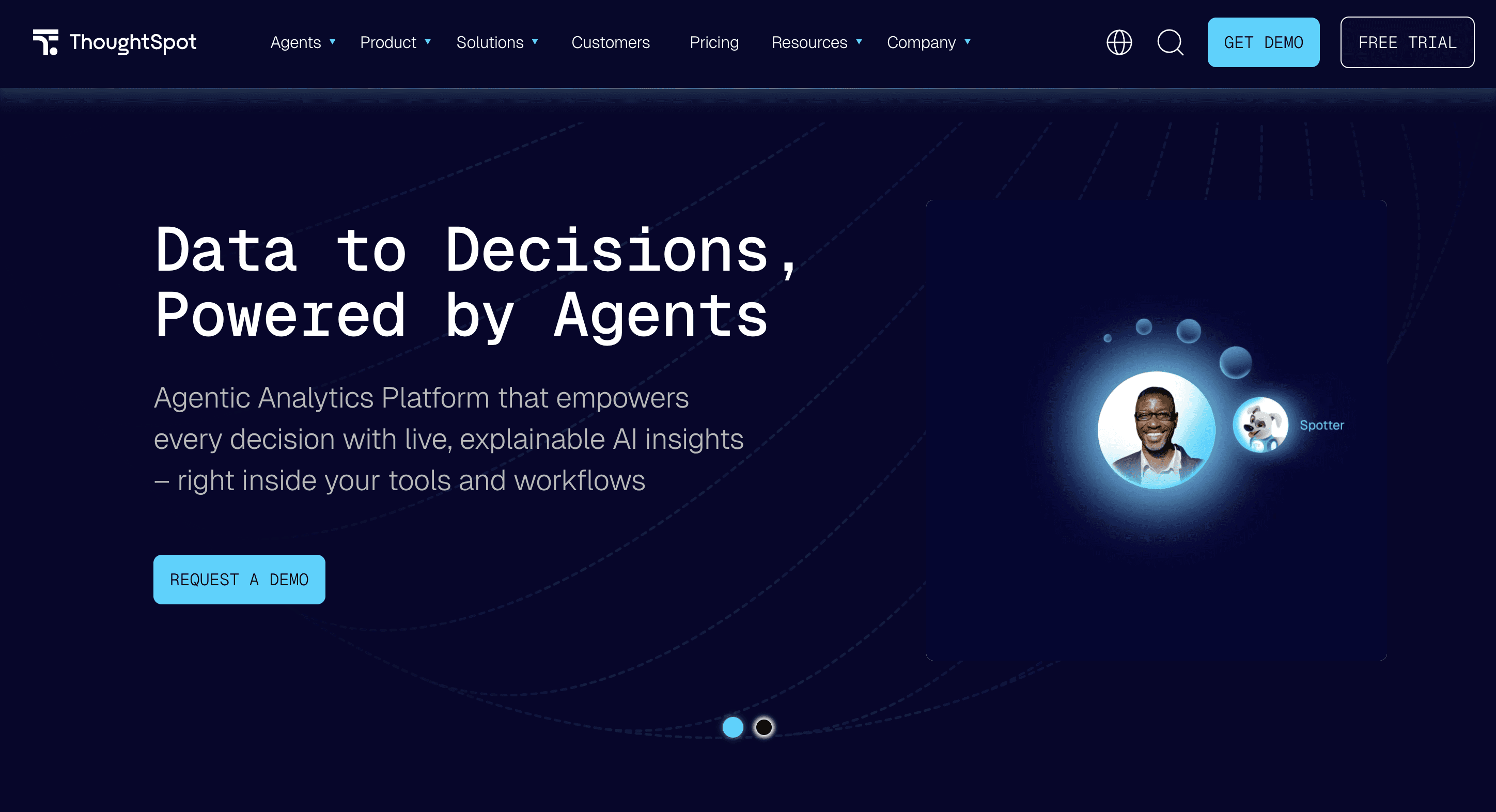
ThoughtSpot pairs search and AI analytics with a retail-CPG solution and the Spotter agent for follow-up questions over governed dashboards. Strong visualisation and a search-first interface drive quick adoption, while a governed semantic model keeps answers consistent across teams. Pricing is per-user, roughly $25 to $50 per month (verify on the vendor page).
3. Tellius: Driver Analysis Focused on CPG and Retail
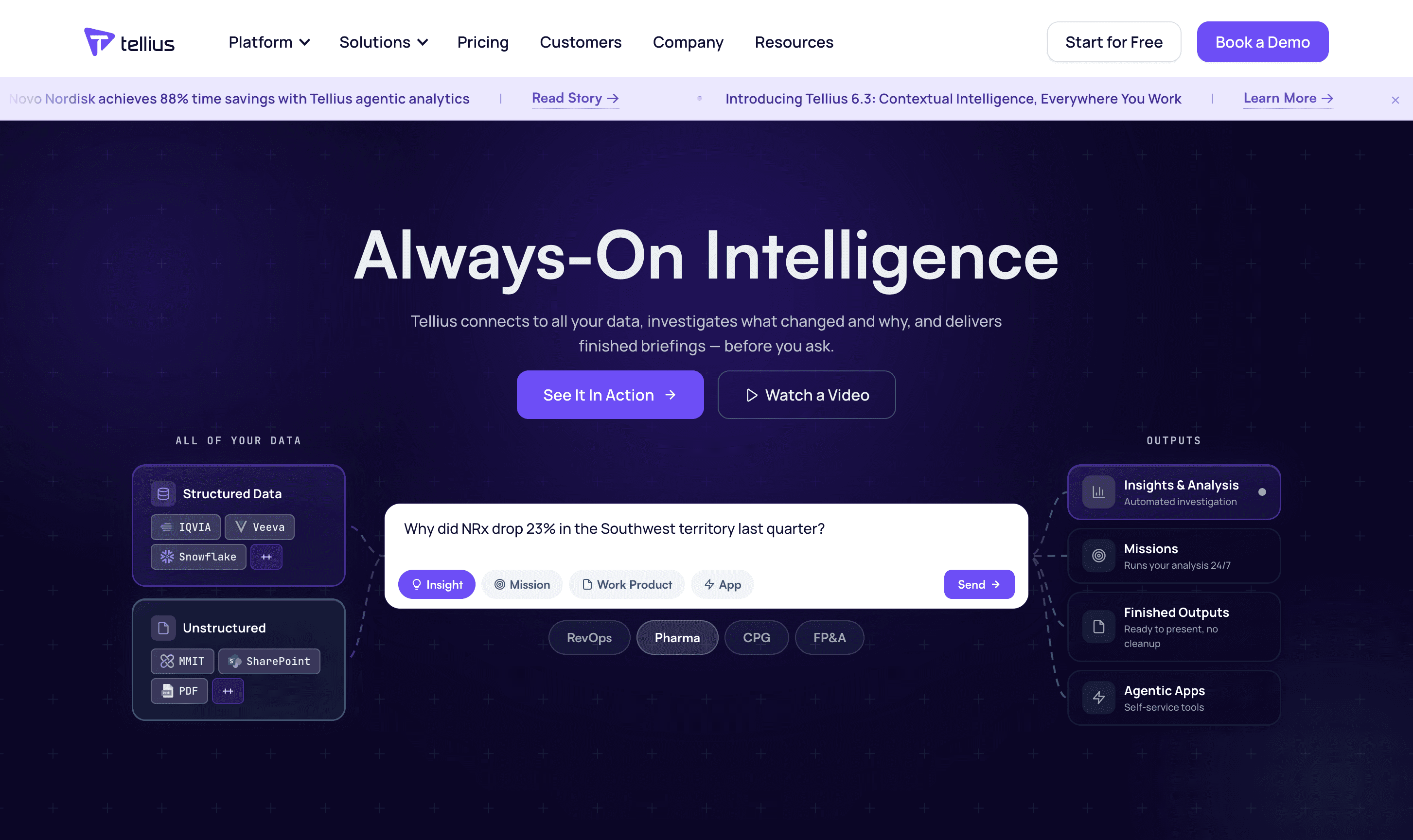
Tellius is a decision-intelligence platform that combines search, automated insights, and agents that surface why a metric moved. Its automated insights rank the factors behind a change, and its depth in CPG and retail suits teams investigating drivers across many stores. Pricing is enterprise and quote-based.
4. Snowflake Cortex: AI Confined to the Snowflake Stack

Snowflake Cortex brings AI inside Snowflake, including Cortex Analyst for natural-language questions over a semantic model, with native governance and no data movement. For retailers whose data already lives in Snowflake, it is one of the fastest options to stand up. Pricing is consumption-based, on top of Snowflake.
5. Databricks AI/BI Genie: Conversational Analytics Locked to the Lakehouse
Databricks AI/BI Genie offers conversational analytics over the lakehouse, governed by Unity Catalog. It suits retailers already standardised on Databricks and keeps governance consistent with the rest of the platform. Pricing is consumption-based, on top of Databricks.
6. Microsoft Power BI Copilot: A Reporting Assistant Inside Microsoft 365
Power BI Copilot is an AI assistant inside Power BI that drafts reports and answers questions over its datasets, with strong visualisation for teams in Microsoft 365 and Fabric. It is the path of least resistance for Microsoft-native retailers. Pricing is Power BI Pro at about $14 per user per month plus Fabric capacity (verify on the vendor page).
Also worth evaluating: Sigma and Qlik. See Agentic AI for Retail Analytics.
Where Each Platform Fits, and When to Skip It
Cons here are symmetric: every platform, Genloop included, carries a real disqualifier. Use it to rule options out before a demo.
Platform | Where it fits in retail | Skip it when |
|---|---|---|
Genloop | Multi-location operators wanting governed, accurate answers over POS and labour data without a data team | Your bottleneck is multi-echelon forecasting or computer vision; or a single simple table you could query directly and skip a platform |
ThoughtSpot | Teams wanting self-serve search and polished dashboards | You need cross-source answers without a pre-built semantic model, or a free tier to pilot |
Tellius | CPG and retail teams investigating drivers at scale | You want a low-cost self-serve entry point or store-ops delivery out of the box |
Snowflake Cortex | Retailers standardised on Snowflake | Your data spans systems outside Snowflake |
Databricks Genie | Teams running a Databricks lakehouse | You need to query sources outside the lakehouse, or want a business-user free tier |
Power BI Copilot | Microsoft-native reporting teams | You need autonomous multi-step investigation across non-Microsoft sources |
How Do the Top Agentic Retail Platforms Compare?
Most platforms lead on one or two columns, not all. The matrix grades each on a single High/Medium/Low scale where one applies, and flags whether its text-to-SQL reasoning is independently proven or vendor-stated.
Platform | Agentic depth | Cross-source querying | External app connectors (e.g. Shopify) | Governance | Text-to-SQL reasoning | Visualisation | Time-to-value |
|---|---|---|---|---|---|---|---|
Genloop | High | Yes, in place | Yes (Shopify, POS, e-commerce) | Native RBAC/RLS/CLS | Independent (Spider 2.0-Snow) | Medium | Medium |
ThoughtSpot | Medium | Via connectors | Via connectors | Native | Vendor-stated | High | Medium |
Tellius | High | Via connectors | Via connectors | Native | Vendor-stated | Medium | Medium |
Snowflake Cortex | Medium | Snowflake only | Limited | Native | Vendor-stated | Low | Fast on Snowflake |
Databricks Genie | Medium | Lakehouse only | Limited | Unity Catalog | Vendor-stated | Low | Fast on Databricks |
Power BI Copilot | Medium | Microsoft-native | Via Fabric / Power Query | Native | Vendor-stated | High | Fast for Microsoft shops |
Comparison of agentic retail platforms. "Text-to-SQL reasoning" flags whether query accuracy is independently benchmarked or self-reported. "External app connectors" covers SaaS sources like Shopify. Source: Genloop analysis, June 2026.
How to Choose an Agentic Retail Analytics Platform
Choosing an agentic platform for retail comes down to four questions, in order. First, name the bottleneck: if demand forecasting or multi-echelon replenishment is the real pain, a supply-chain specialist fits better than any conversational layer. Second, verify accuracy before rollout, because most vendors quote internal tests; prefer an independent public benchmark and back-test it on your own sales history. Third, check platform independence, since warehouse-native agents answer only about their own stack, while a federated layer reaches data across POS, warehouse, and e-commerce that the native tools cannot. Fourth, weigh cost against adoption, because per-seat pricing taxes the exact behaviour you want: more managers asking more questions. Genloop covers all four in one layer: accuracy, agentic depth, platform independence, and cost.
Stack-locked tools may stand up quicker when your data never leaves Snowflake, Databricks, or Microsoft, but each answers only about its own stack. For governed, accurate answers about your stores in plain language across every source, without a data team and without stitching tools together, Genloop is the clearest fit, with the only independent benchmark here. Start free on Genloop, no credit card required. New to the category? Read What Agentic Analytics Actually Needs and Traditional BI vs Conversational Analytics.
Frequently Asked Questions
What is the best agentic AI platform for retail analytics in 2026?
For accuracy-critical, governed answers across every source, Genloop leads with the only independent #1 benchmark here, and it spans the jobs other tools handle one at a time. Stack-locked options such as Snowflake Cortex, Databricks Genie, or Power BI Copilot can suit teams that never leave that single stack.
What is agentic retail analytics?
Agentic retail analytics uses autonomous AI agents that plan and run multi-step investigations across retail data, carry context between questions, and deliver insight proactively. It goes beyond a copilot that answers one prompt and forgets the thread.
How is agentic analytics different from a BI dashboard for retail?
A dashboard renders predefined charts and waits for someone to interpret them. An agentic platform reasons across POS, inventory, and labour data, investigates why a metric moved, verifies its answer, and can deliver it to the right manager without being asked.
Do agentic platforms work with my POS and existing data?
Most ingest POS, inventory, and e-commerce data, though connector coverage varies, so confirm your specific systems during evaluation. Federated platforms query these sources in place with no copies, while warehouse-native agents answer only about data already in their own stack.
Is an agentic platform accurate enough to drive retail decisions?
Accuracy varies by data quality and vendor, and most quote internal tests. Prefer a platform with an independent public benchmark, confirm answers are deterministic and logged, and back-test on your own sales history before letting it trigger reorders or markdowns.
How much does an agentic retail analytics platform cost?
Models vary. Search and copilot tools are often per-user, roughly $14 to $50 per user per month, while warehouse-native options are consumption-based. Genloop is an exception with a free tier and no per-seat charges, which avoids taxing adoption.