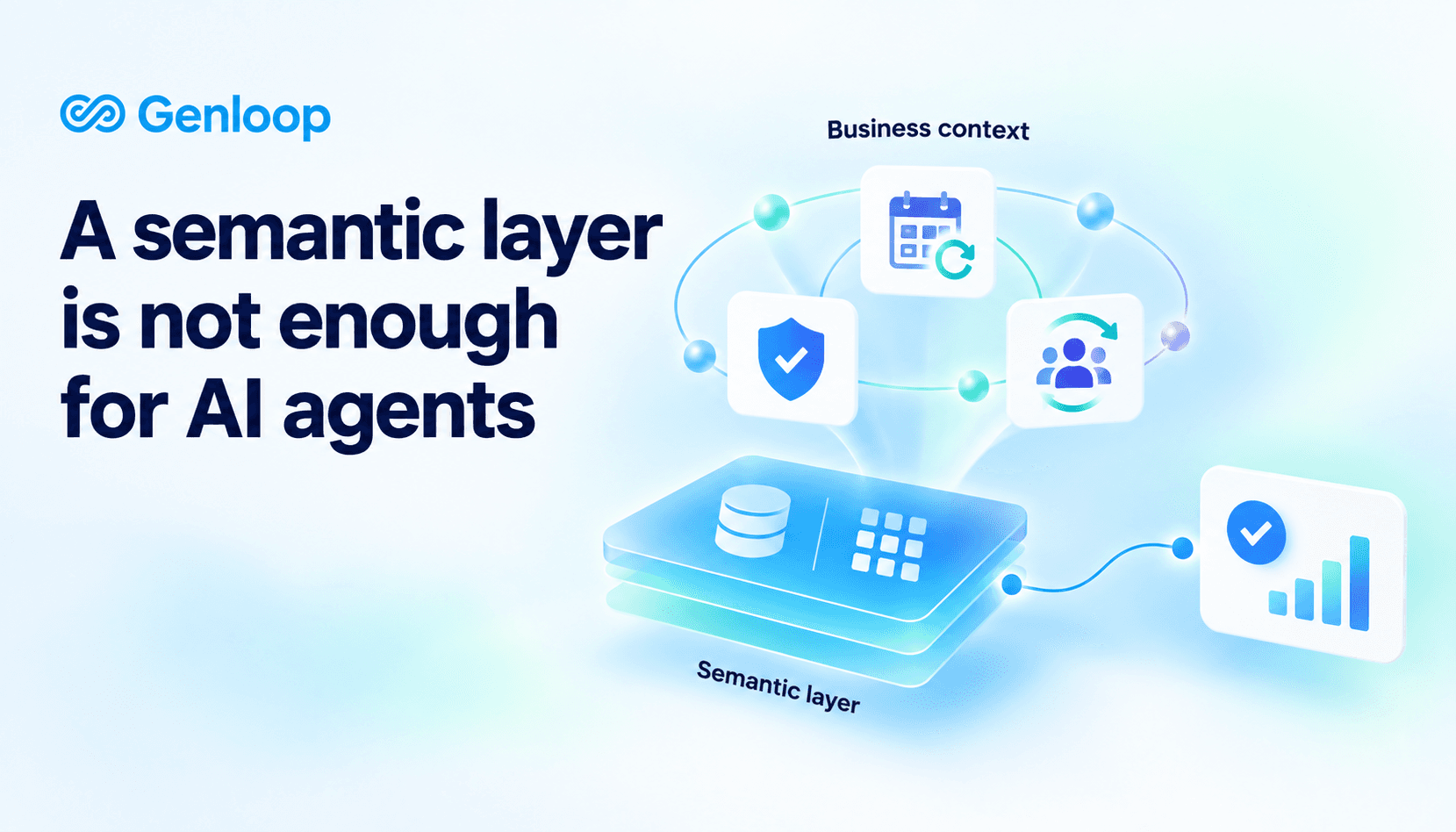
Search-driven analytics has reshaped how business teams interact with data, and ThoughtSpot has been central to this shift. By translating natural language into autocompleted queries against a governed semantic layer, it brought self-service analytics to organizations that previously depended on dashboards and analyst intermediaries. In environments with a centralized warehouse and a stable set of well-defined metrics, this model continues to work effectively.
The constraints emerge as analytics requirements grow more complex. ThoughtSpot's search experience is built on a heavy semantic layer that maps every business term, relationship, and metric definition before users can query effectively. Maintaining this layer requires sustained engineering investment, particularly as data sources expand and business definitions evolve across teams. Search also depends on questions that fit within what has been pre-modeled, which limits coverage of the long tail of investigative and ad-hoc analysis enterprise teams increasingly need.
A new category of platforms, often referred to as agentic analytics, addresses these constraints through a different architecture. Rather than relying on pre-modeled search completion, these systems perform multi-step reasoning across schemas, business context, and multiple sources, covering questions data teams cannot anticipate in advance. They explain how metrics changed, propose next steps, and operate across distributed environments without requiring upfront consolidation.
This guide examines five platforms enterprise teams most frequently evaluate as ThoughtSpot alternatives: Genloop, Hex, Databricks Genie, Sigma Computing, and Domo.
Where ThoughtSpot starts to break down
ThoughtSpot remains a capable search-driven BI platform. Three constraints commonly surface as enterprises scale.
Semantic modeling becomes a continuous engineering load. Definitions for revenue, churn, and customer acquisition cost evolve across teams and regions. Keeping the semantic layer aligned with these definitions requires ongoing coordination between data engineers, analysts, and business stakeholders.
Search struggles with the long tail. Search-style autocompletion handles questions that resemble what has been modeled. Investigative work, multi-step questions, and queries that span unmodeled territory typically return to the analyst queue.
Cross-source analysis requires preparation. Many enterprises operate across multiple warehouses and SaaS systems. ThoughtSpot performs best when data has already been consolidated and modeled within reach of its semantic layer.
What to look for in a ThoughtSpot Alternative
Five dimensions matter most when comparing platforms in this category.
Dimension | What it captures |
|---|---|
Natural language depth | Single lookups versus multi-step reasoning across the long tail |
Semantic modeling overhead | Engineering effort to make the platform productive |
Multi-source data federation | Single warehouse versus distributed enterprise data |
Decision intelligence | Returns values versus suggests actions, tracks outcomes, and learns from them |
Cost model | Predictable versus scaling with users or queries |
Best Alternatives
1. Genloop
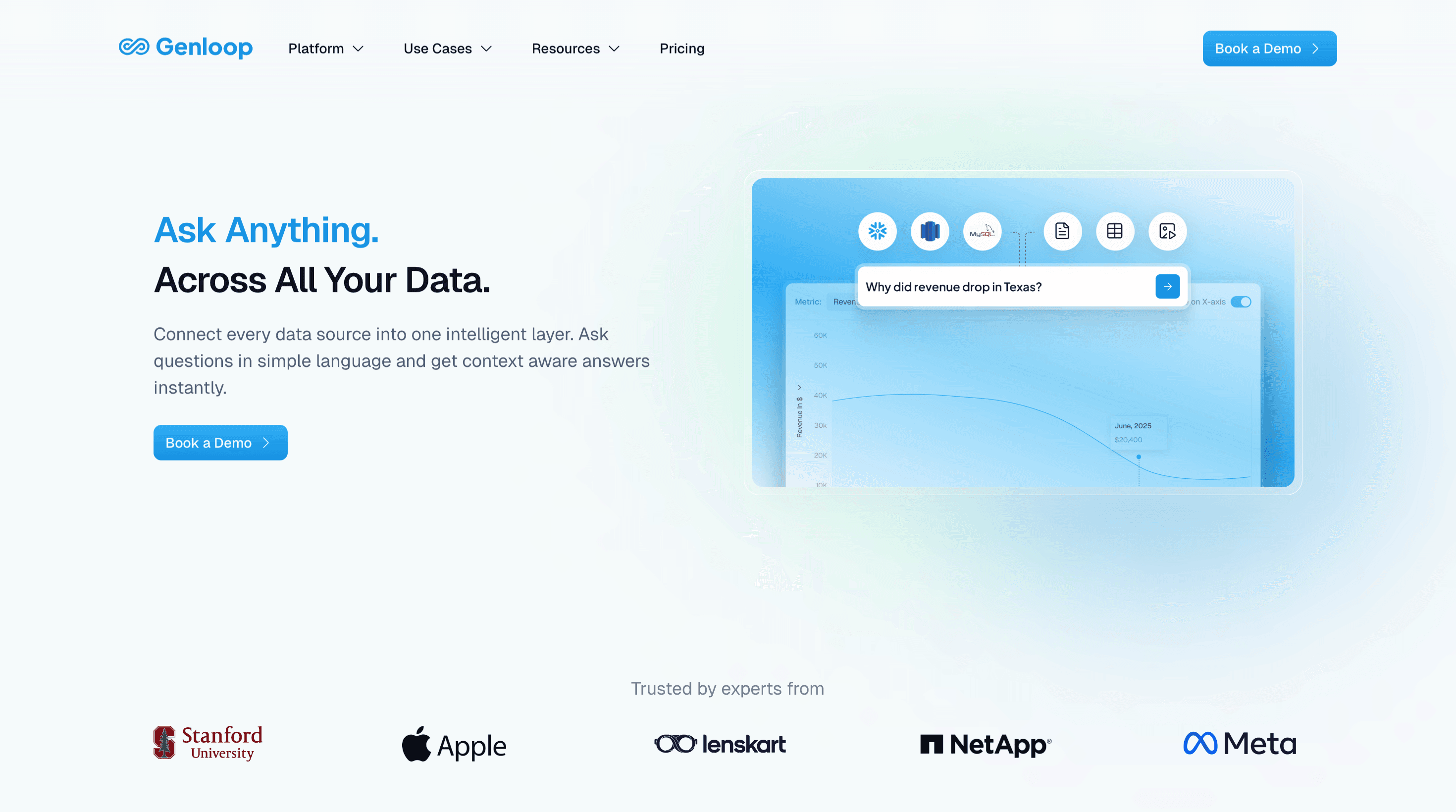
Best for: Enterprise data teams operating across distributed warehouses and SaaS systems that need conversational analytics with multi-step reasoning and decision support.
Genloop federates analytics across Snowflake, BigQuery, Databricks, Redshift, Postgres, and SaaS sources through a living context graph that maps company-specific terminology to governed business definitions. A finance analyst can ask "Why did customer acquisition cost spike in APAC last month?" and receive root-cause analysis with suggested investigative steps. The platform is ranked #1 on Spider 2, the benchmark for complex enterprise SQL and multi-step reasoning.
Dimension | How Genloop performs |
|---|---|
Natural language depth | Handles multi-step reasoning, ambiguous business language, and long-tail investigative questions through the living context graph |
Semantic modeling overhead | Context graph learns terminology and metric definitions continuously, reducing upfront modeling compared to traditional semantic layers |
Multi-source data federation | Connects directly to major warehouses and SaaS sources with cross-source analysis at query time, no consolidation required |
Decision intelligence | Suggests next-step actions, routes them for human review, executes approved actions, and tracks outcomes back into future suggestions |
Cost model | Usage-based pricing tied to query volume and connected sources, not per-user licensing |
2. Hex
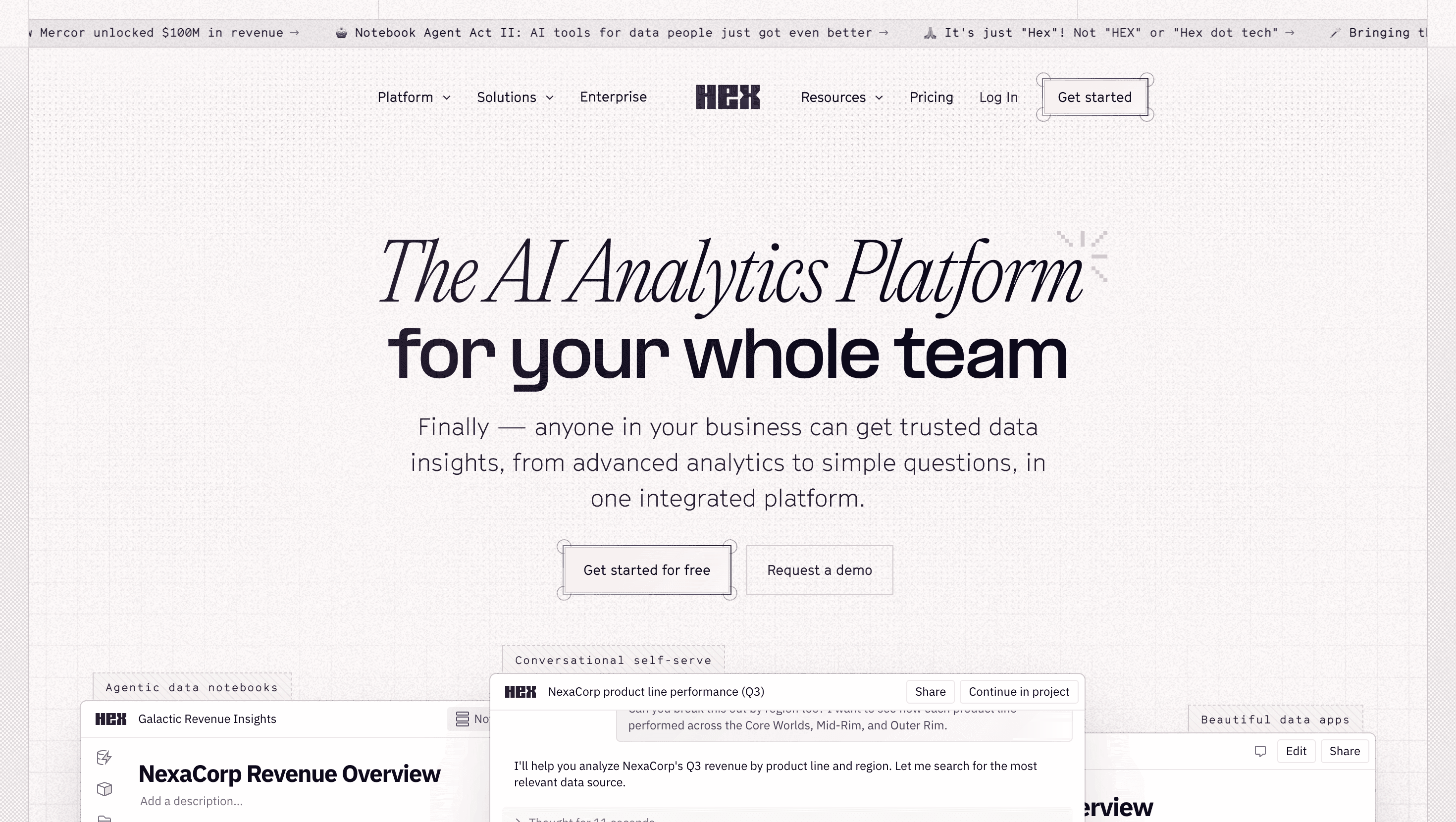
Best for: Analyst-led teams using SQL and Python for exploratory analysis, statistical workflows, and reproducible notebook collaboration.
Hex is a collaborative analytics workspace for analysts and data scientists. It combines SQL editors, Python notebooks, and visualization tools where teams perform exploratory analysis, build statistical models, and publish interactive reports. Hex emphasizes reproducibility through version control and Git integration. Business users typically consume published outputs and depend on analyst support for new investigations.
Dimension | How Hex performs |
|---|---|
Natural language depth | AI assist for code generation, with analysis written primarily in SQL and Python by analysts |
Semantic modeling overhead | Lighter than traditional BI, though cross-source logic and metric definitions are written per analysis in code |
Multi-source data federation | Native warehouse integrations, with cross-source joins implemented manually in code |
Decision intelligence | Returns analytical outputs; action suggestion and outcome tracking happen outside the platform |
Cost model | Per-user licensing for analyst seats plus compute for notebook execution |
3. Databricks Genie
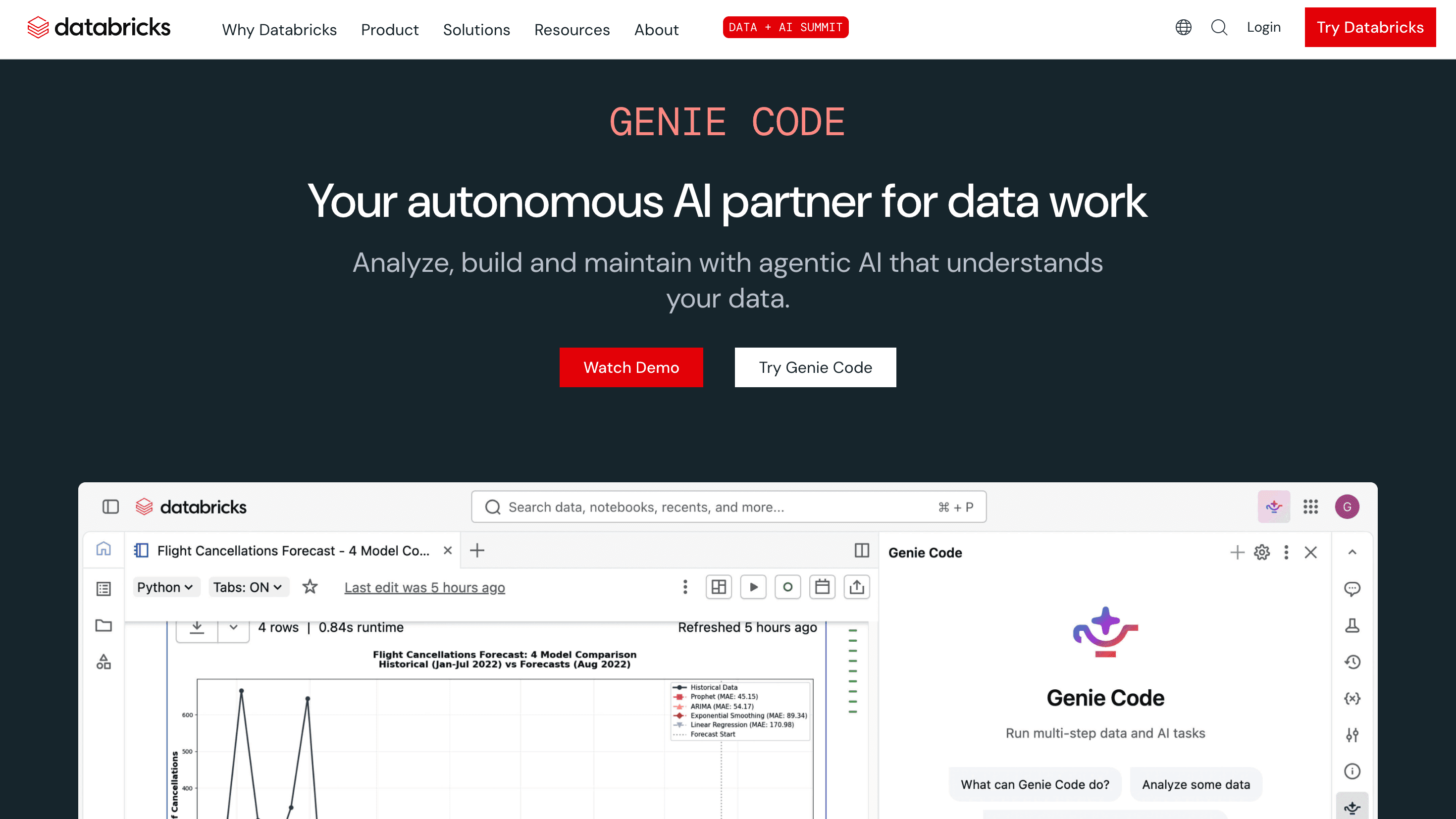
Best for: Organizations fully standardized on Databricks with all data already governed inside Unity Catalog.
Databricks Genie enables conversational analytics within Databricks by converting natural language to SQL executed through Unity Catalog. For teams that have consolidated data, machine learning, and pipelines inside Databricks, Genie provides governed natural language access without replication. Queries execute natively in the Databricks engine. The trade-off is platform lock-in and limited reasoning beyond single-query responses.
Dimension | How Databricks Genie performs |
|---|---|
Natural language depth | Primarily optimized for single-query responses within Unity Catalog; does not proactively suggest investigative paths or reason across conversation sessions |
Semantic modeling overhead | Tied to Unity Catalog quality and cannot map business terminology outside the catalog |
Multi-source data federation | Locked to Databricks Unity Catalog; external sources require replication |
Decision intelligence | Returns query results; reasoning and follow-up workflows are user-driven |
Cost model | Pricing tied to Databricks compute consumption, with query throttling at the workspace level |
4. Sigma Computing
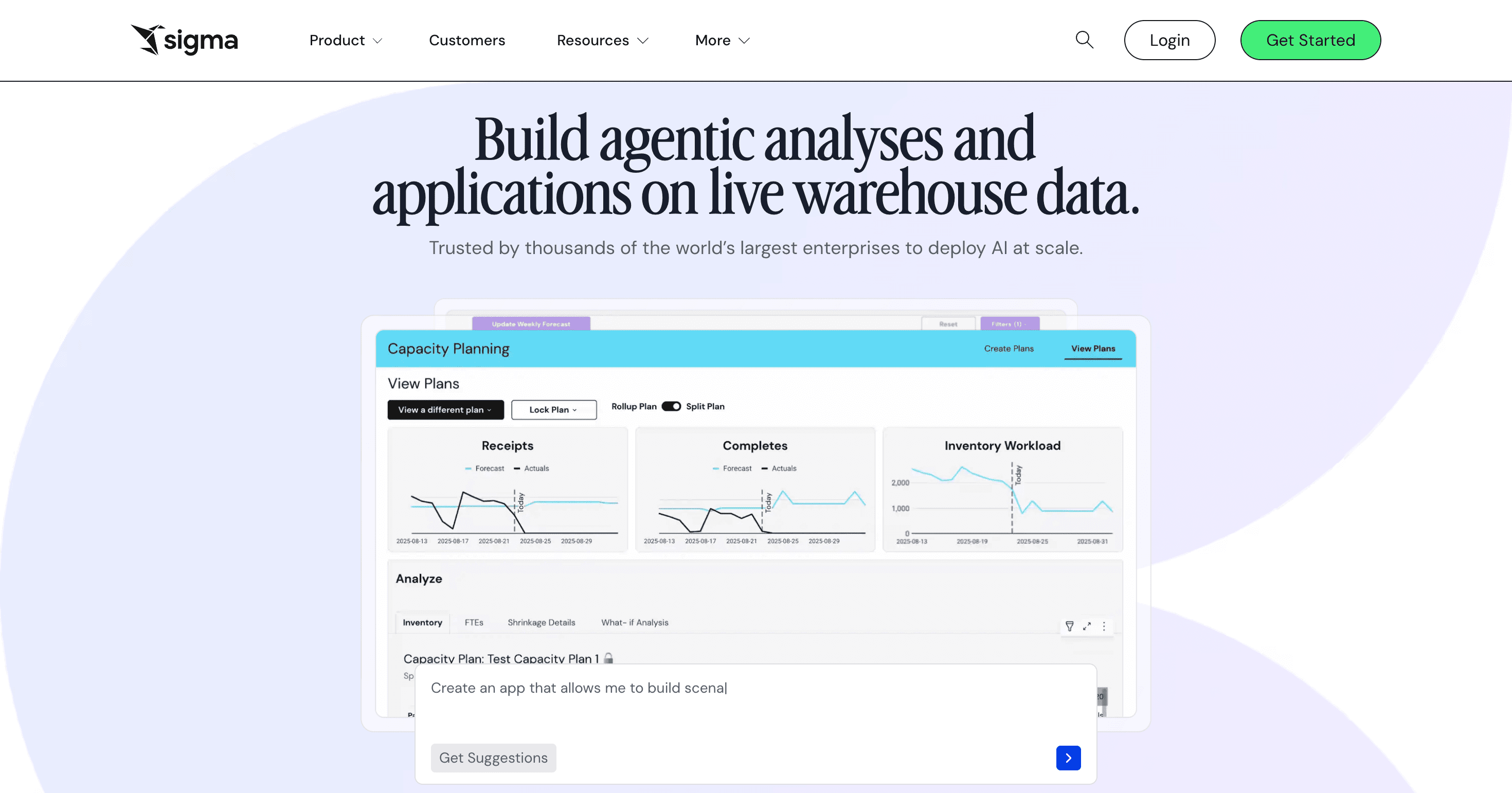
Best for: Business users familiar with spreadsheets who prefer Excel-like analysis directly on cloud warehouse data.
Sigma Computing brings spreadsheet-style analysis to cloud data warehouses. Instead of exporting datasets into Excel, users interact with warehouse data through familiar formulas, pivot tables, and workflows. Calculations execute directly in the warehouse, preserving governance and avoiding data extracts. The interface lowers the learning curve for business users transitioning from spreadsheet-based analytics.
Dimension | How Sigma Computing performs |
|---|---|
Natural language depth | Limited; primary interface is spreadsheet formulas and pivot tables rather than conversational queries |
Semantic modeling overhead | Lighter than traditional BI; analysis is built on warehouse schema and formula logic per workbook |
Multi-source data federation | Connects to multiple cloud warehouses, though analysis is typically centered on a single warehouse context per workbook |
Decision intelligence | Surfaces values through formulas and pivots; does not suggest actions or track outcomes |
Cost model | Per-user licensing plus underlying warehouse compute |
5. Domo
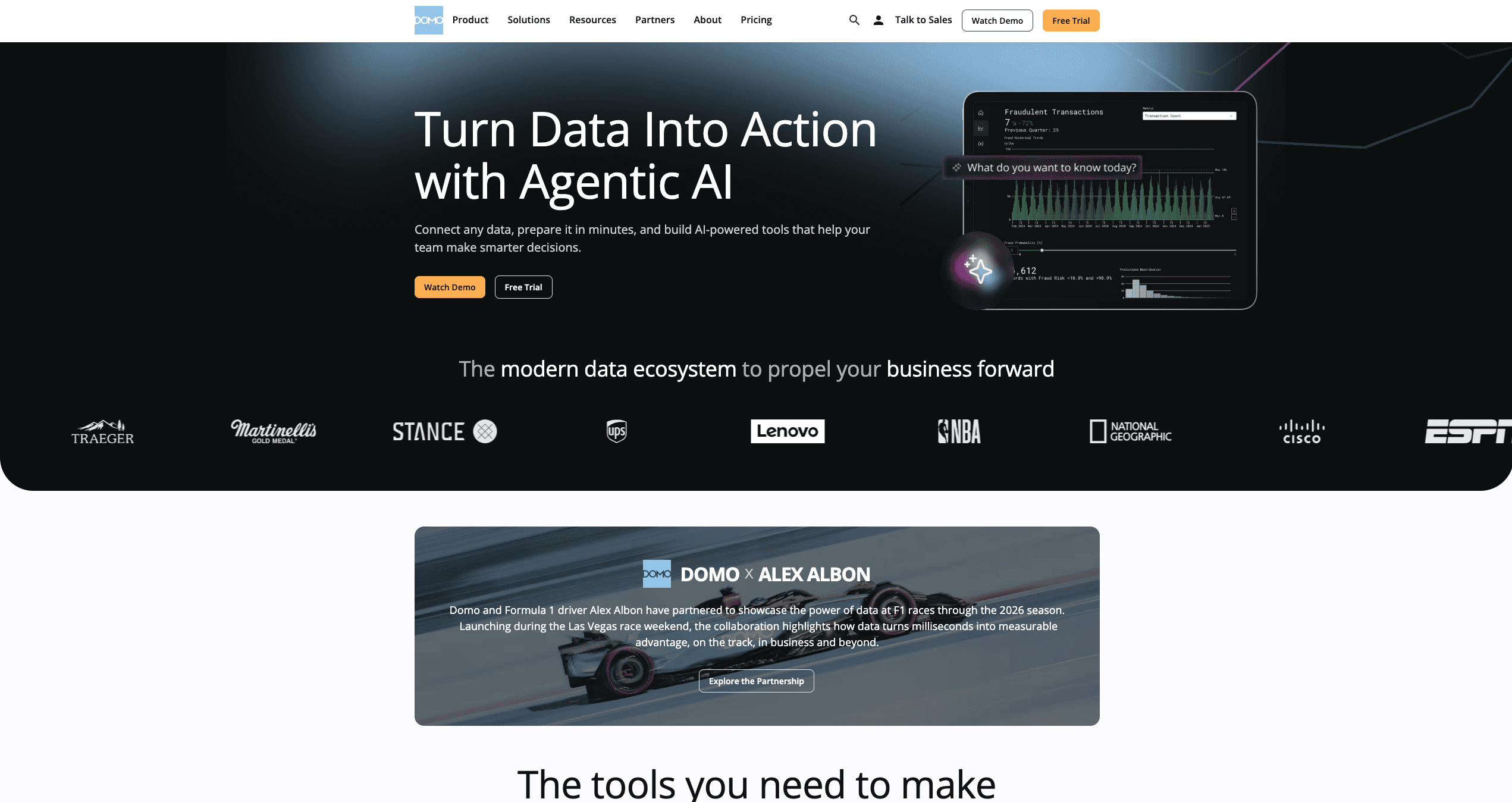
Best for: Teams focused on operational dashboards, KPI tracking, and rapid deployment through pre-built connectors.
Domo is an integrated analytics platform that combines data integration, visualization, and workflow automation. It offers hundreds of pre-built connectors and supports real-time dashboards for operational monitoring across sales, marketing, and finance. The platform is strongest for standardized reporting and rapid setup rather than ad-hoc investigation or conversational analysis.
Dimension | How Domo performs |
|---|---|
Natural language depth | Basic search across pre-built dashboards and datasets, not conversational reasoning |
Semantic modeling overhead | Modeling happens through ETL into Domo's backend rather than an upfront semantic layer |
Multi-source data federation | Hundreds of pre-built connectors with data replicated into Domo storage for visualization |
Decision intelligence | Strong alerting and KPI tracking; no agentic reasoning or action tracking |
Cost model | Per-user licensing scaling with connector count, data volume, and refresh frequency |
How to choose the right ThoughtSpot Alternative
The right choice depends less on individual features and more on how data is distributed across your organization and how teams need to interact with it.
Tool | Most suitable when | Less suitable when |
|---|---|---|
Genloop | Data spans warehouses and SaaS sources, and teams need conversational analytics, multi-step reasoning, and decision support | Data sits entirely within one ecosystem and requirements stop at single-query lookups |
Hex | Workflows are analyst-led with SQL, Python, and notebook-based investigation | Self-service is required for non-technical business users without analyst dependency |
Databricks Genie | The full data stack runs on Databricks and Unity Catalog | Data spans multiple warehouses or platforms |
Sigma Computing | Business users prefer spreadsheet-style exploration with Excel-like formulas | Conversational analysis or multi-step investigation is the priority |
Domo | Operational dashboards, alerting, and KPI tracking are the primary use case | Ad-hoc questions, investigation, or reasoning-driven analysis dominate |
Most evaluations begin with interface preference. The more durable approach is to align the platform with how data is structured, how decisions get made, and where analytics needs to operate inside the broader business workflow.
FAQs
What should teams evaluate when choosing ThoughtSpot alternatives?
Key considerations include natural language accuracy, semantic modeling effort, cross-source query capability, governance controls, and whether the platform explains why metrics changed or simply returns values. Pricing model also matters as analytical access expands across business teams.
What features matter most when comparing analytics platforms?
The factors that consistently shape decisions are data integration breadth, natural language depth, modeling overhead, decision intelligence, and cost predictability. Buyers also evaluate whether the platform supports static dashboards, ad-hoc investigation, or both.
How do traditional BI tools differ from agentic analytics platforms?
Traditional BI tools are organized around dashboards and predefined reports, where users consume what has already been built. Agentic analytics platforms perform multi-step reasoning, explain trends, and suggest next actions, shifting analytics from passive reporting toward active decision support.
Which ThoughtSpot alternatives are best for non-technical users?
Sigma Computing and tools like Power BI work well for business users comfortable with spreadsheet-style or visual interfaces. Agentic analytics platforms further reduce the barrier by accepting natural language and providing reasoning, with Genloop extending this through multi-source coverage and outcome-aware suggestions.
What is the difference between dashboard analytics and agentic analytics?
Dashboard analytics monitors predefined metrics through reports built in advance. Agentic analytics drives the analysis workflow itself, investigating why metrics changed, performing multi-step analysis, suggesting actions, and incorporating outcomes into future reasoning.