Enterprises have spent years consolidating data in Databricks. They have built pipelines, organized tables, established permissions, and governed access through Unity Catalog.
The next challenge is making that foundation usable by enterprise AI.
Connecting a model to a Databricks SQL warehouse is relatively easy. The harder problem is helping it understand which data matters, what each field means, which definitions are approved, and what every user is allowed to access.
Without that context, an AI application can generate valid SQL and still produce the wrong answer. It might use the wrong definition of revenue, join incompatible tables, overlook a trusted source, or expose data the user should not see.
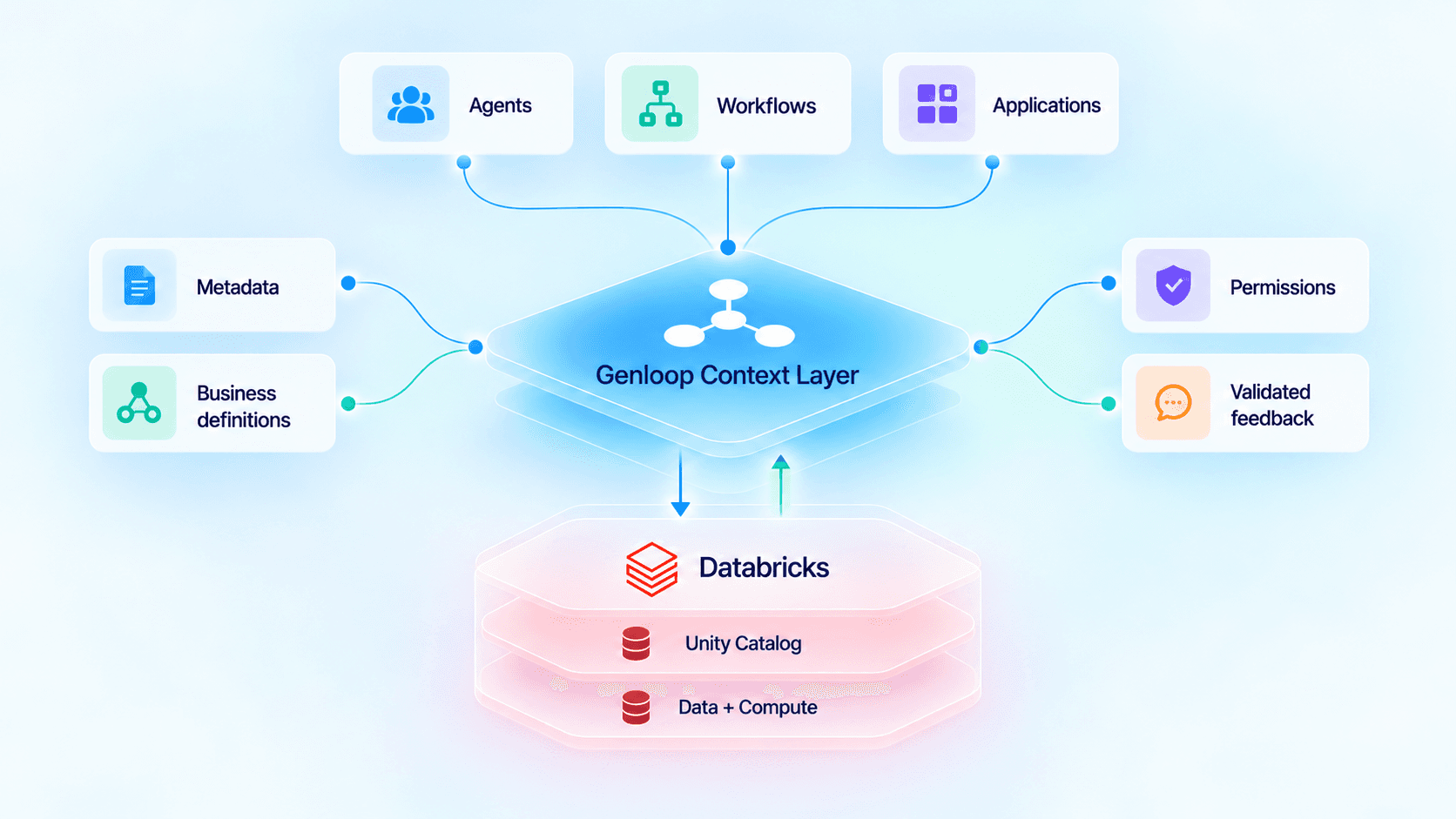
Genloop adds a shared context layer that allows agents, workflows, and applications to use governed Databricks data without moving it into another system.
Databricks remains the foundation for data, compute, and governance. Genloop helps enterprise AI understand and use it.
Why direct access is not enough
A basic Databricks AI integration follows a simple workflow. A user makes a request, a model generates SQL, Databricks executes it, and the result is returned.
That can work in a demonstration. It becomes less reliable across a real enterprise.
The same business concept often has several technical representations. Revenue might mean booked revenue, recognized revenue, or recurring revenue. Finance and Sales may also use different versions of the same metric.
Schemas do not resolve these differences. An AI system also needs internal definitions, operating rules, previous decisions, and expert feedback.
This is the missing layer between governed data and reliable AI applications.
How Genloop works with Databricks
Genloop reads available metadata, identifies relevant data assets, and connects them with company specific definitions, processes, permissions, and validated knowledge. This context can then be reused across applications.
Discover the available data
Genloop uses Databricks metadata to understand catalogs, schemas, tables, columns, views, and relationships. An agent investigating customer churn can then locate relevant subscription, support, product usage, and account data without being given every table name manually.
Add business context
Technical metadata explains how data is stored. It does not fully explain what the data means.
Genloop connects Databricks assets with concepts such as active customer, gross margin, or inventory risk. It incorporates metric definitions, documentation, analyst knowledge, and reviewed usage patterns.
This becomes the context layer giving different AI applications a consistent interpretation of the business.
Execute against the governed source
When an application needs data, Genloop determines the required context and executes the relevant query against Databricks. The data remains in the existing environment, while Databricks continues to provide compute and access controls.
The goal is to use the governed source directly while applying the context required to form the right query.
Learn from validated feedback
Enterprise context changes. Genloop captures validated feedback so a correction made by an analyst can improve every approved application that relies on the same concept.
The architecture
A typical Genloop and Databricks workflow looks like this:
Genloop reads the relevant metadata from Unity Catalog.
It connects technical assets with business definitions and organizational knowledge.
An agent, workflow, or application submits a request.
Genloop identifies the relevant context and required data.
The query runs on Databricks compute under the existing access controls.
Genloop returns the result with its reasoning and supporting evidence.
Reviewed corrections improve the shared context for future requests.
Databricks owns the data, compute, catalog, and core governance controls. Genloop provides the context that helps AI systems interpret and use that data correctly.
One integration, multiple applications
The value of this architecture extends beyond a natural language interface.
A support agent can combine account data, product usage, previous tickets, and escalation rules. A finance workflow can investigate a margin change using approved definitions. An operations application can identify inventory risks and apply replenishment rules.
Employees can also ask questions in plain English and receive answers grounded in Databricks data. Conversational analytics is one interface supported by the architecture, not the limit of what the integration can do.
Why shared context matters
Without a shared context layer, every AI project rebuilds the same foundations.
One team maps business terms to tables. Another recreates permissions. A third writes new instructions for handling ambiguity. Each application develops its own interpretation of the company.
This creates duplicated work, inconsistent answers, and fragmented governance. Genloop instead makes data relationships, business definitions, permissions, and validated feedback reusable across applications.
The applications remain separate. The enterprise understanding beneath them is shared.
Conclusion
The enterprise AI challenge is not simply giving a model access to more data. It is ensuring that the model understands what the data means and how it should be used.
Databricks provides the data foundation. Genloop connects that foundation with the business context, processes, and decisions required by enterprise AI.
Together, they allow organizations to build AI applications that use current data, respect existing controls, and reuse institutional knowledge.
The result is not merely a better way to query a lakehouse. It is a foundation for building enterprise AI on top of it.
Frequently Asked Questions
What is a Databricks AI integration?
A Databricks AI integration connects agents, workflows, or applications to data and compute in Databricks. A complete integration also provides the business context, permissions, and execution controls needed to use that data correctly.
Does Genloop replace Databricks?
No. Databricks remains the platform for data, compute and cataloging. Genloop adds the context and execution layer that helps enterprise AI discover, interpret, and use that data.
Does Genloop copy data out of Databricks?
Genloop can execute against the governed data source rather than creating another warehouse.
How does Genloop work with Unity Catalog?
Genloop uses Unity Catalog metadata to understand available data assets and their technical structure. It connects this metadata with business definitions and other validated organizational knowledge.
Is Genloop only for conversational analytics?
No. Natural language analysis is one possible interface. The same context can support enterprise agents, automated workflows, internal applications, and operational systems.
Why not connect every AI application directly to Databricks?
A direct connection provides data access but not business understanding. If every application builds its own definitions, instructions, and mappings, the organization creates duplicated work and inconsistent interpretations. Genloop provides a shared foundation that can be reused across applications.