Connecting an AI system to Postgres is easy. Helping it discover what the data means, preserve governance and turn that knowledge into reusable data apps is the real integration challenge.
PostgreSQL often contains the data closest to how a business actually operates: customers and accounts, orders and inventory, product events, support workflows, approvals, entitlements and application state. It may be the system behind several internal tools, each with its own schema and naming conventions.
That makes Postgres valuable to people and AI agents. It also makes it difficult to navigate. A person may know that a delayed order is one that has missed its service-level window and has no valid exception code. The database may express the same idea through four tables, an enum, a view and logic embedded in an application service. The data is available, but its meaning is scattered.
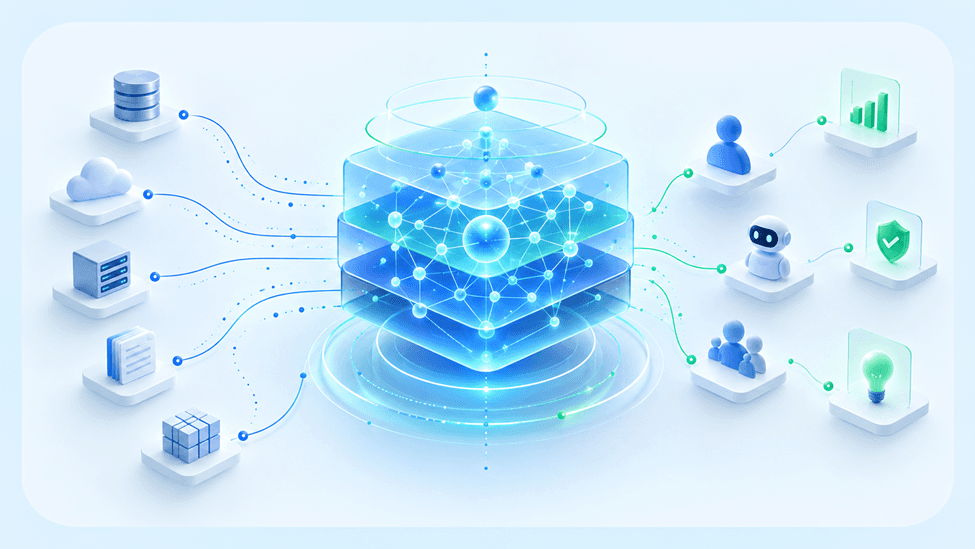
A basic connector can read tables. A useful PostgreSQL AI integration must do more: discover the database structure, add business context, respect the access model, expose provenance and preserve validated learning so the next person or agent does not start from zero.
SHORT ANSWER A PostgreSQL AI integration is a governed context layer between Postgres and the people, agents or applications that need to use it. It discovers metadata, maps technical objects to business concepts, supports traceable query execution and improves through reviewed feedback.
Key takeaways
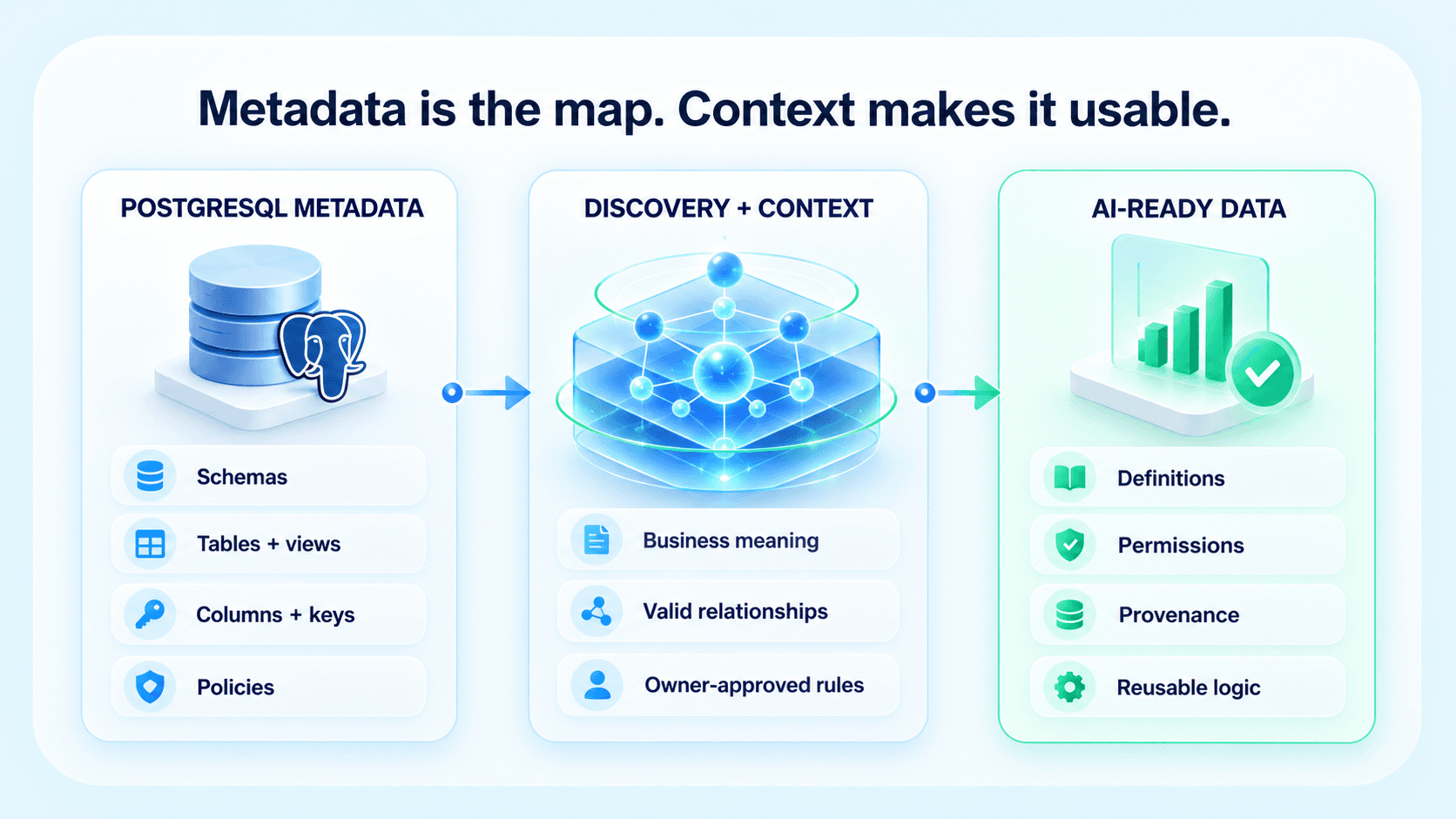
PostgreSQL metadata tells an AI system what exists; business context tells it what those objects mean and when they should be used.
AI-ready data is not simply clean data. It also needs definitions, relationships, permissions, ownership and provenance that machines can use.
A governed self-learning loop should propose improvements, route them for review, version approved changes and reuse them across future work.
Data apps make discovery reusable by packaging live records, context and proven workflows for a specific operational job.
Deterministic reasoning depends on constrained execution and versioned context, not on assuming that a language model will always behave identically.
Why is PostgreSQL data discovery harder than connecting?
PostgreSQL exposes rich technical metadata. The information_schema contains portable views describing objects in the current database, while PostgreSQL's system catalogs store implementation-specific metadata about tables, columns, constraints, roles, policies and other database objects. Schemas provide another layer of organization and access control.
This is an excellent foundation for automated database schema discovery. It can reveal that a relation exists, which columns it contains, its data types, declared keys, views, indexes and permissions. It cannot, by itself, answer questions such as:
Which table is the authoritative customer record?
Does status = 'active' mean billable, enabled or simply not deleted?
Which timestamp should define when an order was completed?
Which join path is valid for the current use case?
Who owns the definition, and when was it last approved?
Operational schemas are usually designed for application correctness and performance, not for a new user trying to discover the business. Names reflect code boundaries. Important logic may live in views, functions, comments, services, documentation or the habits of experienced engineers. Foreign keys can be absent, polymorphic or insufficient to explain the intended relationship.
This is why natural language to SQL, often shortened to NL2SQL, is not enough. Generating valid SQL is useful. Choosing the right objects, filters and relationships requires context that SQL syntax alone does not provide.
What should a discovery-first Postgres integration learn?
A strong integration builds understanding in layers. Each layer reduces a different kind of ambiguity.
Structural context. Databases, schemas, tables, views, materialized views, columns, data types, constraints, relationships, comments and functions. This is the machine-readable map of what exists.
Business context. Entity definitions, approved terminology, lifecycle states, calculations, business rules and valid join paths. This connects database objects to the concepts people use.
Operational context. Which sources are authoritative, which paths have produced validated results, how fresh the data is, and where an answer came from. This is where data provenance and repeatability become practical.
Identity and access context. Who is asking, which database role or workspace role applies, and which objects or rows are in scope. The same question may require a different answer or level of detail for different users.
Together, these layers make data AI-ready. Clean types and consistent keys still matter, but they are only the beginning. AI-ready PostgreSQL data is data whose meaning, relationships, limits and permissions are explicit enough for a machine to use without inventing the missing rules.
From a data catalog to a living context graph
A catalog, semantic layer and context graph solve related but different problems. Treating them as interchangeable creates unrealistic expectations.
Layer | Primary question | What it contributes |
|---|---|---|
Data catalog | What exists? | Inventory, ownership, documentation, classification and searchable metadata. |
Semantic layer | What does it mean? | Business definitions, metrics, dimensions, rules and approved query logic. |
Living context graph | How is it connected and used? | Relationships among data, processes, decisions and users, updated as approved knowledge accumulates. |
An ontology defines categories, properties and rules: for example, that an order belongs to a customer and may be fulfilled by one or more shipments. A graph represents concrete relationships among actual concepts, database objects and approved knowledge. In practice, an ontology-backed context graph can give AI systems a stable vocabulary without forcing every relationship into a rigid model on day one.
The word living matters only if updates are controlled. A context graph should detect changes, learn from usage and become more useful over time, while keeping approved knowledge distinct from an unverified suggestion.
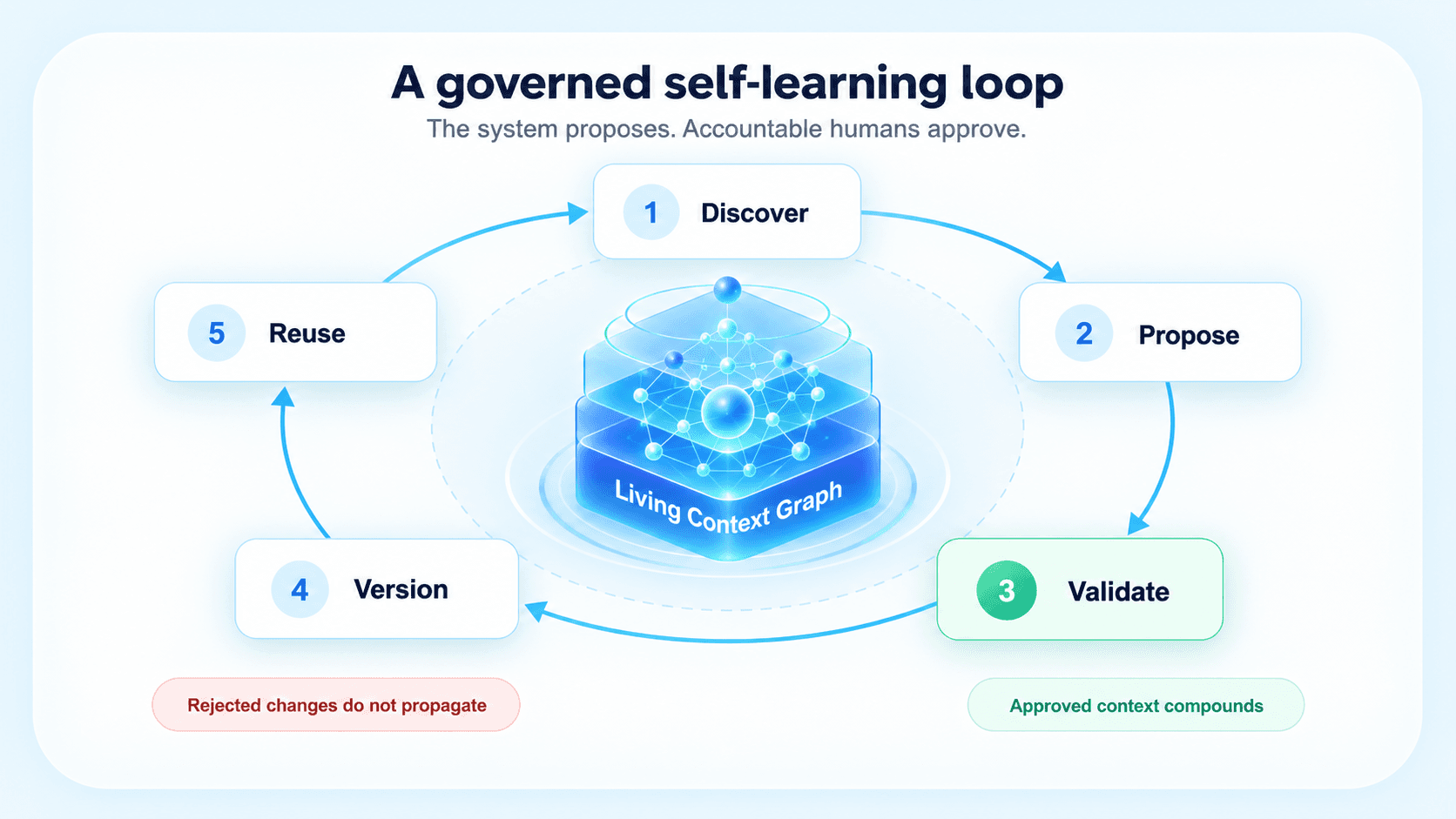
How does a governed self-learning loop work?
Self-learning should not mean that an AI system silently rewrites business truth. A production-grade loop is closer to a reviewable knowledge workflow:
****Read the PostgreSQL metadata available to the connector and assemble an initial map of objects, relationships and access boundaries.
****Infer candidate descriptions, entity mappings or join paths from metadata, documentation and observed usage. Mark them as inferred, not approved.
****Apply the current approved context to a discovery task, a query or a data app, while exposing the evidence and execution path.
****Let a data owner or subject matter expert approve, correct or reject a definition, mapping or result.
Version and reuse. Carry the approved change forward so future users and agents work from the same trusted context, with an audit trail of what changed.
This is a self-learning loop because each reviewed interaction can improve the shared context or a reusable skill. It is not the same as fine-tuning a model on every user action. In many enterprise settings, updating a versioned knowledge layer is more transparent, reversible and governable than continuously changing model weights.
Where deterministic reasoning actually fits
Deterministic reasoning should be treated as an engineering goal for reproducibility, not as a claim that a language model is inherently deterministic. Stable business definitions, constrained join paths, validated SQL, explicit permissions, context versioning and visible provenance can make the execution path repeatable under the same inputs.
If the question is ambiguous, the system should surface the ambiguity, compare interpretations or ask for clarification. A confidently generated query is not the same as a correct one. Trust comes from showing how an answer was produced and which approved context shaped it.
How do data apps turn discovery into reusable work?
Data discovery is most valuable when it becomes reusable. Once an integration understands the relevant Postgres entities, relationships and rules, a team can package that understanding into a data app: a focused interface for a recurring job, backed by live governed data.
A data app is not simply another dashboard. It can combine search, record-level detail, relationship exploration, explanations, evidence and a defined workflow. Examples include:
A customer operations explorer that brings together accounts, entitlements, onboarding state and support activity.
A fulfilment exception workbench that finds delayed orders, explains the blocking condition and groups them by the team that can resolve it.
A compliance review queue that applies approved rules, shows the source records behind each flag and limits visibility by role.
A product adoption explorer that connects organizations, users, feature events and plan entitlements without requiring people to learn the underlying schema.
The app is useful because it reuses context. The definition of an active customer, the approved relationship between account and entitlement, and the access rules should not be recreated inside every interface. When an approved definition changes, the applications that depend on it can inherit that update through the shared layer.
For operational use cases, write-back should be a separate, explicit decision. Discovery and read-only investigation can often be deployed broadly. Any action that changes PostgreSQL records should have its own authorization, validation, idempotency and audit controls.
Why shared context matters in multiplayer AI
Enterprise AI is becoming multiplayer: several people, copilots, agents and applications may work on the same business problem. Without shared context, each one interprets the Postgres schema independently. One agent may treat an account as a billing entity, another as a product workspace, and a third as a CRM company record.
A governed context layer gives these participants the same vocabulary, source mappings and validated knowledge while still respecting their identities and permissions. Corrections made by an expert can improve the experience for the wider system instead of remaining trapped in one conversation. This is how organizational learning compounds without collapsing every user's needs into one generic prompt.
Governance, provenance and sovereign deployment
PostgreSQL already provides a strong foundation for access control through roles, object privileges and row-level security policies. An AI integration should work within a deliberately scoped access model rather than connecting with an all-powerful database account. What the integration can discover and query should be constrained by the role it uses and the policies in force.
A production design should also record the generated SQL or retrieval path, the source objects used, the version of the context applied, the user or agent identity and any validation outcome. That provenance makes an answer inspectable and helps teams distinguish a data error from a definition error or an inference error.
For organizations evaluating sovereign AI, data location is only one part of the architecture. Review where prompts, query results, embeddings, logs and learned context are processed and stored; which model providers are involved; and whether the system can operate in a VPC, on premises or in an air-gapped environment. A no-copy design is useful, but it does not replace a complete data-flow review.
Where Genloop fits
Genloop supports PostgreSQL alongside other databases, warehouses, business applications and documents. It reads from existing infrastructure and builds a Living Context Graph designed to connect schema structure with business meaning, processes, decisions and user context.
The discovery-first value is that PostgreSQL does not remain a collection of unfamiliar tables behind a connector. Definitions, business logic, validated answers and investigation patterns accumulate in the Context Hub. Genloop's Review Center lets data experts approve or correct proposed learning before the accepted version is carried forward.
That shared context can then support more than a chat interface. Genloop has Data Apps, scheduled reports and presentations, integrations with AI tools, and embedded experiences delivered through APIs or iframes. The same context can therefore be reused across people, agents and applications instead of being rebuilt in each surface.
Genloop creates no enterprise data copies and offers workspace controls, SOC 2 Type II and ISO 27001 compliance, plus on-premises, VPC and air-gapped deployment options.
How to evaluate a PostgreSQL AI integration
A strong evaluation starts with a real discovery problem, not a polished demo question. Give the platform an unfamiliar but representative part of your Postgres environment and ask it to show what it knows, what it inferred and what still requires a human decision.
Metadata coverage: Does it discover schemas, tables, views, relationships, comments, functions and policy-relevant metadata that matter to your use case?
Meaning: Can it represent entity definitions, lifecycle rules, approved terminology and valid relationship paths?
Evidence: Can users inspect the source objects, query path and context behind an answer or app?
Learning governance: Are inferred changes separated from approved knowledge, with review, version history and rollback?
Access control: Can you use least-privileged connections and preserve the intended PostgreSQL and workspace permissions?
Schema change handling: Does the system detect drift and show which definitions or apps may be affected?
Application reuse: Can discovered context power data apps, APIs, embedded experiences or other agents without rebuilding the logic?
Ambiguity behavior: Does it clarify uncertain requests and expose alternatives instead of selecting a plausible interpretation silently?
Deployment and retention: Can you explain the full data flow, including model calls, logs, caches and learned context?
Postgres-specific testing: Can it handle your schemas, JSONB fields, views, naming conventions and real access policies on a representative workload?
The real integration is the context that compounds
Connecting AI to PostgreSQL is a solved plumbing problem. The more valuable question is whether the integration can turn a complex operational database into a discoverable, governed and reusable source of knowledge.
That requires more than a connector and more than a model that can write SQL. It requires a context layer that understands the difference between a table and a business entity, a query and an approved rule, an inference and a verified fact. It also requires a learning loop that improves the shared system without taking control away from data owners.
When those pieces work together, PostgreSQL becomes more than a backend that specialists know how to query. It becomes an AI-ready foundation for discovery, data apps and shared organizational intelligence - while the source data remains governed where it already lives.
Frequently asked questions
What is a PostgreSQL AI integration?
It is a connection and context layer that lets AI systems discover, interpret and use PostgreSQL data. Genloop integration covers metadata discovery, business definitions, permissions, provenance, query execution and a governed way to improve context over time.
How does AI data discovery work in PostgreSQL?
Genloop reads metadata available through PostgreSQL, such as schemas, tables, columns, constraints, views and policies. It then connects that technical map to business terminology, documentation and reviewed usage so users can find relevant data without already knowing the schema.
What makes PostgreSQL data AI-ready?
AI-ready data has more than clean rows. It includes machine-usable definitions, relationships, ownership, access rules, freshness information and provenance. These signals help an AI system choose the correct source and explain how it reached a result.
Can AI safely discover undocumented joins?
AI can propose candidate relationships from keys, names, profiles, query history or documentation, but a proposal should not automatically become trusted business logic. High-impact joins need validation, versioning and evidence before they are reused broadly.
How does a self-learning loop stay governed?
Genloop separates inference from approval. The system proposes a definition or mapping, a qualified reviewer approves, edits or rejects it, and only the accepted version becomes reusable context. The change should retain its owner, timestamp, evidence and version history.
Can a PostgreSQL AI integration power data apps?
Yes. Once Genloop understands relevant entities and rules, that context can support focused applications such as customer explorers, exception workbenches or compliance review queues. Actions that modify source records should use separate permissions and validation controls.