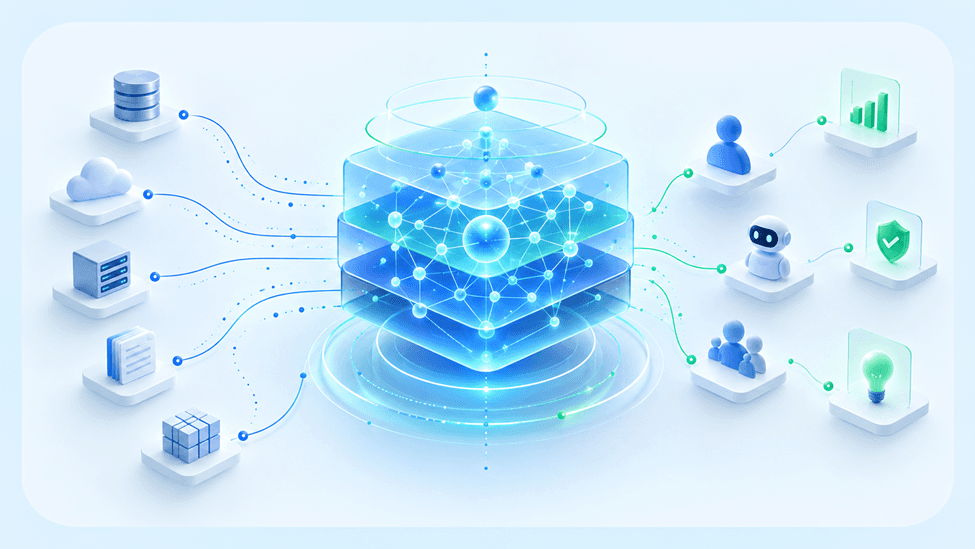
Your data team built a RAG system. It connects the warehouse, CRM, product analytics platform, and a growing library of internal documents. The LLM can retrieve context, generate SQL, and explain its answer.
Then the CFO asks a simple question: “What was revenue last quarter?”
Finance means recognized revenue. Sales means booked contract value. Product means monthly recurring revenue. All three definitions are present in the retrieved context. The model produces a confident answer, but it has no authoritative way to decide which definition applies.
This is not primarily a model problem. It is a meaning problem.
A living semantic layer turns fragmented enterprise data into AI-ready data by giving every authorized person and AI agent the same governed business context: definitions, relationships, permissions, lineage, and the history behind important decisions. Unlike a static glossary, it evolves as the business changes while keeping every approved change versioned and auditable.
Genloop’s term for this broader implementation is the Living Context Graph: context that spans data, processes, decisions, and users rather than a manually authored metric model alone.
Key takeaways
RAG retrieves information; it does not resolve conflicting business meaning on its own.
Data becomes AI-ready only when business definitions, relationships, ownership, lineage, and access policies are machine-readable.
A living semantic layer is operational: it shapes query generation, metric logic, permissions, validation, and audit trails.
Business ontologies and knowledge graphs can represent meaning; the semantic layer makes that meaning usable during AI execution.
RAG retrieves information—but not business meaning
Retrieval-augmented generation improves an LLM by supplying relevant information at query time. It can find a metric definition in a wiki, a field in a schema, or a rule in a policy document. What it cannot do by itself is decide which source is authoritative when those sources disagree.
That gap creates semantic errors that look like reasoning errors.
Imagine that “active customer” is defined three ways:
Finance: a customer with recognized revenue in the past 90 days
Product: an account with at least one weekly active user
Customer success: an account with an open contract and no churn notice
All three definitions may be valid in context. The failure happens when an AI system silently chooses one without knowing who is asking, why they are asking, which policy is current, or what data they are allowed to see.
A vector index can make the three definitions retrievable. It cannot turn them into governed business truth. For that, the enterprise needs an operational layer that connects language to approved logic and applies that logic consistently.
Illustrative flow: governed context constrains resolution and exposes ambiguity; it does not make an LLM infallible.
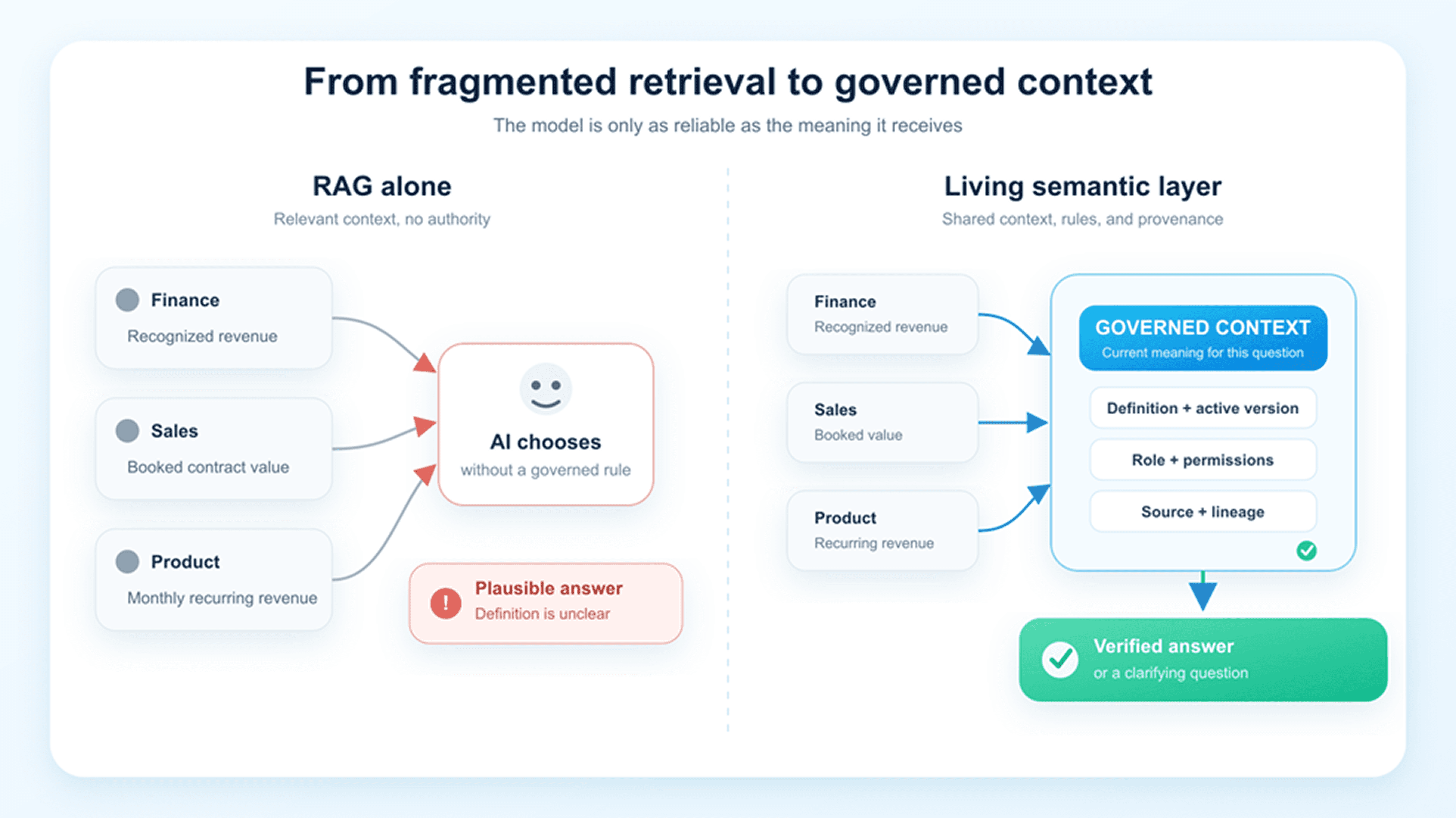
Illustrative flow: governed context constrains resolution and exposes ambiguity; it does not make an LLM infallible.
What makes a semantic layer “living”?
A traditional semantic layer maps business terms to fields, joins, and calculations. A living semantic layer does that and continues to adapt as definitions, systems, users, and business processes change.
It is “living” when five properties work together:
Machine-readable meaning. Metrics, entities, relationships, policies, and exceptions are represented as data that analytics tools and AI agents can query.
Context awareness. The system considers the question, the user’s role, the workflow, the active definition, and the relevant data state before choosing a path.
Versioned governance. Every material definition has an owner, approval state, effective date, and history.
Operational enforcement. Approved semantics shape query generation, joins, metric calculation, access control, and answer validation—not just documentation.
Continuous refinement. Queries, corrections, and outcomes reveal gaps in the model. Proposed improvements enter a controlled review workflow and, once approved, become available to future work.
That makes the layer more than a catalog. A modern catalog can be valuable for discovery, lineage, and governance, but a catalog alone is not enough if business meaning remains passive metadata that every consuming system must reinterpret.
Static metadata | Living semantic layer |
|---|---|
Describes tables and fields | Connects data to business concepts, rules, owners, and decisions |
Updated manually and periodically | Detects change continuously and routes proposals for validation |
Read by people | Queried and enforced by people, applications, and AI agents |
Records the latest definition | Versions definitions with effective dates and approval history |
Leaves each tool to interpret meaning | Supplies shared, governed context across tools |
Documents lineage | Uses lineage to validate answers and assess downstream impact |
How a living context graph makes enterprise data AI-ready
Clean, accessible data is not automatically AI-ready data.
An AI system may be able to reach a table and still misunderstand it. Column names rarely capture fiscal calendars, regional exceptions, customer hierarchies, approved join paths, exclusions, or the difference between a provisional and audited number.
Data becomes AI-ready when an agent can determine:
what an entity or metric means;
which definition is active for this question;
how concepts relate across systems;
where the underlying data came from;
who owns and approved the rule;
which permissions apply to the current user;
what changed between semantic versions; and
when ambiguity is high enough to require clarification.
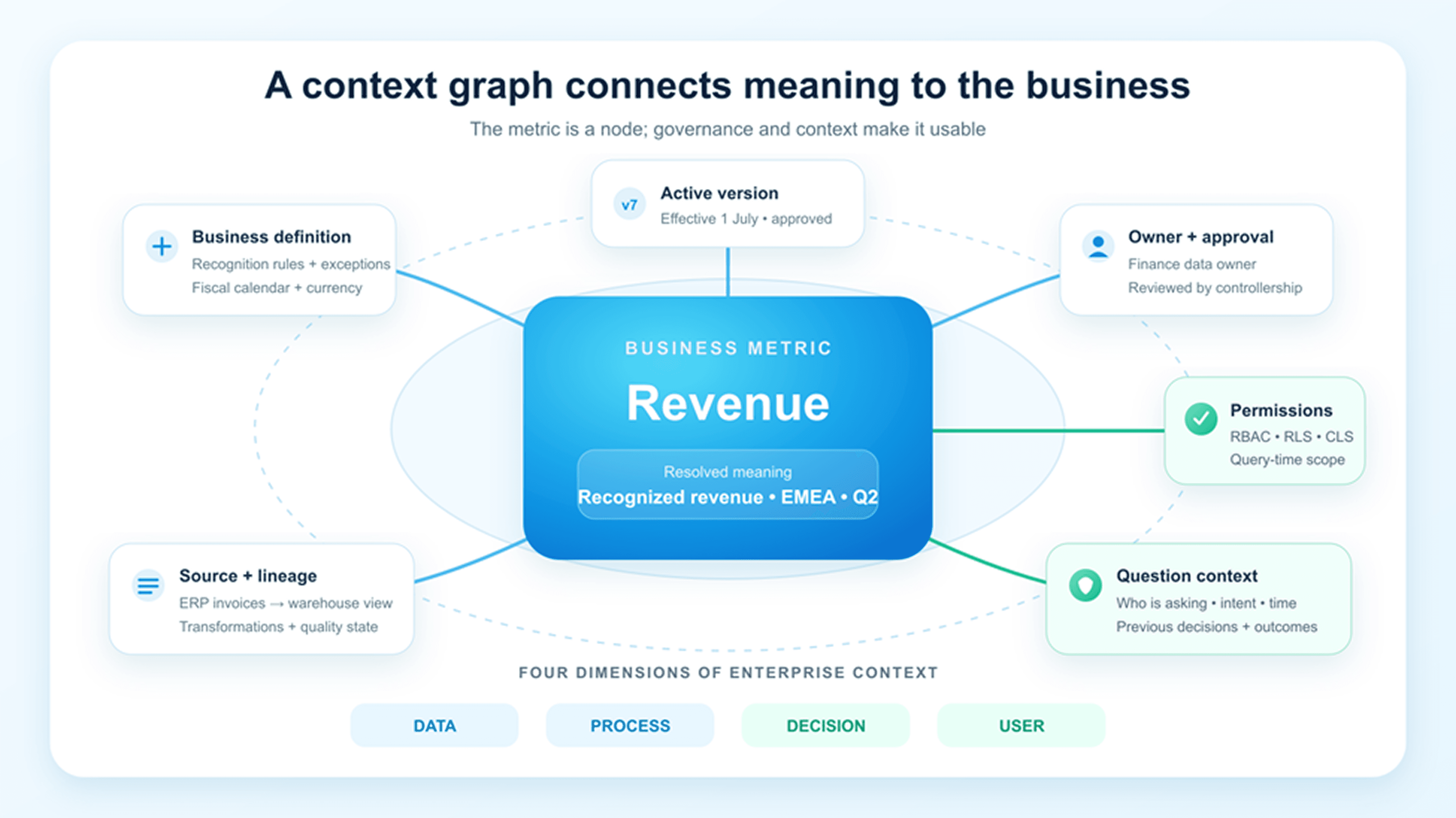
This is where a living context graph becomes useful. It can connect four dimensions of enterprise context:
Data context: schema relationships, metric logic, mappings, quality signals, and lineage
Process context: investigation playbooks, recurring workflows, and approved analytical paths
Decision context: previous findings, actions taken, and observed outcomes
User context: roles, permissions, preferences, and the purpose behind a question
Together, these dimensions turn institutional knowledge into an operating system for enterprise AI.
Semantic layers, business ontologies, and knowledge graphs
These terms overlap, but they are not interchangeable.
A business ontology defines the concepts and relationships in a domain: a customer owns an account, an account has a subscription, a subscription produces recurring revenue, and a policy determines when that revenue is recognized.
A knowledge graph connects those concepts to real enterprise information. It can link a metric to source tables, owners, policies, versions, reports, and previous decisions.
A semantic layer operationalizes that meaning for analytics and AI. It resolves a business question to governed logic, constrains the query, and explains how the result was produced.
Some teams use the phrase ontology graph for a graph whose structure is governed by an ontology. The useful distinction is not the label; it is whether the model connects business meaning to live data and can enforce that meaning when an AI system acts.
Illustrative metric example; the values and dates shown are not live company data.
Governed context makes AI answers repeatable
LLMs are probabilistic, but enterprise analytics still needs a repeatable and verifiable path from question to answer.
The reliable path looks like this:
Question → context resolution → approved metric definition → constrained query plan → permission-aware execution → validation → cited answer or clarification
The LLM can interpret language, plan an investigation, and explain a result. The semantic layer keeps the critical path anchored to approved definitions, known joins, access policies, and traceable data.
This is more useful than promising to eliminate hallucinations. A strong system should reduce semantic errors, expose its query path, show its sources, and ask for clarification when it cannot resolve ambiguity safely.
How to evaluate a living semantic layer
The difference between a convincing demo and production infrastructure becomes clear under change, ambiguity, and audit. Ask these questions:
1. Can it resolve ambiguity instead of hiding it?
Test a term with multiple legitimate definitions, such as revenue, customer, or churn. The system should select the governed definition for the context, explain its choice, or ask a clarifying question.
2. Does the same governed question follow the same path?
Ask the same question in two different ways. With the same permissions, data snapshot, and semantic version, the metric logic and result should remain consistent.
3. Are semantics operational or merely documented?
Check whether definitions actually constrain query generation, joins, calculations, and access—or whether they sit in a glossary that the model may ignore.
4. Can domain experts govern meaning without becoming developers?
Business owners should be able to review proposed definitions, approve changes, see downstream impact, and roll back a bad version through a controlled workflow.
5. Is every answer traceable?
The system should show the sources, transformations, metric definition, semantic version, permissions, and reasoning path behind an important result.
6. Can it stay current without losing governance?
Determine how the system detects outdated definitions, who approves proposed changes, how versions are published, and whether a bad change can be rolled back.
7. Can it work across your existing data and AI stack?
Shared semantics should work across analytics interfaces, agents, APIs, workflows, and business applications without forcing a wholesale rebuild. Open and portable approaches such as the Open Semantic Interchange can reduce tool lock-in.
How Genloop applies the pattern
Genloop’s Living Context Graph functions as a living semantic layer without asking data teams to hand-build and continuously maintain a separate, static model. It connects directly to structured and unstructured sources, builds context from the data estate, and refines that context through governed use.
The graph goes beyond schema. It connects data, processes, decisions, and people so that the system can interpret a question in the way the business actually works. Context Hub gives teams a place to review and manage that accumulated knowledge, while human validation determines which corrections become reusable context.
For a question such as “Why did EMEA revenue fall last quarter?”, the flow is:
Resolve “revenue,” “EMEA,” and “last quarter” against the active business definitions and the requester’s permissions.
Select approved sources, joins, fiscal logic, and investigation paths.
Execute directly against authorized enterprise data.
Validate the result and surface the reasoning, sources, and lineage.
Continue from the number into root-cause analysis and possible next actions.
Route any newly discovered definition or correction for human review so the next investigation starts with deeper context.
This is the context foundation beneath the Genloop agentic analytics architecture. Genloop’s governance layer keeps approved corrections, access controls, and auditability connected to the answers the system produces.
The goal is not to make a language model infallible. It is to make the path from a business question to an authorized, verified answer consistent enough to trust—and transparent enough to challenge.
The model is not the memory
Enterprise AI will not become reliable simply because the next model is more capable. A stronger model can reason more fluently over the context it receives; it cannot repair contradictory definitions it has no authority to resolve.
A living semantic layer provides that authority. It turns business meaning into governed, machine-readable infrastructure, makes enterprise data genuinely AI-ready, and gives every authorized system a consistent foundation for analysis.
The model generates possibilities. The living semantic layer keeps them grounded in how the business actually works.
Try Genloop on your own data and test the questions that expose semantic drift: ask for a contested metric two different ways, inspect the path behind each answer, and see whether the system can explain what changed.
Frequently asked questions
What is a living semantic layer?
A living semantic layer is a governed, machine-readable model of business definitions, relationships, rules, and context that evolves as enterprise data and business logic change. Unlike a static glossary, it versions approved changes and makes them operational across analytics tools, applications, people, and AI agents.
Why is RAG alone not enough for enterprise AI?
RAG can retrieve relevant definitions and documents, but it does not automatically know which source is authoritative when information conflicts. A living semantic layer resolves retrieved information against approved business definitions, current versions, user permissions, and context before analysis proceeds.
How does a semantic layer make enterprise data AI-ready?
AI-ready data includes more than clean fields and accessible tables. It also includes business meaning, validated metrics, entity relationships, lineage, ownership, quality signals, and access policies that an AI system can reliably interpret and apply.
Is a living semantic layer the same as an ontology graph or knowledge graph?
No. A business ontology defines the concepts and relationships in a domain. A knowledge or context graph connects those concepts to real enterprise information. A living semantic layer operationalizes that meaning by using it to resolve questions, govern queries, validate results, and explain answers.
How does a living semantic layer reduce AI errors?
It resolves ambiguous language against approved definitions before a query runs, constrains joins and metric logic, applies permissions, and preserves lineage. It cannot make an LLM infallible, but it makes semantic errors less likely and easier to detect.
How is a living semantic layer different from a data catalog?
A data catalog helps people discover and understand data assets. A living semantic layer applies approved meaning during execution. Many modern catalogs include glossaries and lineage, but they become part of a living architecture only when their semantics are current, versioned, queryable, and enforced across AI and analytics workflows.
Does adopting one require moving or duplicating enterprise data?
Not necessarily. A semantic or context layer can query governed data in place and store meaning, lineage, and rules separately from the underlying records. The right architecture depends on performance, security, and deployment requirements, but a wholesale data migration should not be assumed.
What should an enterprise evaluate in a living semantic layer?
Test whether it can resolve ambiguous terms, apply approved definitions during execution, preserve permissions, show lineage, version changes, support business-user validation, and work with the organization’s existing data and AI tools.