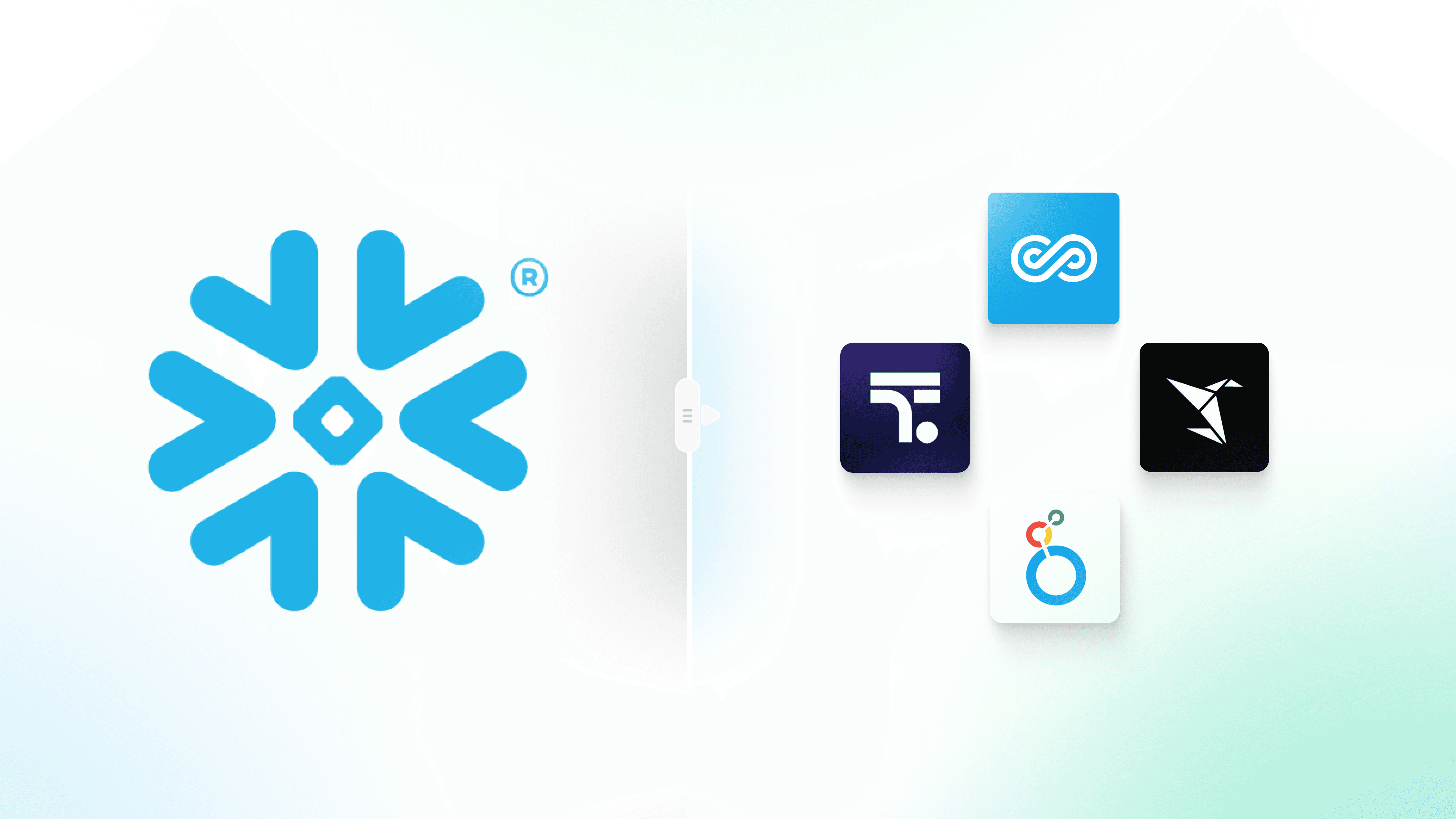
Snowflake Cortex brings AI-powered query generation directly into the data warehouse. Ask a question in natural language, get SQL back, run it against your Snowflake tables. For teams already centralized on Snowflake with clean schemas, it works. But enterprise data environments are rarely that simple.
Business metrics like customer acquisition cost or churn are defined differently across teams, regions, and source systems. When an analytics platform does not understand these definitions, it generates technically correct SQL that maps to the wrong calculation. The query executes successfully, but the answer does not reflect how the business actually measures the metric. Cortex generates SQL against schema.
Enterprise analytics requires mapping business terminology to governed logic across multiple sources, explaining why metrics moved, and running queries that respect row-level access controls without copying data first.
This post evaluates what enterprise analytics actually requires beyond SQL generation, where Cortex stops, and which platforms close the gap.
Where Snowflake Cortex Stops
Cortex runs inside Snowflake's warehouse and sees raw schema. It generates SQL against the tables available in that environment. If your data is already centralized in Snowflake and your schema matches business terminology, Cortex works.
But these architectural gaps show up in enterprise environments:
Limited analytical reasoning beyond query generation : Cortex focuses on generating SQL queries and AI functions within Snowflake. More complex analytical workflows such as multi-step investigation, root-cause analysis, or hypothesis exploration still require analysts to run multiple queries manually or orchestrate pipelines outside the Cortex interface.
Heavy dependence on schema quality : If tables, columns, and relationships are poorly structured, Cortex may generate technically correct SQL that does not reflect the intended analytical question.
Primarily Snowflake-centric data access: Cortex works best on data stored inside Snowflake. While Snowflake supports external tables, connectors, and ingestion pipelines, most analytics workflows still require data to be replicated or integrated into the Snowflake environment before it can be queried effectively. Organizations operating across multiple warehouses or operational databases often need additional integration work before Cortex can analyze that data.
For teams already invested in Snowflake with clean, well-governed schemas and no multi-source federation requirements, Cortex is fast and practical. For enterprise environments with distributed data, inconsistent metric definitions, and complex governance needs, it is the first step, not the full answer.
What Enterprise Analytics Requires
This section outlines the dimensions required for an AI analytics platform to deliver business answers, not just correct SQL.
Semantic Layer Quality: Whether the platform maps company-specific terminology to governed business logic across sources, or generates syntactically correct queries that measure the wrong thing.
Multi-Source Federation: Whether it unifies data across Snowflake, Postgres, BigQuery, and data lakes at query time, or requires ETL pipelines and data copies first.
Business Context Preservation: Whether it explains why metrics moved and suggests next steps, or returns numbers without reasoning.
Governance and Security Depth: Whether it supports row-level RBAC, SOC 2 compliance, air-gapped deployment, and deterministic execution with audit trails.
Deployment Flexibility: Whether it runs on cloud, on-premise, or in a VPC without vendor lock-in to Snowflake's infrastructure.
Platforms That Close the Gap
1. Genloop
Best for: Enterprise data teams with multiple data sources who need non-technical teams to ask ad-hoc questions without creating dashboards or waiting for data engineering
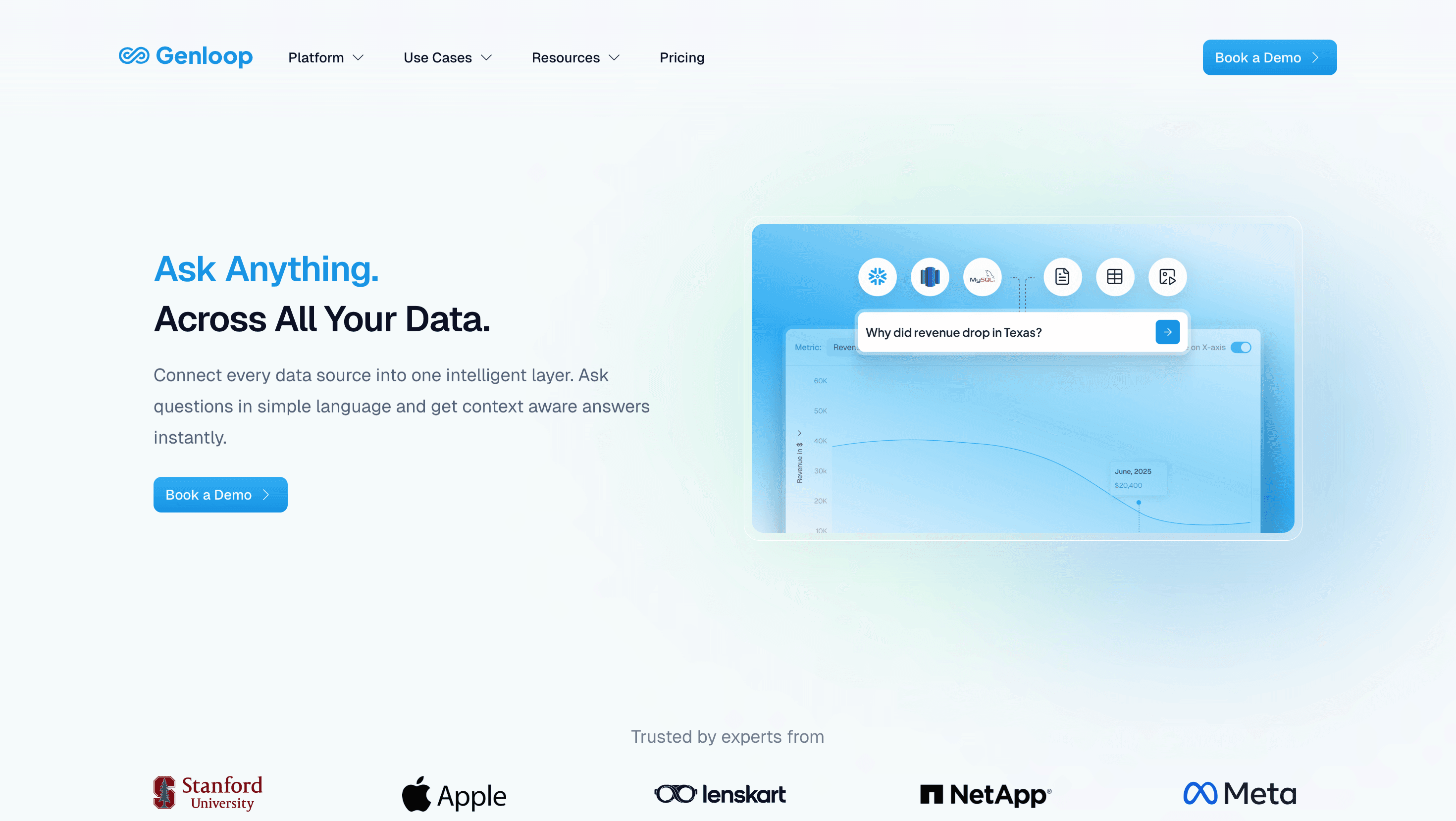
Genloop is an agentic analytics platform built for enterprise data environments. It federates across Snowflake, Postgres, BigQuery, and data lakes through a unified semantic layer called Business Memory, which maps company-specific terminology to governed business logic. A finance analyst can ask "Why did customer acquisition cost spike 23% in APAC last month?" in plain language and get a governed answer with root-cause analysis and suggested next steps. No data team ticket required.
Business Memory improves with usage through human-in-the-loop validation and confidence scores. NetApp achieved 95% accuracy across 4+ unified data sources. Lenskart rolled out conversational analytics to 2,500+ store teams without building new dashboards.
Dimension | How Genloop performs |
|---|---|
Semantic Layer Quality | Business Memory maps company-specific terminology to governed business logic across multiple sources. Human-in-the-loop validation catches errors before they propagate. NetApp case: 95% business accuracy across 4+ sources. |
Multi-Source Federation | Queries Snowflake, Postgres, BigQuery, and data lakes simultaneously without ETL or data copies. No warehouse lock-in. |
Business Context Preservation | Agentic workflows deliver multi-step analysis, root-cause identification, and suggested next actions. Explains why metrics moved, not just what changed. |
Governance and Security Depth | SOC 2 Type II + ISO 27001. Row-level and column-level RBAC enforce at query time. Air-gapped deployment supported. Deterministic execution with full audit trails. |
Deployment Flexibility | Runs on cloud, on-premise, VPC, or fully air-gapped environments. No vendor lock-in to Snowflake or any cloud provider. |
2. ThoughtSpot
Best for: Large enterprises with dedicated analytics budgets who need centralized semantic governance
ThoughtSpot is a conversational analytics platform with a mature semantic layer and a focus on business user adoption. The interface is designed for non-technical users—low learning curve for business teams who need to ask ad-hoc questions without SQL knowledge. Row-level and column-level RBAC, audit trails, and compliance certifications make governance enterprise-grade.
The trade-off is cost and architecture. Connectors pull data into ThoughtSpot's backend—no true federation without data movement. Query latency increases with data volume because the architecture is centralized. The semantic model is proprietary, which creates vendor lock-in.
Dimension | How ThoughtSpot performs |
|---|---|
Semantic Layer Quality | ThoughtSpot's Semantic Model is mature and supports complex business logic, hierarchies, and calculated fields. Strong governance for metric definitions. |
Multi-Source Federation | Supports multiple sources through connectors, but requires data centralization into ThoughtSpot's backend. No true federation—data must move before queries can run. |
Business Context Preservation | Returns answers with some context, but limited multi-step analysis. No agentic workflows or root-cause identification beyond what analysts build into the semantic model. |
Governance and Security Depth | Row-level and column-level RBAC. Audit trails. Compliance certifications. Mature governance controls. |
Deployment Flexibility | Cloud and on-premise options available, but semantic model is proprietary. Migrating away from ThoughtSpot is difficult due to vendor lock-in. |
3. Looker
Best for: Engineering-led organizations comfortable with LookML who need centralized semantic governance and can dedicate SQL-fluent resources to model maintenance
Looker is a BI platform with a powerful semantic layer defined in LookML. When the LookML model is complete and well-maintained, Looker provides strong governance, reusable metric definitions, and centralized control over business logic. The platform is strong for organizations with data engineering capacity to own and evolve the semantic layer over time.
The constraint is engineering dependency. LookML requires SQL fluency. Non-technical teams cannot self-serve beyond what analysts have explicitly modeled. Adding new metrics or data sources requires engineering work. Natural language search exists but is limited compared to conversational analytics platforms—it navigates the existing model rather than reasoning across sources.
Dimension | How Looker performs |
|---|---|
Semantic Layer Quality | LookML provides a powerful, centralized semantic layer when well-maintained. Metric definitions are governed and reusable. But quality depends entirely on engineering capacity to define and evolve the model. |
Multi-Source Federation | Supports multiple data sources through connections, but federation depends on how LookML is structured. Joins and relationships must be explicitly defined—no automatic cross-source reasoning. |
Business Context Preservation | Returns answers based on the LookML model. No agentic workflows. Natural language search navigates the existing model but does not reason across sources or explain why metrics moved. |
Governance and Security Depth | Strong governance within the LookML model. Row-level and column-level access control supported. Audit trails. Compliance certifications available. |
Deployment Flexibility | Cloud-based on Google Cloud Platform. On-premise options are limited. Vendor lock-in to Google's infrastructure. |
4. Sigma Computing
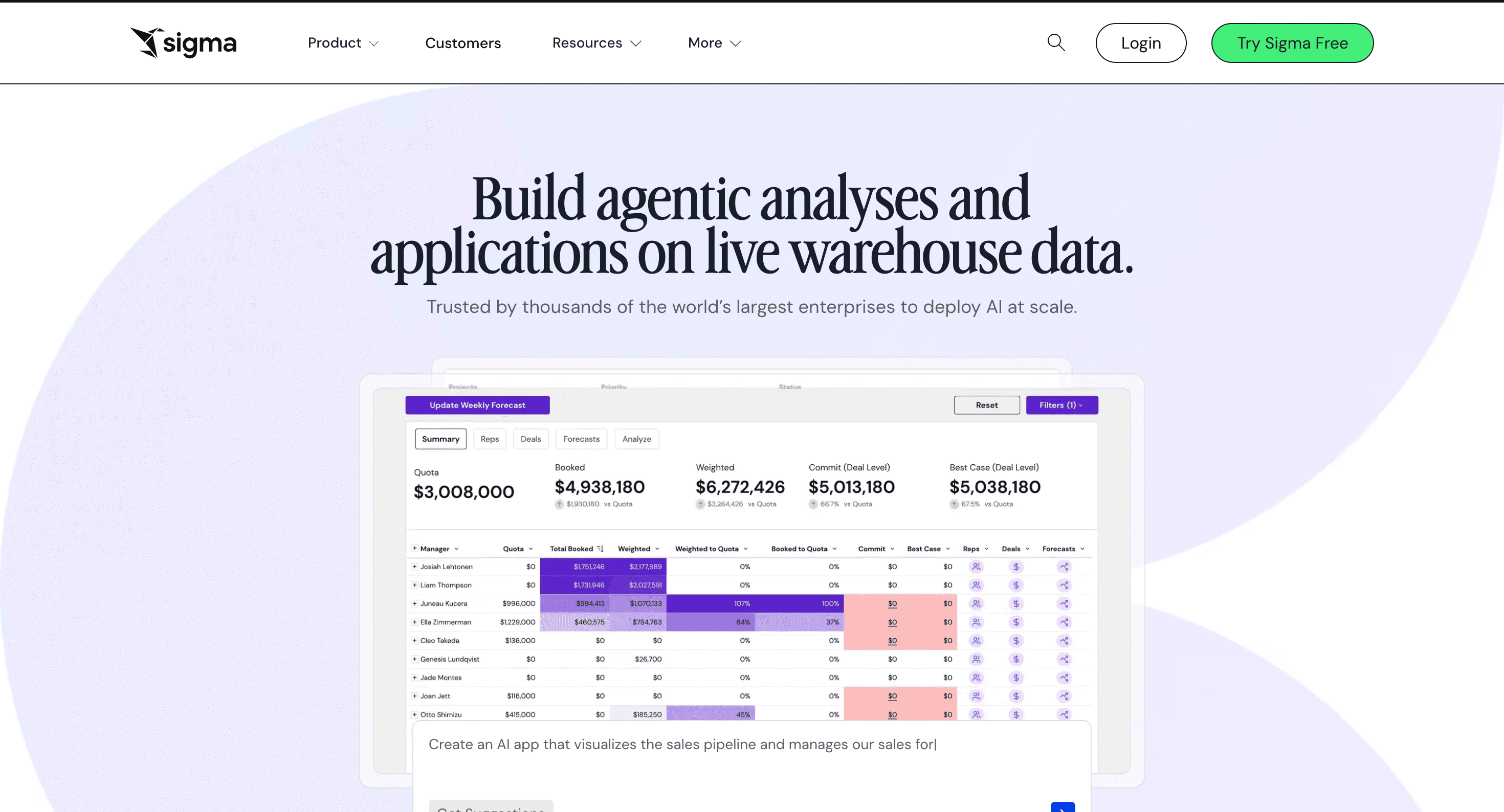
Best for: Organizations operating directly on modern cloud warehouses who want business users to explore data without relying on SQL or engineering teams.
Sigma Computing is a cloud-native analytics platform built to operate directly on modern cloud data warehouses such as Snowflake, BigQuery, and Redshift. It provides a spreadsheet-like interface that allows business users to explore warehouse data, create calculations, and build analyses without writing SQL or relying entirely on pre-built dashboards. Because Sigma runs queries directly on the underlying warehouse, organizations can analyze governed data without creating additional extracts or copies.
The constraint is that Sigma still relies heavily on the structure and modeling of the underlying warehouse. If schemas, joins, or metric definitions are not well defined, analysis becomes difficult for business users. While the platform enables interactive exploration and metric creation, complex investigations such as multi-step analysis or automated root-cause discovery typically require analysts to structure the logic within the warehouse before users can analyze it effectively.
Dimension | How Sigma Computing performs |
|---|---|
Semantic Layer Quality | Supports governed models and reusable calculations but relies heavily on warehouse schema and modeling practices. |
Multi-Source Federation | Connects to multiple cloud warehouses but typically analyzes data within each warehouse environment. |
Business Context Preservation | Enables exploratory analysis but limited automated reasoning or root-cause workflows. |
Governance and Security Depth | Inherits governance and access controls from the underlying warehouse platform. |
Deployment Flexibility | Cloud-native and tightly integrated with modern cloud data warehouse ecosystems. |
How to Choose
Different platforms address different parts of the enterprise analytics problem. Some focus on governed metric definitions, others prioritize exploration on top of modern data warehouses, while some platforms combine these capabilities with automated multi-step investigation and cross-source analysis.
Platform | Semantic Layer Quality | Multi-Source Federation | Business Context Preservation | Governance and Security Depth | Deployment Flexibility |
|---|---|---|---|---|---|
Genloop | ✓ | ✓ | ✓ | ✓ | ✓ |
ThoughtSpot | ✓ | ◐ | ◐ | ✓ | ◐ |
Looker | ✓ | ◐ | ✗ | ✓ | ◐ |
Sigma Computing | ◐ | ◐ | ◐ | ✓ | ◐ |
FAQs
What makes AI analytics different from traditional BI?
Traditional BI requires analysts to build dashboards for predefined questions. AI analytics platforms let users ask new questions in natural language and get governed answers without building new reports. Platforms like Genloop translate these questions into deterministic queries that respect business metric definitions. For a deeper look at how different autonomous analytics systems work, see our breakdown of Top Tools for Agentic Data Analysis.
Can Snowflake Cortex handle multi-source analytics?
Snowflake Cortex runs inside Snowflake and generates queries against the data available in that warehouse. While Snowflake supports external integrations, most analytics workflows still require data to be integrated into Snowflake before it can be analyzed effectively. Agentic analytics platforms focus on analyzing metrics across multiple systems without heavy data replication.
What is a semantic layer and why does it matter?
A semantic layer maps business terminology to governed metric definitions so users interact with metrics instead of raw tables and columns. This ensures that metrics follow consistent logic across queries and teams. Agentic analytics platforms rely on semantic layers to produce answers that reflect business definitions rather than just database schema.
How do agentic analytics platforms differ from warehouse-native AI?
Warehouse-native AI systems typically generate queries directly from database schemas. Agentic analytics platforms first interpret business context through a semantic layer and can perform multi-step investigation when metrics change. Platforms like Genloop combine semantic modeling with automated reasoning to support deeper analysis.
What should I look for in a Snowflake alternative?
Look for platforms that support multi-source federation without ETL, maintain a unified semantic layer across all data sources, provide deterministic execution with audit trails, and offer deployment flexibility (cloud, on-premise, VPC, air-gapped). Governance and business context preservation are non-negotiable for enterprise use.