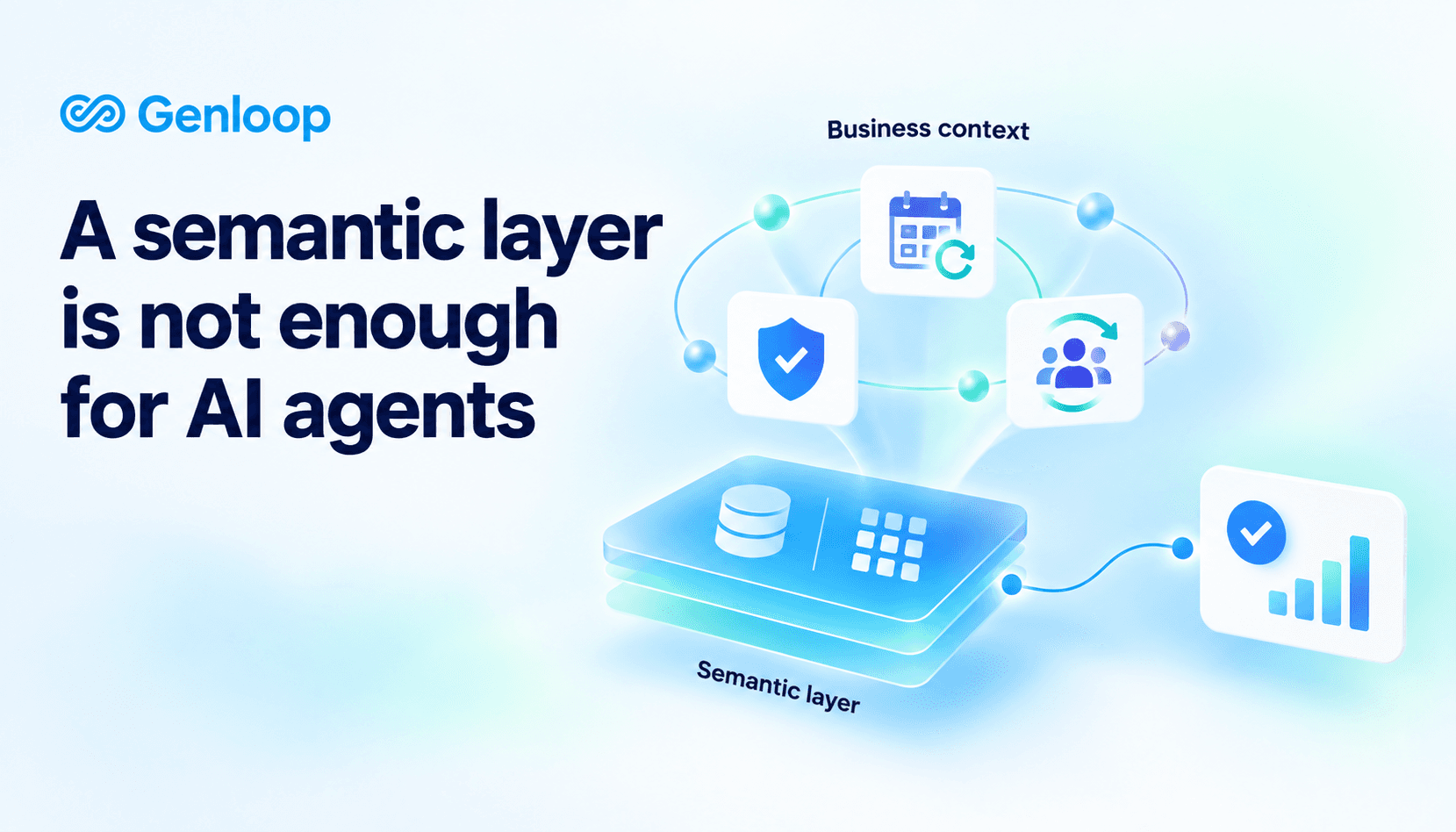

AI analytics for enterprise BI is the class of platform that lets business users query governed enterprise data in natural language and get answers that are accurate, auditable, and safe to act on. The popular claim that AI simply replaces SQL misses what these systems actually require. SQL generation is the easy part: modern language models write valid queries for most business questions. The hard part is meaning. Enterprise deployments fail on semantic alignment, metric governance, and cold-start reliability, not on syntax. Until those three problems are solved at the architecture level, an AI interface returns confident numbers that different teams cannot reconcile, and practitioners quietly stop trusting it.
Key Takeaways
The bottleneck in enterprise AI analytics is semantic, not syntactic. Models already generate valid SQL; ambiguous metric definitions are what make the numbers silently wrong.
Gartner predicts that through 2026, organisations will abandon 60% of AI projects unsupported by AI-ready data. The constraint is data readiness, not model quality.
Three failure modes recur in production deployments: semantic drift across teams, cold-start context loss, and stateless follow-up queries.
A governed, self-learning semantic layer resolves all three failure modes. A chat interface on its own resolves none of them.
Why the "AI Replaces SQL" Claim Fails in Production
The pitch is seductive: ask a question in plain English, get an accurate answer instantly, and eliminate the analyst bottleneck overnight. Several established BI vendors and a wave of AI BI startups sell this narrative. In a controlled demo, with a clean schema, a single data source, and pre-tested example questions, it works exactly as advertised.
Production is a different country.
Through late 2025 and early 2026, practitioner threads across analytics and data engineering communities surfaced a consistent pattern. Teams that deployed AI-powered BI tools found the chat interface was the least of their problems. The real failures were silent. An AI would generate syntactically valid SQL that returned a number, just not the right number. "Revenue" meant one thing to the finance team, something else to sales operations, and a third thing to the data warehouse schema. The AI had no way to know. It picked one. Nobody caught it for three reporting cycles.
This is not a model quality problem. It is an architecture problem. Gartner predicts that through 2026, organisations will abandon 60% of AI projects that are not supported by AI-ready data; in the same research, 63% of organisations either lacked, or were unsure they had, the right data management practices for AI (Gartner, 2025). The model can generate perfect SQL against a perfectly ambiguous schema and still be wrong.
The "AI replaces SQL" narrative implicitly assumes that the hard problem, aligning what business users mean with what the data actually contains, is already solved. It almost never is.
What Breaks: Three Recurring Failure Modes
Enterprise analytics teams running AI BI evaluations keep hitting the same three walls. These are not edge cases. They are the default for any organisation with more than one team, more than one data source, and more than two years of schema evolution.
Semantic drift across teams. Finance defines "active customer" as anyone who transacted in the last 90 days. Marketing defines it as anyone who opened an email in 30 days. The warehouse has a column called is_active that was last updated in 2022. An AI query engine now has three competing truths and no way to adjudicate between them, so it picks one silently. Practitioners already see the risk: in dbt Labs' 2026 State of Analytics Engineering survey, 71% of data professionals reported concern about incorrect or hallucinated outputs reaching stakeholders, and "increasing trust in data" rose from 66% to 83% year over year as a stated priority, the steepest rise of any objective measured (dbt Labs, 2026). The AI does not create this problem, but it amplifies it, because it removes the human in the loop who used to catch the inconsistency before it reached a board deck.
Cold-start context loss. Every AI analytics deployment starts with zero institutional context. The model does not know that gross_margin in the schema is pre-returns, that the fiscal year starts in February, or that one regional market uses a different currency baseline. Onboarding an AI BI tool onto an enterprise data estate without a pre-existing semantic layer means every early query runs on raw schema inference. This cold-start period is where AI BI tools lose practitioner trust permanently: users hit one wrong answer in week one and never come back. Trust, once lost to a silently wrong number, is far harder to rebuild than it was to earn.
Stateless query context. Standard NL2SQL implementations treat every question as independent. A follow-up such as "now break that down by region" has no guaranteed awareness of what "that" referred to, which filters were active, or which version of a metric produced the previous answer. Real analysis is iterative; a decision-quality answer almost always emerges from a chain of follow-up questions, not a single shot. Research from Microsoft and Salesforce measured what happens when language models iterate: across more than 200,000 simulated conversations, top models performed on average 39% worse in multi-turn conversations than in single-turn ones, and once a model took a wrong turn it rarely recovered (LLMs Get Lost in Multi-Turn Conversation, 2025). A system that resets context on every query forces users to re-specify their entire analytical frame at each step, which defeats the purpose of Conversational Analytics entirely.
The Real Problem Is Semantic, Not Syntactic
Here is the reframe most vendor content avoids because it is commercially inconvenient: the bottleneck is not SQL generation. NL2SQL (natural language to SQL) is the technique of converting a plain-English question into a database query, and modern language models now do this well enough for the majority of business questions, as the public leaderboards tracked in Text-to-SQL: The Ultimate Guide show. The bottleneck is meaning: the gap between what a business user intends, what the semantic layer encodes, and what the physical schema contains.
A semantic layer is the business-logic layer that maps raw tables and columns to consistent, governed business terms, so that "revenue" resolves to one audited definition no matter who asks. Organisations with mature semantic layers, whether dbt metric definitions, Looker LookML, or purpose-built ontology graphs, consistently report better AI BI outcomes than those without. The AI is not smarter. It has a better map.
A governed semantic layer does four things that raw NL2SQL cannot:
It enforces a single canonical definition for each metric across all queries and all teams.
It stores business context (fiscal calendars, currency normalisation, regional exceptions) that never appears in column names.
It tracks lineage: which source tables, transformations, and business rules produced each number.
It provides a trust surface: when an answer is wrong, there is an auditable path to diagnose why.
Without this layer, AI analytics is autocomplete for SQL. With it, AI analytics becomes a governed intelligence layer that non-technical users can actually trust. This is the same architectural argument made in What Agentic Analytics Actually Needs, applied to the specific question of whether AI replaces SQL.
What Enterprise AI Analytics Actually Requires
The comparison below maps architectural requirements to the failure modes described above.
Requirement | Standard NL2SQL / Chat BI | Production-Grade Enterprise AI Analytics |
|---|---|---|
Metric governance | Inferred from schema column names | Canonical definitions enforced per query |
Semantic context | None; cold start on every session | Living context graph that refines with every interaction |
Multi-team consistency | Each query independently generated | Single governed semantic layer, one truth per metric |
Follow-up query coherence | Stateless; context resets | Session-aware, maintains the analytical thread |
Lineage and auditability | SQL shown, derivation opaque | Full reasoning path, source tables, business rules |
Cold-start readiness | Low; fails on ambiguous schemas | Auto-discovery plus iterative refinement from day one |
Governance controls | Rarely enforced at query time | RBAC, RLS, and CLS enforced on every query |
Wrong answer detection | Silent; no signal to the user | Answer reasoning shown, query path transparent |
The gap between the two columns is not a model upgrade. It is a different architecture, one that treats the semantic layer as the product rather than an afterthought.
How a Self-Learning Semantic Layer Changes the Equation
The architecture that resolves all three failure modes is a persistent, self-learning semantic layer. The Living Context Graph is Genloop's implementation of this idea: a semantic layer that auto-discovers schema structure and business terminology on connection, then refines its understanding with every query interaction, rather than requiring a data engineering team to author and maintain every definition by hand. Manual authorship is the approach that makes dbt metrics and LookML expensive to operate at scale; a self-learning graph shifts that cost from people to the system.
In practice, this means the cold-start problem is structural rather than permanent. A new workspace begins with schema inference and improves with usage instead of starting from scratch on every session. Business definitions, fiscal rules, metric hierarchies, and join logic accumulate in Context Hub, the platform module where the graph is surfaced and maintained, and every subsequent query draws on it automatically. In Genloop deployments across multi-location retail and logistics data estates, the inflection point typically arrives around 30 to 40 governed queries: by then the graph has absorbed enough validated business logic that answer accuracy holds across users and teams, not just for the analyst who set it up. That accuracy rests on a reasoning layer that ranks first on the independent Spider 2.0-Snow text-to-SQL benchmark at 96.70% (Spider 2.0, 2026).
This is not a claim that AI has solved analytics. It is a claim that the right architecture narrows the gap between what business users ask and what the data actually contains, in a way that is auditable, governed, and production-safe.
Critically, governance runs through the architecture rather than being retrofitted after the fact. Every query passes through RBAC, RLS, and CLS controls, so a finance analyst and a marketing manager asking the same question in natural language each receive answers scoped to their own data permissions automatically. The AI does not bypass governance. It operates inside it.
When a Governed Platform Is the Wrong Choice
This architecture is not the right fit for every team, and pretending otherwise would undercut the argument. An organisation with a single analyst, a single data source, and no cross-team metric conflicts will be well served by a lightweight NL2SQL wrapper; the overhead of a governed semantic layer is unnecessary at that scale. A data team already invested in a mature dbt semantic layer may need an integration point rather than a platform. And for a single simple table with little complexity, a team can query it directly with a tool like Claude Code and skip a platform entirely. The trust and governance architecture described here earns its cost where wrong numbers are expensive: multiple teams, multiple sources, and decisions that ride on the answer.
Choosing AI Analytics for Enterprise BI
The choice reduces to one question: where does meaning live in the stack? If every metric a team cares about is already unambiguous, any competent NL2SQL tool will do. If metric definitions differ by team, span sources, or carry business rules that no column name reveals, then the semantic layer is the product, and the chat interface is just the door. Evaluate platforms on how they build, govern, and refine that layer, not on how fluent the chat interface feels in a short scripted vendor demo; Agentic Analytics vs Traditional BI sets out what that shift changes in practice. Your warehouse knows more than you're getting from it. Get started for free and test your hardest metric question against your own schema.
Frequently Asked Questions
What is AI analytics for enterprise BI and how is it different from standard BI tools?
AI analytics for enterprise BI refers to platforms that let business users query data warehouses in natural language and receive governed, accurate answers without writing SQL or building dashboards. Unlike standard BI tools such as Power BI or Tableau, which depend on pre-built reports and SQL-literate users, enterprise AI analytics combines NL2SQL generation with a governed semantic layer, RBAC controls, and persistent business context, so answers stay consistent, auditable, and accessible to non-technical users.
Does AI replace SQL in enterprise analytics?
No. AI generates SQL; it does not remove the need for the governed definitions that make SQL correct. Modern language models handle query syntax well, but a query built on an ambiguous metric definition returns a wrong number regardless of how clean the SQL is. What AI genuinely replaces is the wait for an analyst on routine and ad-hoc questions, provided a semantic layer resolves meaning before the query runs.
How long does it take to deploy an AI analytics platform for enterprise use?
Timelines vary with data estate complexity, but a self-learning semantic layer can reach baseline production readiness in days rather than months. Schema auto-discovery happens on connection, governance controls are configured at workspace setup, and context refinement is continuous from first use. Teams with large multi-source estates should expect roughly 30 to 90 days before the context graph has absorbed enough validated business logic for fully consistent cross-team accuracy, compared with 6 to 12 months for manually authored semantic layers.
How does AI analytics for enterprise BI compare to improving an existing Tableau or Power BI setup?
Tableau and Power BI are dashboard-first tools: they answer the questions anticipated when the report was built. AI analytics for enterprise BI answers the questions nobody anticipated, in real time, without a new dashboard build. The meaningful difference for enterprise teams is coverage rather than speed. Governed AI analytics shrinks the analyst bottleneck on ad-hoc questions while holding the same governance standards as a pre-built dashboard.
Which enterprise teams benefit most from AI-powered BI platforms?
The highest returns go to teams whose decision velocity is constrained by analyst availability: finance teams running weekly variance analysis, sales operations tracking pipeline across regions, marketing teams investigating attribution, and operations leaders monitoring multi-site performance. The prerequisite is data readiness rather than technical sophistication: a connected warehouse, defined access controls, and clarity on which metrics matter. Organisations still resolving fundamental data quality issues will benefit more from fixing those foundations first.