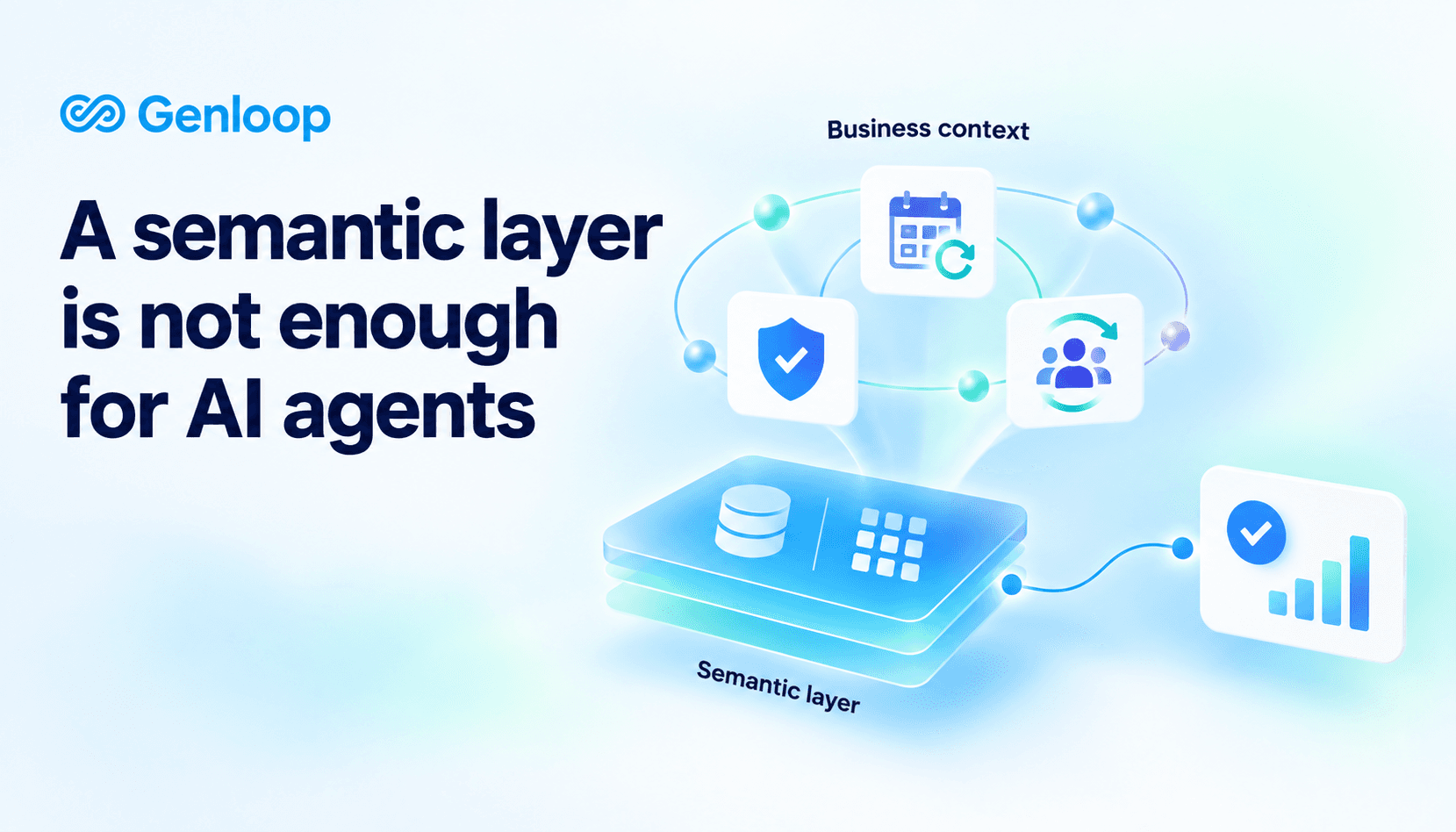
A revenue table can pass every schema check and still produce the wrong AI answer.
The pipeline ran on time. The SQL executes. But the assistant counts bookings instead of recognized revenue, duplicates totals through an incorrect join, or exposes a region the user should never see.
Each failure starts with a missing requirement.
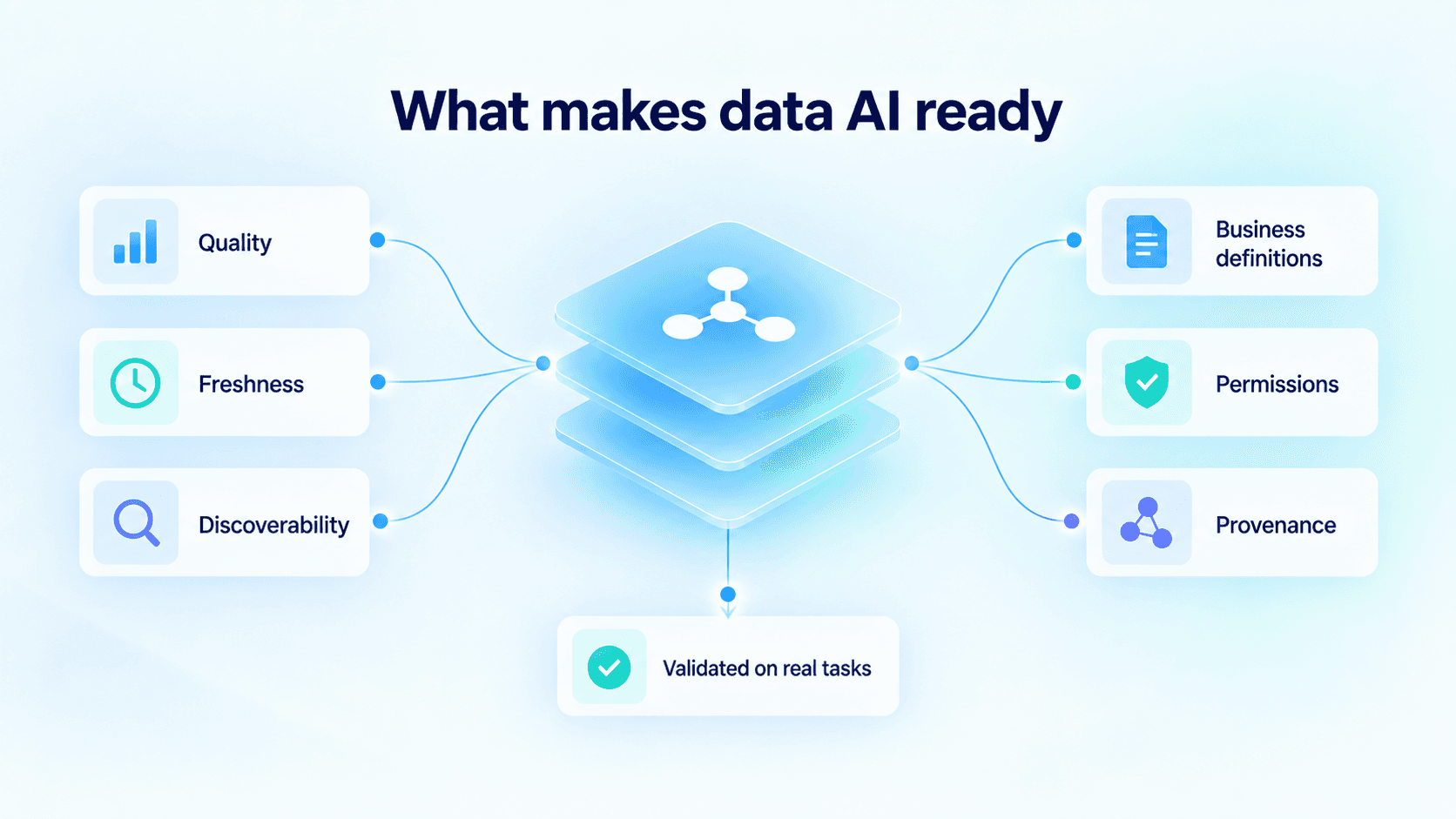
AI ready data is data an AI system can discover, interpret, access, and use correctly for a defined task, with evidence that the result is trustworthy.
For enterprise analytics, that requires quality, freshness, discoverability, business definitions, permissions, provenance, and validation against actual questions.
Readiness belongs to a use case. Prove it there.
Start with a business decision
“Make our data AI ready” is too broad to execute. “Explain weekly revenue changes by product and region using finance approved definitions” creates a testable scope.
That scope identifies the sources, metrics, joins, users, and freshness requirements. It also establishes when the assistant should ask for clarification, disclose incomplete data, or refuse an answer.
Start with one workflow and representative questions. Define expected results before connecting the assistant.
Valid SQL is only the beginning.
Quality and freshness need explicit thresholds
Test the defects that affect the decision. For revenue analysis, that means unique transaction identifiers, complete account mappings, valid relationships, and reconciliation with approved financial totals.
Test joins too. An invoice joined to multiple account classifications can multiply revenue without producing a database error. Established controls provide a foundation.
Freshness requires more than a successful pipeline run. Track when events occurred, when records arrived, and which reporting period is complete. A newly loaded table can still contain incomplete transactions.
Set thresholds around the workflow. When data falls outside them, the assistant must disclose the cutoff, use a complete period, or stop.
Recognizing stale data does not repair the pipeline.
Discovery must resolve to approved meaning
A catalog can return six tables containing “customer.” The assistant still needs to identify the authoritative source.
Useful discovery requires ownership, business descriptions, record grain, supported joins, and deprecation status. Business definitions need equal precision.
“Active customer” must specify the qualifying event, measurement window, exclusions, and entity identifier. Revenue needs explicit currency, refund, and recognition rules.
Store these definitions as reusable, versioned context. Semantic models and ontology graphs can represent entities and relationships, but discovered relationships still require business approval.
Give definitions named owners. Preserve their portability across tools.
Business meaning should survive a platform change.
Permissions and provenance must cover the entire answer
Access controls must remain effective across retrieved context, query execution, conversation history, caches, and shared outputs.
Test denied requests as deliberately as allowed ones. Ask a regional manager for another region’s records. Repeat through a follow up question. Revoke access and test an existing conversation.
A prompt is not an access control.
For provenance, retain the source references, executed query, filters, metric version, data cutoff, and execution time. Preserve a snapshot reference where reproducibility requires it.
SQL shows what executed. It does not prove that the calculation matched the business question.
Trust requires a trace.
Validate the tasks users will actually perform
Warehouse tests check the data. AI evaluations check whether the system uses it correctly.
Build an independent evaluation set from analyst requests and recurring investigations. Include ambiguous terms, fiscal boundaries, incomplete data, restricted users, and follow up questions.
Compare answers with approved reference queries on the same data snapshot. Assess explanations as well as totals.
Measure accuracy by question category. Track unauthorized disclosures, unqualified stale answers, appropriate clarification, and response time.
Verify deterministic reasoning under controlled conditions: hold the question, permissions, definitions, and data snapshot constant, then repeat the task. Change those conditions deliberately and confirm that the answer responds correctly.
A headline accuracy score cannot replace these tests.
Where Genloop fits
Genloop addresses context and analytical reasoning.
Its context intelligence layer connects definitions, relationships, freshness information, permissions, and source context. It captures company specific terminology and logic while queries data where it resides. Genloop’s context architecture
Genloop also documents verified reasoning paths, review of proposed learning updates, attribution of approved definitions, and preservation of source row and column security. These capabilities support repeatable analysis and governed use. Genloop’s platform architecture
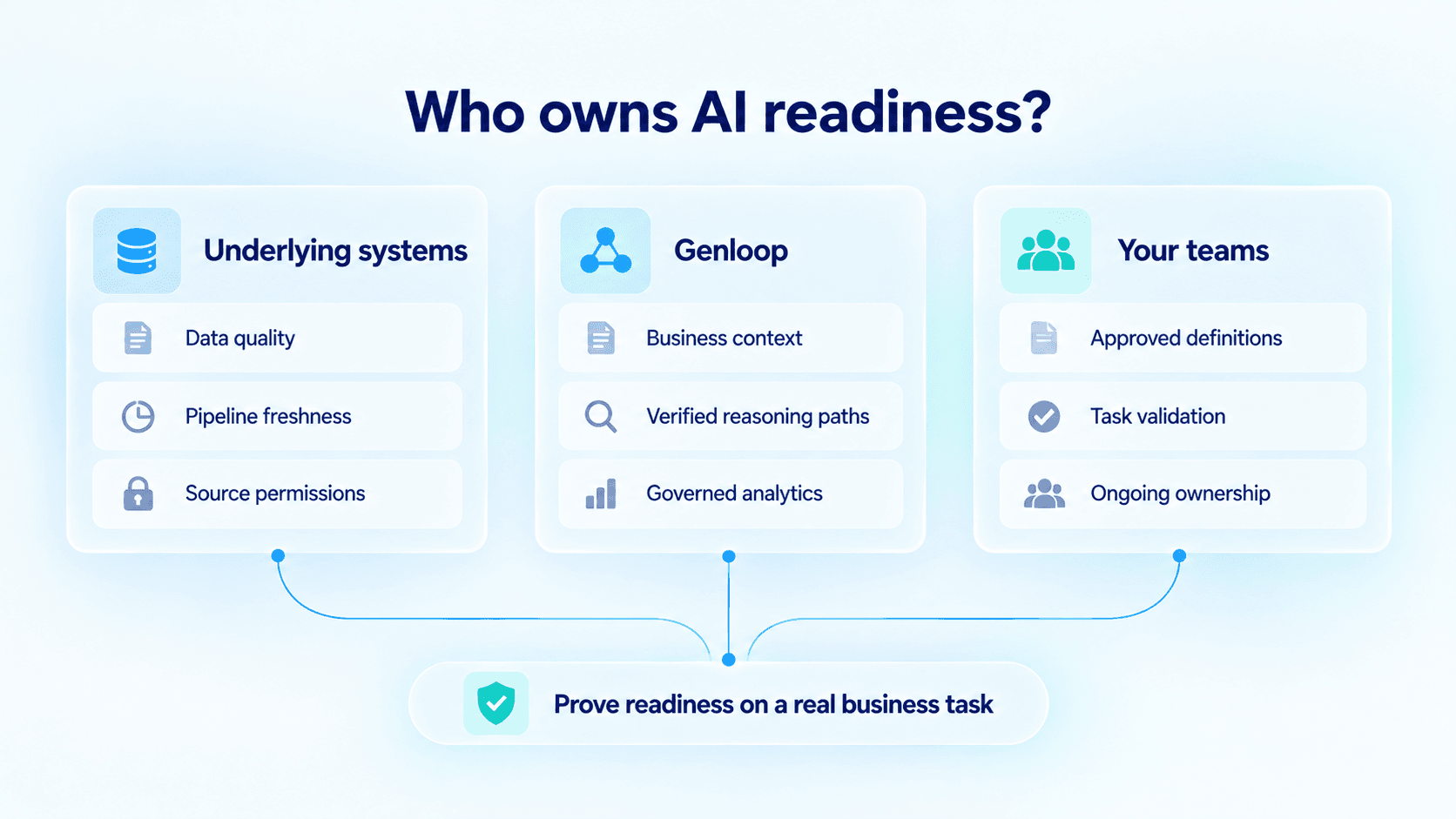
Underlying systems still own correct data capture, deduplication, pipeline delivery, and source policies. Business owners approve definitions. Deployment teams validate the complete experience.
A context layer does not fix missing transactions, repair delayed pipelines, or resolve conflicting business rules without accountable owners.
The platform supplies capabilities. Your deployment must supply proof.
Implementation checklist
Use this checklist as a release gate. Assign an owner and evidence to every item.
Scope: Define the decision, users, supported questions, and clarification or refusal conditions.
Quality: Validate identifiers, completeness, joins, and reconciliation with approved totals.
Freshness: Establish data cutoffs, completeness thresholds, and behavior when thresholds fail.
Discovery and meaning: Confirm that business language resolves to authoritative sources and approved, versioned definitions.
Permissions: Test allowed and denied access across conversations, caches, and shared outputs. Include revocation.
Provenance: Capture sources, query logic, filters, definition versions, and timestamps.
Task validation: Compare independent questions with approved results. Test ambiguity, incomplete data, and repeated execution.
Release and ownership: Set acceptance thresholds, block critical failures, and assign monitoring, regression testing, and rollback responsibility.
Repeat evaluations after changes to schemas, definitions, permissions, models, or context.
Readiness expires when its assumptions change.
Prove readiness before expanding access
Start with the questions your analysts already answer. Establish the requirements, test the difficult cases, and expand after the workflow meets its acceptance criteria.
To evaluate Genloop, bring a business workflow, approved definitions, representative questions, and access constraints. Assess its context layer and conversational analytics against those requirements.
AI ready data earns the label through evidence.
Frequently asked questions
How is AI ready data different from clean data?
Clean data meets quality rules such as completeness, uniqueness, and validity. AI ready data also carries the business meaning, access controls, freshness context, and provenance needed for a specific task. Clean records alone do not prevent an assistant from choosing the wrong metric.
Do we need to prepare the entire data estate first?
No. Start with a bounded workflow and the sources it requires. Validate that workflow before adding more domains, users, or questions. Each expansion needs its own acceptance evidence.
Is a semantic layer enough for AI readiness?
A semantic layer provides consistent metrics and relationships. The deployment also needs current data, enforced permissions, traceable answers, and task evaluations. Check each requirement explicitly.
Does Genloop fix data quality problems?
Source applications and pipelines remain responsible for correcting missing, duplicated, or delayed records. Genloop addresses the context and reasoning used to interpret and query enterprise data. Validate both parts together.
How should we measure AI data readiness?
Measure task accuracy by question category, freshness compliance, access control test results, provenance coverage, and response latency. Set thresholds according to business risk. An aggregate score must never conceal unauthorized disclosure or critical calculation failures.