An AI agent can use your certified revenue metric, execute valid SQL, and still give the business the wrong answer.
Consider a sales leader asking why enterprise revenue fell last quarter. The agent retrieves the approved metric, compares periods, and identifies the region with the largest decline.
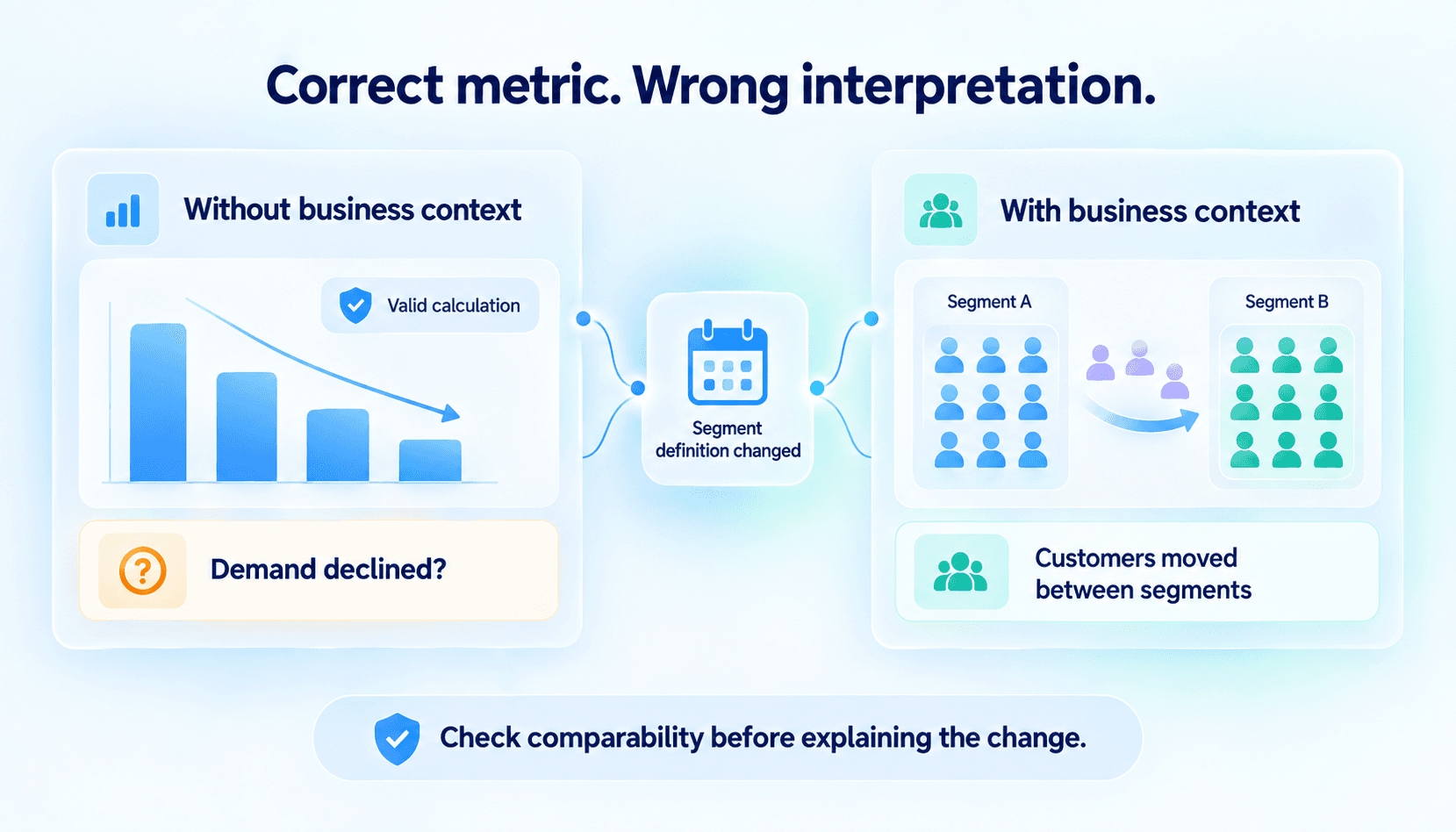
The calculation is correct. The explanation misses something critical: the company changed its enterprise account threshold during the quarter. Customers moved between segments. The agent interpreted a classification change as declining demand.
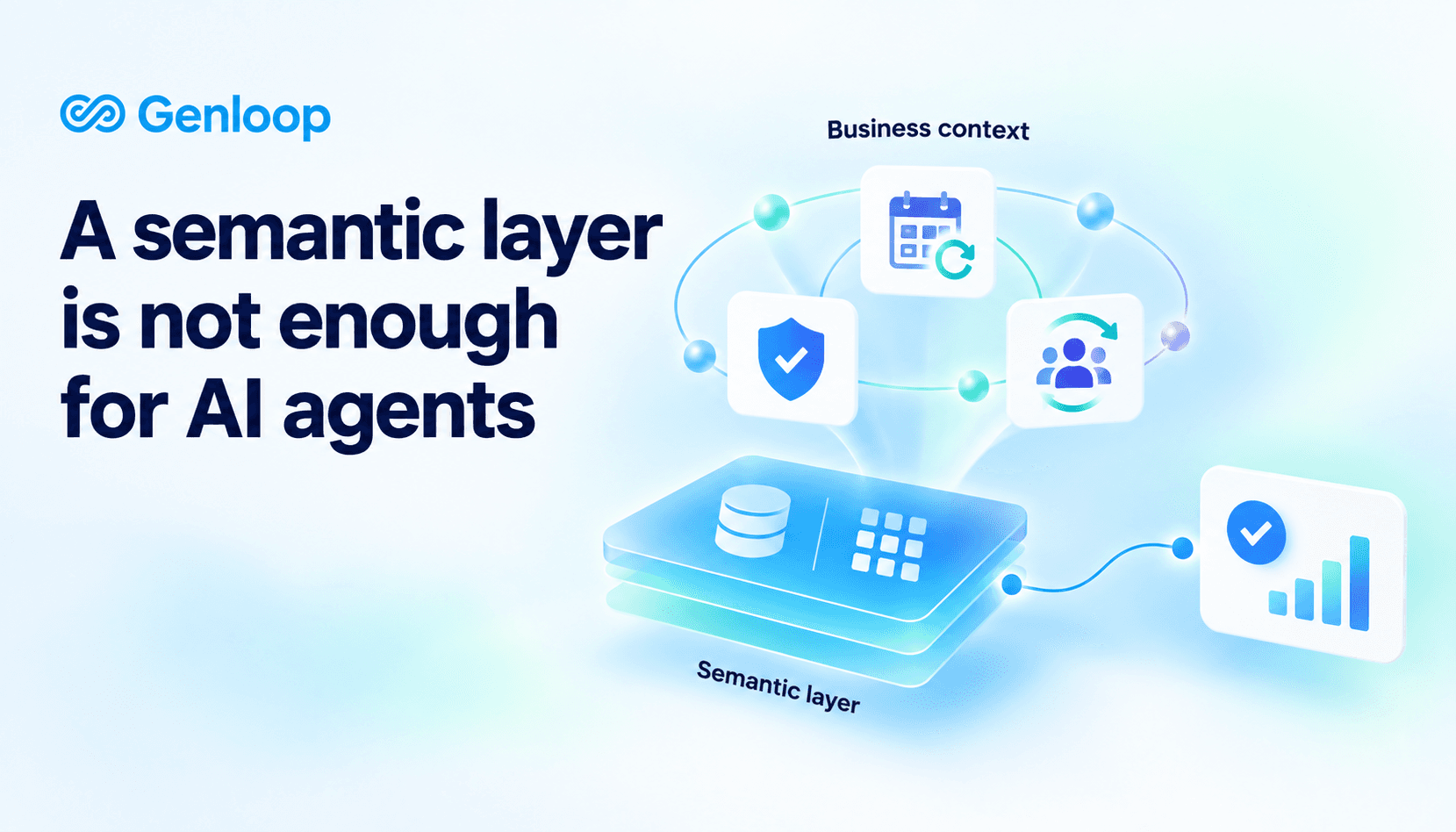
A semantic layer can standardize the calculation. It cannot supply business context nobody captured.
That is why connecting an agent to governed metrics does not, by itself, produce trustworthy analytics.
What the semantic layer gets right
A semantic layer gives an agent explicit rules for working with business data: metric definitions, dimensions, entity relationships, and aggregation logic.
These constraints matter. They reduce the amount of business logic an agent must invent when translating a question into a query.
For data teams that have spent years reconciling conflicting dashboards, this is valuable infrastructure. An agent should reuse it.
But consistent calculation and correct interpretation are separate requirements. A certified revenue metric does not automatically explain a territory reorganization, an acquisition exclusion, or a change in customer classification.
The definition tells the agent what to calculate. Context tells it whether that calculation answers the question.
Where a correct query becomes a wrong answer
The gap opens when a business user moves from “What happened?” to “Why?”
Explaining a revenue decline requires more than retrieving a metric. The agent must establish a comparable population, verify that both periods are complete, check for business changes, and choose an appropriate analytical method.
In the opening example, the first useful step is checking whether “enterprise” means the same thing in both quarters. Without that check, every subsequent breakdown inherits a faulty comparison.
There is another boundary: identifying a contribution does not establish a cause. A regional breakdown shows where revenue declined. It does not prove that demand weakened.
Enterprise querying research illustrates how demanding the surrounding work becomes. The March 2025 Spider 2.0 paper reported that an agent based on o1 preview solved 21.3% of its enterprise workflow tasks, compared with 91.2% on Spider 1.0. Tasks required navigating metadata, documentation, and project code. These historical results demonstrate workflow complexity; they are not a measurement of semantic layer effectiveness. Source: arxiv.org.
The deployment lesson is straightforward. Test the investigation, including its assumptions.
SQL that runs is one checkpoint. It is not the acceptance criterion.
The missing context needs an architecture
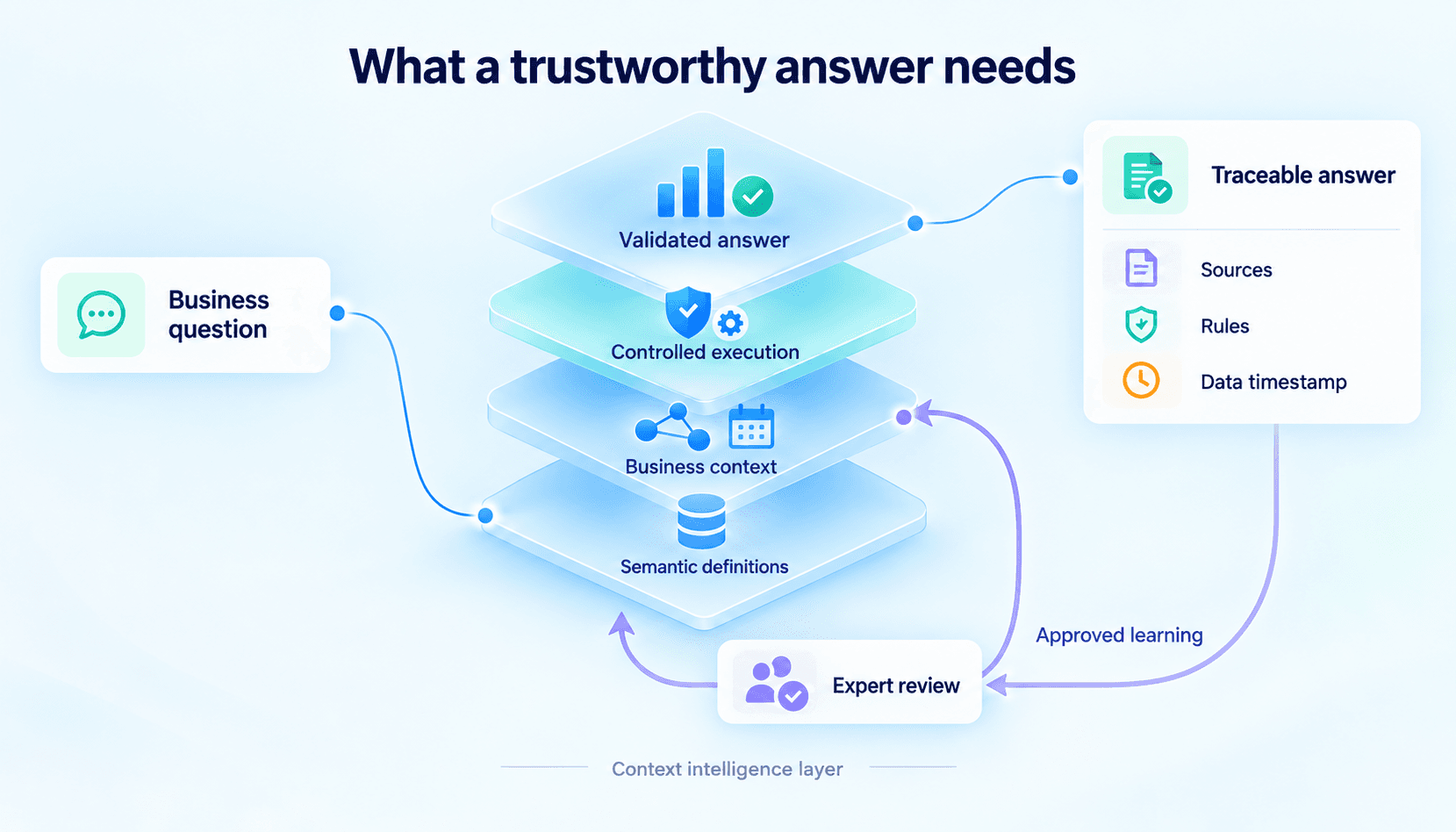
A context intelligence layer connects governed metrics to the knowledge required to use them: business events, effective dates, analytical procedures, ownership, and decision history.
Ontology graphs provide a structure for those connections. An enterprise segment can connect to its eligibility rule, the date that rule changed, the person who approved it, and the reports affected.
That gives the agent a path to investigate the classification change before explaining the revenue movement.
Some of this information can live inside an extended semantic model. The location matters less than the operating discipline. Context needs an authoritative source, a defined scope, and a maintenance process. These are also core requirements of a living semantic layer.
A Finance exclusion approved for consolidated reporting must not silently become the default for sales compensation. An old investigation must not override a newer policy.
More context helps only when the agent can establish which context applies.
Reliable reasoning requires controlled execution
Deterministic reasoning should have a concrete meaning: explicit rules and reproducible analytical steps for a fixed interpretation and data snapshot.
The model can propose an investigation. The system must control how that investigation executes.
Approved definitions should govern metric resolution. Permissions should constrain retrieval and queries. Validation should check data completeness, aggregation grain, and reconciliation. The answer should retain enough evidence to reproduce the result.
For the revenue question, that evidence includes the segment definition, comparison periods, filters, and data timestamp. If the agent claims demand declined, it must also supply evidence supporting that explanation.
Reproducibility makes the work inspectable. Validation establishes whether it deserves trust.
Business knowledge must improve through review
The next challenge arrives when someone corrects the agent.
A sales analyst identifies the segment change. Finance clarifies which historical comparison is valid. Those corrections should improve future investigations.
Multiplayer AI makes expert contributions part of a shared analytical process. A self learning loop turns approved contributions into reusable knowledge.
Approval is essential. Capture the correction, identify its owner, test its effect, and define where it applies. Preserve the previous version so the team can explain why an answer changed.
Genloop’s agentic analytics architecture addresses this requirement through its Living Context Graph and Review Center. The graph brings together data, process, decision, and user context. The Review Center lets data teams and subject matter experts review, approve, or reject proposed learning updates.
A correction becomes institutional knowledge only after its authority and scope are established.
What enterprise teams should demand
AI ready data requires governed definitions, current business context, enforceable permissions, and traceable execution.
The same scrutiny applies to sovereign deployment. Enterprise control must cover where prompts, retrieved context, results, and interaction history are processed and retained.
When evaluating an agentic analytics platform, test these requirements with questions your analysts actually struggle to answer. Include a changed business definition, an incomplete reporting period, and a question with ambiguous intent. Measure correct interpretations, appropriate clarification, and analyst intervention alongside query accuracy.
Keep the semantic layer. It remains a critical foundation.
Then build the context, validation, and learning processes around it.
A correct metric is the beginning of a trustworthy answer.
Frequently Asked Questions
Is a semantic layer enough for an AI analytics agent?
No. It supplies governed definitions and relationships. Reliable analysis also requires business context, validation, permissions, and procedures for investigating the question.
How does a context intelligence layer complement a semantic layer?
It connects definitions to business events, effective dates, ownership, and analytical procedures. Those connections help an agent determine whether a metric or comparison applies to the question.
Can ontology graphs replace a semantic layer?
A graph alone cannot replace executable metric definitions, aggregation rules, and query controls. Ontology graphs help represent business relationships and connect them to supporting context.
How should an agent learn from user corrections?
Capture each correction with its owner, scope, and supporting evidence. Validate and approve it before changing shared logic. Retain version history so future answers remain explainable.