Predictive maintenance programs in manufacturing often fail not because the technology is immature, but because operational data remains fragmented across systems. Sensor streams, ERP maintenance records, MES production logs, and supply chain data rarely exist in a unified analytical layer. As a result, root cause analysis takes hours or days instead of minutes, delaying intervention and increasing the risk of equipment failure. Unplanned downtime is estimated to cost Fortune 500 manufacturers up to 11% of annual revenue.
In response, organizations often add more tools such as predictive maintenance platforms, BI dashboards, and data warehouse integrations. While each tool addresses a specific problem, the overall analytics stack becomes more complex, creating new bottlenecks for data teams and limiting how quickly operators can access actionable insights. As a result, significant investments in AI and analytics remain underutilized in real production environments.
TLDR
This blog evaluates five platforms based on the capabilities that determine whether AI analytics delivers reliable business answers, not just correct SQL.
Multi-source data unification with business context: The platform should federate across connected data sources through a unified semantic layer that maps business terminology to underlying data schemas, ensuring consistent metric definitions and governed query execution without requiring data movement or duplication.
Real-time root cause analysis: The system should go beyond anomaly detection and automatically correlate operational events to explain performance changes and identify likely causes.
Accessibility for operational teams: Insights should be accessible through natural language queries and automated alerts so plant, maintenance, and supply chain teams can obtain answers without relying on technical workflows.
Deterministic execution and hallucination control: All outputs must be traceable to validated data sources, ensuring queries are executed reliably and preventing fabricated or unsupported results.
Enterprise governance and secure data access: The platform should enforce role-based access controls and auditability while querying data in place without unnecessary duplication across systems.
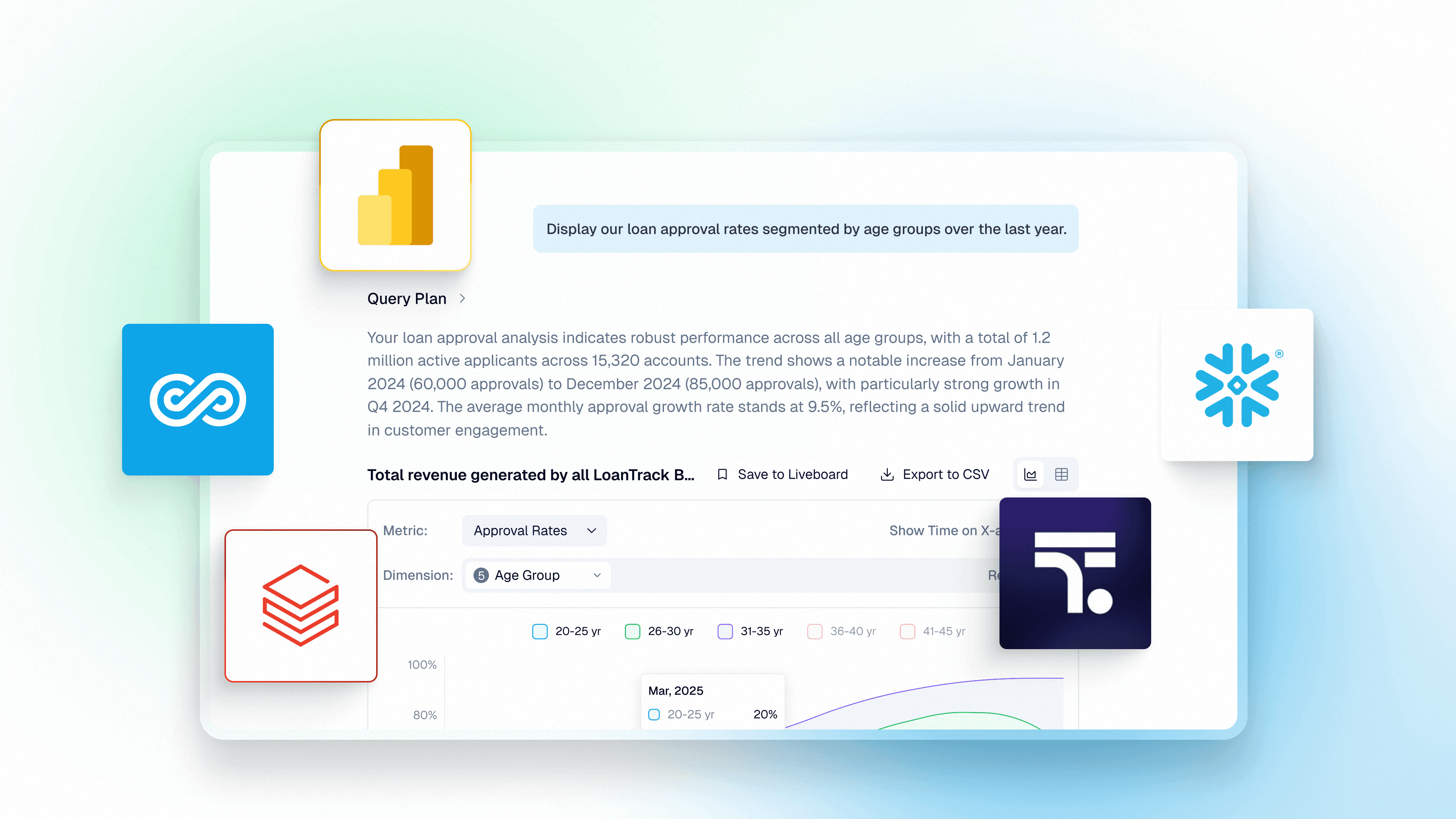
The platforms covered: Genloop, Power BI Copilot, ThoughtSpot and Sigma Computing.
The Core Problem: Data Silos Masquerading as Integration
Manufacturing environments generate large volumes of operational data across multiple production, maintenance, quality, and supply chain systems. However, integration alone does not create unified analytics. Data often resides across separate platforms with different schemas, metric definitions, and operational calendars, leading to inconsistent interpretations of metrics such as downtime, failure events, or OEE. As a result, operational questions frequently require complex analysis before reliable answers can be produced.
Several key challenges limit the effectiveness of predictive maintenance programs:
Fragmented data architecture — Operational data is distributed across multiple systems with inconsistent schemas and definitions, making cross-system analysis slow and difficult.
Manual and dashboard-dependent analysis — Organizations rely on manual SQL queries, static dashboards, or analyst-driven investigations, which delays responses when new operational questions arise.
Limited root cause visibility — Many platforms detect anomalies but cannot easily correlate signals across datasets to explain why failures occur.
Low operational accessibility — Insights are often confined to BI tools or data warehouses, making them difficult for maintenance teams to access and act on in real time.
These challenges illustrate a broader issue: predictive maintenance initiatives often fail when analytics platforms focus on data analysis rather than delivering timely, contextual answers that operational teams can trust and act upon.
Platforms That Close the Gap
Here's how the leading manufacturing analytics platforms perform against these five criteria.
Genloop
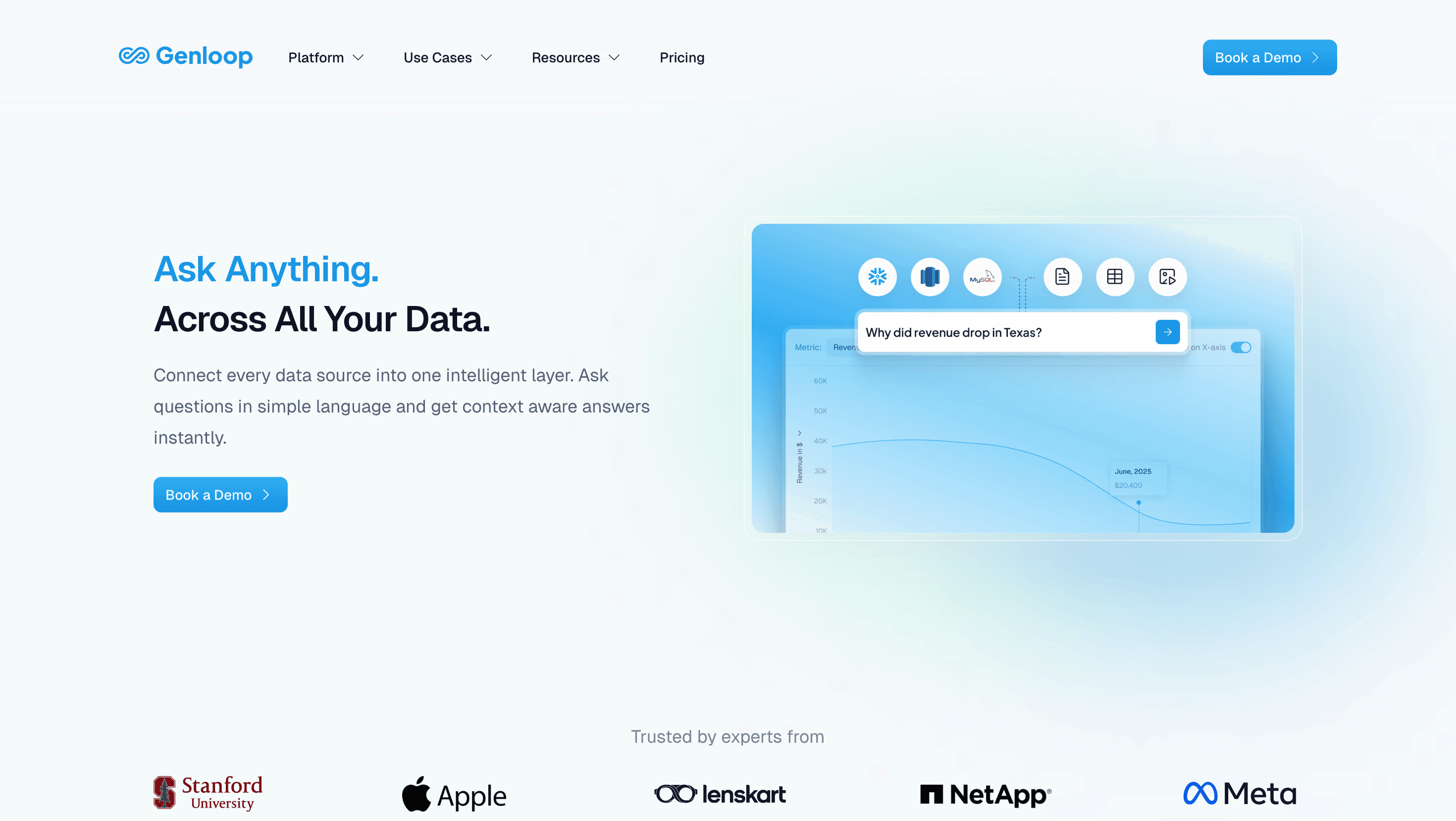
Genloop is an agentic analytics platform built for enterprise data environments. It is the most accurate data reasoning platform available, scoring 96.7% on Spider 2. It federates queries across sources such as Snowflake, Postgres, BigQuery, and data lakes through a unified semantic layer called Business Memory, which maps company-specific terminology to governed business metrics and logic. A user can ask questions like “Why did OEE drop in the Northeast region last week?” in plain language and receive answers grounded in defined metrics across connected data sources, without writing SQL or relying on dashboards.
Criterion | Explanation |
|---|---|
Multi-source unification with business context | Business Memory semantic layer maps business terminology to underlying data schemas across connected data sources, ensuring consistent metric definitions and governed query execution without requiring data movement or duplication. |
Real-time root cause analysis | Agentic workflows chain multiple queries, correlate events, and synthesize root causes with next actions. Deep analysis, not just anomalies. |
Accessibility for non-technical users | Conversational analytics in plain English. Works across unified data without SQL or dashboards. Domain language understood natively. |
Deterministic execution and hallucination suppression | Deterministic execution grounded in actual data. Validates all reasoning against schema and source data. No hallucinations. |
Enterprise governance without friction | SOC 2 Type II + ISO 27001. No data copies. RBAC with row-level and column-level security. Cloud, on-prem, VPC, or air-gapped deployment. |
Databricks
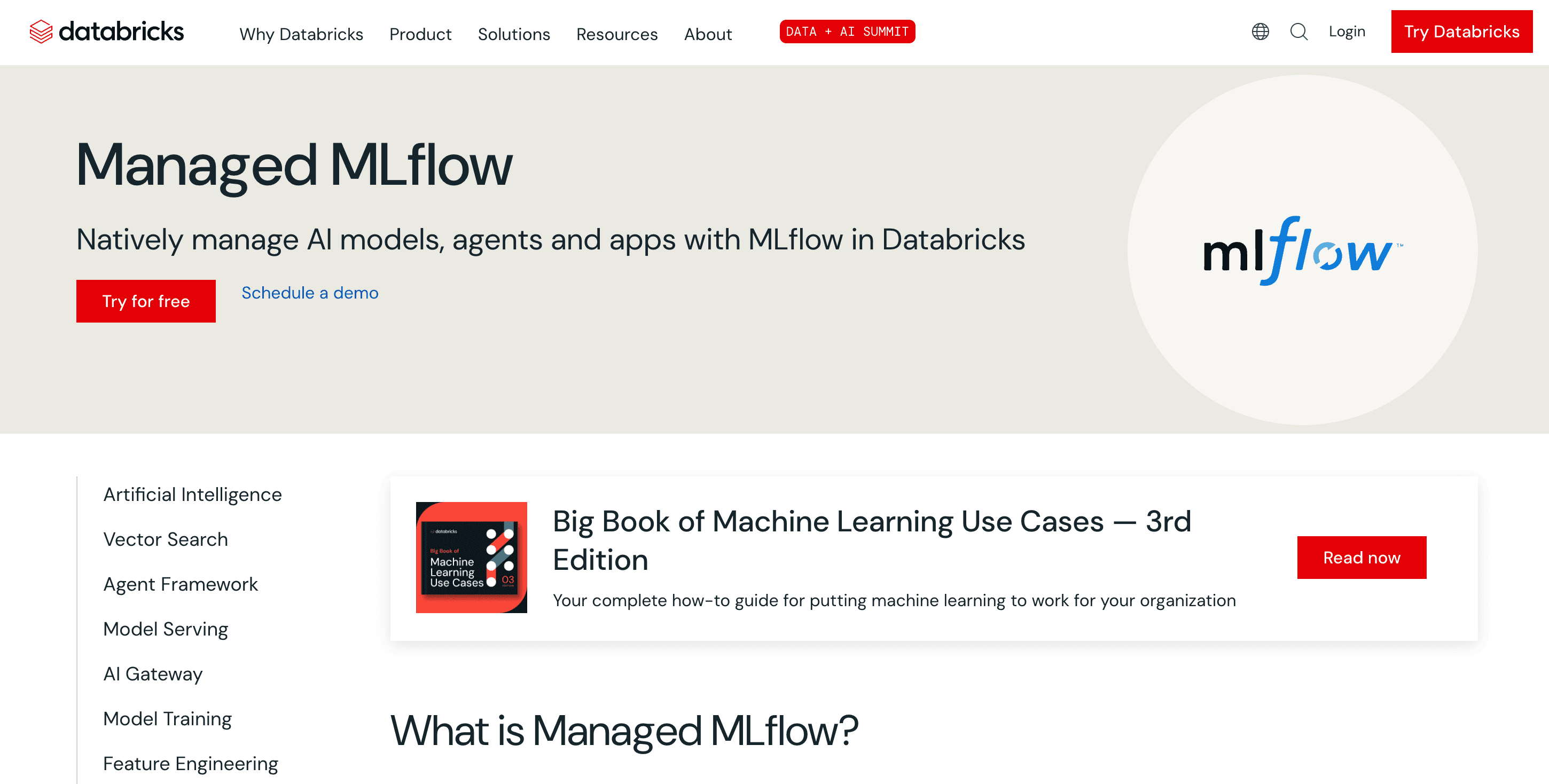
Databricks is a unified platform for data engineering, analytics, and machine learning. It enables teams to ingest and process large-scale data, build features, train and deploy models, and manage ML workflows within a single environment. Components such as MLflow support model tracking and lifecycle management, Feature Store organizes reusable features, and Vector Search enables semantic retrieval over unstructured data, allowing organizations to develop and operationalize advanced analytics pipelines on top of their data infrastructure.
Criterion | Explanation |
|---|---|
Multi-source unification with business context | Can connect multiple sources, but integration is manual. No semantic layer. Business language mapping requires custom code. |
Real-time root cause analysis | Possible through custom ML models and analytics, but requires data team effort. Not a built-in capability. |
Accessibility for non-technical users | SQL and Python required. Not conversational. Requires data team intermediaries. |
Deterministic execution and hallucination suppression | Deterministic. Models are explicit and auditable. |
Enterprise governance without friction | Governance possible but requires configuration. Data copies required. |
Snowflake Cortex Analyst
Cortex Analyst is Snowflake's generative BI tool. You ask questions in plain English, and it generates SQL against your Snowflake warehouse. It handles multi-table joins, aggregations, and basic reasoning. Fast for single-source queries. Natural language interface. Low friction for Snowflake customers.
Criterion | Explanation |
|---|---|
Multi-source unification with business context | Single-source only. Data must be copied to Snowflake. No semantic layer for business language. |
Real-time root cause analysis | Can answer follow-up questions, but requires manual correlation. Not agentic. |
Accessibility for non-technical users | Natural language interface. Easy to use. |
Deterministic execution and hallucination suppression | Generates SQL, which can hallucinate. Validation is limited. |
Enterprise governance without friction | Snowflake governance applies. Data copies required. |
Power BI with Copilot
Power BI Copilot is Microsoft’s AI assistant integrated into Power BI that allows users to ask questions in natural language and generate charts, summaries, and insights from existing reports and datasets. It works within Power BI dashboards and semantic models, helping users explore data conversationally while leveraging the data models, visualizations, and governance framework already defined in the Power BI environment.
Criterion | Explanation |
|---|---|
Multi-source unification with business context | Works within pre-built Power BI models. No multi-source unification. No semantic layer. |
Real-time root cause analysis | Limited to pre-built dashboards. Manual follow-up required. |
Accessibility for non-technical users | Natural language interface. Easy for Power BI users. |
Deterministic execution and hallucination suppression | Hallucination risk. Limited validation. |
Enterprise governance without friction | Power BI governance applies. Role-based access only. |
ThoughtSpot
ThoughtSpot is a search-based analytics platform that allows users to analyze data by typing queries in natural language. Its interface focuses on quickly surfacing metrics, trends, and anomalies from connected datasets, while features like SpotIQ automatically analyze data patterns and highlight notable changes. The platform emphasizes self-service analytics, enabling business users to explore data and generate insights through a search-style experience rather than traditional dashboard navigation.
Criterion | Explanation |
|---|---|
Multi-source data unification with business context | Connects to multiple data sources but typically relies on underlying data warehouses or prepared datasets. Business definitions and relationships are configured through data models rather than a unified semantic layer across systems. |
Real-time root cause analysis | Features like SpotIQ automatically surface anomalies and trends in data, helping users identify potential drivers behind metric changes. Deeper causal investigation generally requires further exploration or analyst involvement. |
Accessibility for non-technical users | Search-based analytics allows users to query metrics using natural language or keyword-style searches, making it easier for business users to explore data without writing SQL. |
Deterministic execution and hallucination control | Queries are executed directly against connected datasets and defined models, ensuring results are grounded in the underlying data rather than generated responses. |
Enterprise governance and secure data access | Supports enterprise governance through role-based access controls and integration with warehouse-level security policies while leveraging existing data infrastructure. |
How to Choose
Platform | Multi-Source Data Unification with Business Context | Real-Time Root Cause Analysis | Accessibility for Operational Teams | Deterministic Execution & Hallucination Control | Enterprise Governance & Secure Access |
|---|---|---|---|---|---|
Genloop | ✓ | ✓ | ✓ | ✓ | ✓ |
Databricks | ◐ | ◐ | ✗ | ✓ | ◐ |
Snowflake Cortex Analyst | ✗ | ◐ | ✓ | ◐ | ◐ |
Power BI Copilot | ✗ | ◐ | ✓ | ◐ | ◐ |
ThoughtSpot | ◐ | ◐ | ✓ | ✓ | ◐ |
FAQs
What should I look for in an AI analytics platform for manufacturing?
Look for platforms that can analyze data across multiple sources while maintaining consistent metric definitions through a semantic layer. Tools like Genloop focus on mapping business terminology to governed data models so operational teams can ask questions and receive reliable answers.
What is agentic analytics?
Agentic analytics refers to AI systems that can interpret business questions, generate queries, and guide users through analytical workflows automatically. Platforms like Genloop apply this approach to help users explore data conversationally while grounding answers in governed business metrics.
Why is a semantic layer important in analytics platforms?
A semantic layer ensures that business metrics are defined consistently across queries. Genloop uses a semantic layer called Business Memory to map business terminology to underlying data schemas, helping maintain consistent metric definitions.
Can AI analytics platforms reduce dependence on data teams?
AI analytics platforms can help business users explore data without writing SQL, reducing routine data requests. Platforms like Genloop allow teams to ask questions directly against governed datasets while data teams maintain the underlying models.
How do AI analytics platforms ensure answers are reliable?
Reliable analytics requires queries to be grounded in governed data models and defined metrics. Genloop generates queries against validated schemas and controlled data sources, allowing results to be traced back to the underlying datasets.
What is the difference between agentic analytics and traditional BI tools in manufacturing environments?
Traditional BI tools rely on predefined dashboards and reports, which makes it difficult to investigate new operational questions when unexpected issues occur. Agentic analytics platforms can interpret questions, generate queries, and guide users through multi-step analysis automatically. This allows manufacturing teams to move from detecting anomalies to understanding root causes across production, maintenance, and supply chain data. For a deeper explanation of how autonomous analytics systems work, see our breakdown of Top Tools for Agentic Data Analysis.