A retail manager opens her dashboard on Monday and sees last week's sales slipping. The data was there the whole time, but it takes her two hours to find the cause: an ad campaign quietly expired six days ago and took the store's foot traffic with it. A week of losses, hiding in plain sight. The promise behind tools like Databricks Genie One and Genloop (#1 on Spider 2.0) is that the alert reaches her on day one, in plain language, with an actionable insight and a recommended next step, before the money is gone.
Her story is a small case for where analytics is heading: away from static dashboard software that waits to be read, and toward agentic analytics and conversational BI that watch the numbers and raise a hand first.
Genie One is the version of that promise Databricks shipped in June 2026. It is pitched as an AI agent that works for you, grounded in your data: ask a question, take action, and drive real outcomes with a system that knows your business. This piece explains what Genie One is, how it differs from the earlier Genie, and the features it ships with.
What is Genie One
Genie One is Databricks' data-smart AI coworker for business users. Someone types a question in plain English, and Genie One turns it into a query, runs it against governed data, and returns an answer with charts and a path to action. It grounds every answer in real company data through SQL, so the numbers come from curated tables rather than loose guesses, and it can carry the work forward into tasks and updates instead of stopping at a chart.
It launched at the Data and AI Summit in June 2026 as the next step for Databricks Genie, and it sits inside the Databricks platform, where Unity Catalog governs what each person is allowed to see.
Genie One's features
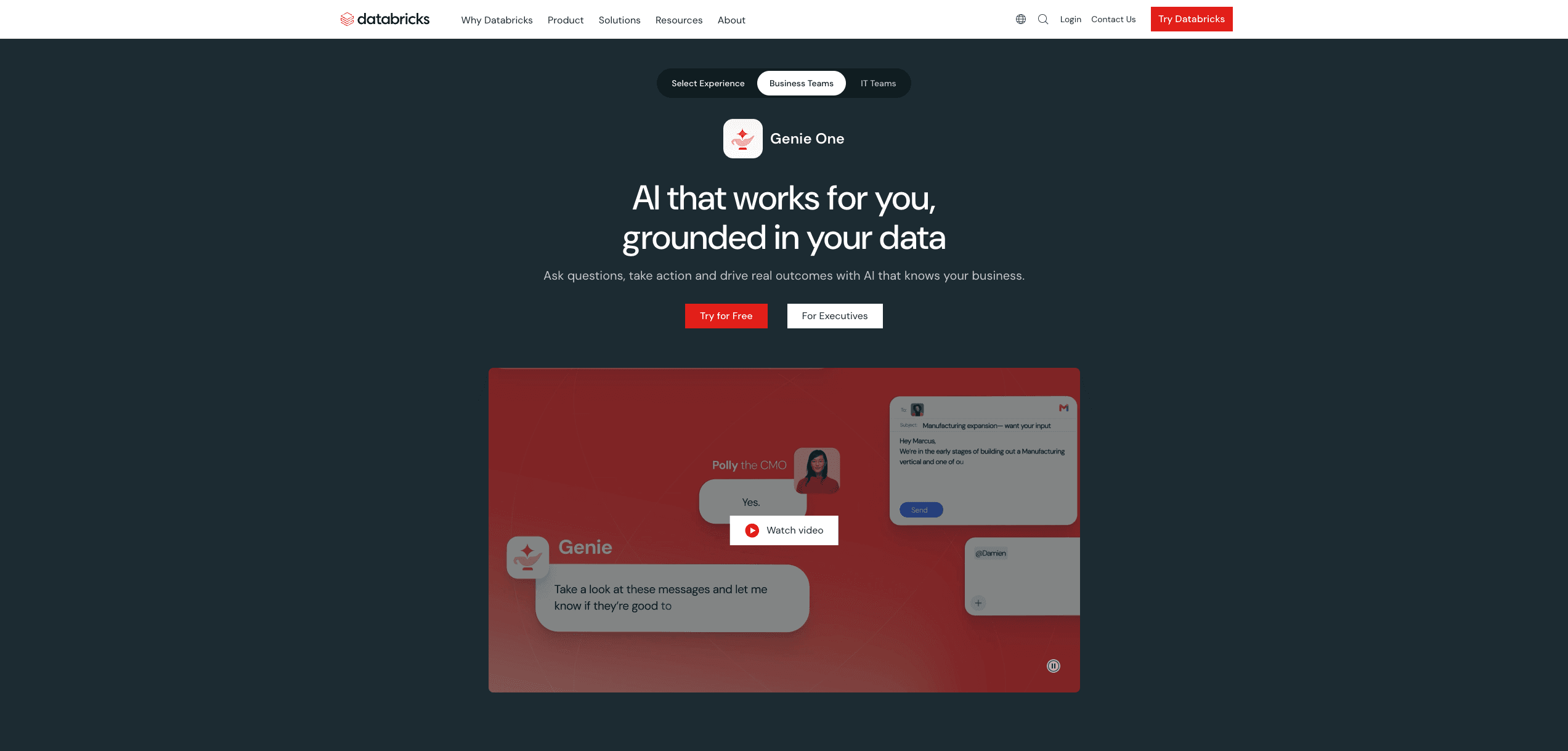
The five pieces that make up Genie One:
Unified Home. One central, branded place where business users talk with their data, get governed answers, and take action.
Genie Ontology. A self-improving context layer that maps business terms, entities, and KPIs so answers stay grounded in curated data.
Connect external data sources. Reasons across company data beyond Databricks through 50-plus connectors and federation.
Bring Genie One anywhere. Available on web, mobile, Slack, Teams, and MCP apps.
Automate work. Schedules tasks, monitors metrics, drafts documents, and writes back to email, Jira, and Slack.
How Genloop compares
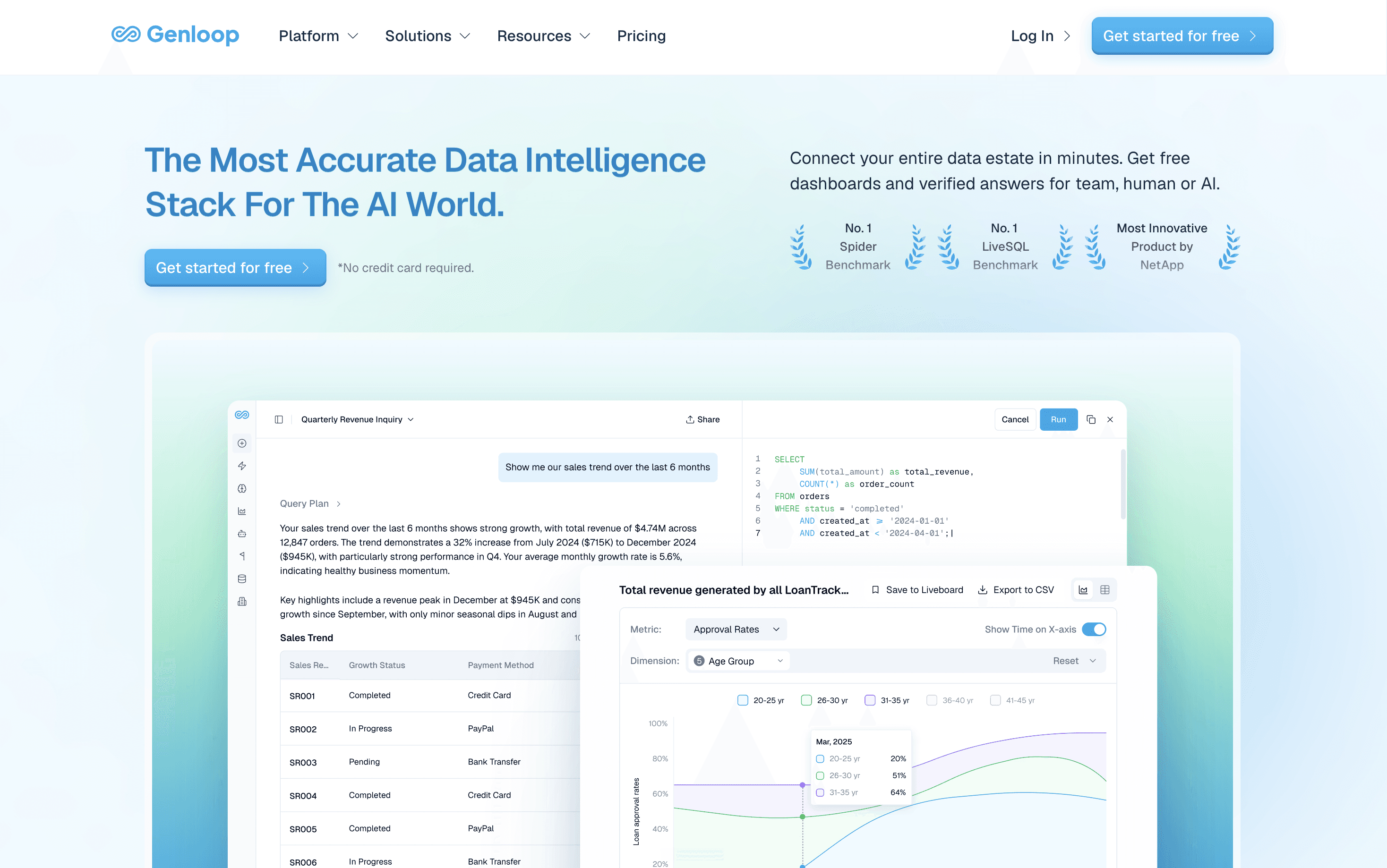
Genie One assumes the Databricks platform is the center of gravity. Genloop starts from a different assumption: that your data is already spread across several clouds and warehouses, and that moving it is not on the table. So instead of routing sources through one platform, Genloop connects to your warehouses and apps and reads each one in place, with zero copies and no migration. Its conversational analytics layer scores 96.7% on Spider 2, the hardest data reasoning benchmark, and ranks first on LiveSQL.
Both now aim to go past what happened to why it happened and what to do next. Where Genloop pushes further is the playbook: every answer your team validates makes the next one better, and each answer shows the reasoning path it took and a confidence score, so the why is visible rather than asserted.
Where Genloop is strong:
It reads each source in place with zero copies, so your data never leaves your systems.
It is cloud and model agnostic, and runs on-prem, in a VPC, or fully air-gapped with no external LLM calls.
It runs SQL and Python together, including regression and custom statistical analysis that SQL alone cannot express.
Your data team approves every update it learns, with role-based access enforced in each conversation, plus SOC2 Type II and ISO 27001.
Deterministic reasoning shows the path to each answer and traces anomalies to root cause, and a reliability engine flags answers it is unsure about.
Every answer carries a confidence score and shows the reasoning path it took, so a user can see exactly how a number was reached.
It goes beyond reporting to predictive, proactive insights and actionable next steps, surfacing what changed, suggesting what to do, and remembering what worked.
Dashboards are free with no per-seat cost, which puts it among the few genuinely free BI tools, so usage is not rationed by a meter.
Side-by-side comparison
Dimension | Databricks Genie One | Genloop |
|---|---|---|
Context layer | Genie Ontology, an inferred knowledge graph of business terms and KPIs. | Multi-modal context graph plus Unified Business Memory holding logic, metric definitions, team context, and join logic. |
Source integration | 50-plus external tools and databases through Databricks federation and connectors. | Direct connectors to Snowflake, BigQuery, Redshift, PostgreSQL, MySQL, and SQL Server, plus business apps. |
Data movement | External sources are reached through Databricks federation and connectors, and governed through Unity Catalog. | Reads each source in place, zero copies, no required migration. |
Analysis depth | Grounds answers in governed SQL, oriented to no-code use for business users. | Runs SQL and Python, including regression and custom statistical analysis. |
Deployment | Managed cloud only, on AWS, Azure, or Google Cloud. | Cloud, on-prem, VPC, or fully air-gapped with no external LLM calls. |
Governance | Unity Catalog enforces row and column security on every answer. | Role-based access with data-team validation of each learned update, SOC2 Type II, and ISO 27001. |
Action and automation | Schedules tasks, drafts documents, writes back to email, Jira, and Slack. | Report and metric triggers from chat, collaborative liveboards, deterministic reasoning that shows its path. |
Reach | Web, mobile, Slack, Teams, and MCP apps. | Web, Slack, MCP, embedded analytics, and your own product. |
Ecosystem | Wide Genie family: Agents, Code (generally available), App Builder and ZeroOps (in preview). | Specialized agents for deep-dive analysis and decision automation. |
Pricing | No seat pricing, with up to $10 free per user each month, then usage-based, so heavier use raises the bill. | Free dashboards with no per-seat cost, so usage is not rationed by a meter. |
Accuracy proof | Rests on Databricks scale and the ontology rather than a published public benchmark. | 96.7% on Spider 2 and first on the LiveSQL benchmark. |
Best fit | Teams already consolidated on Databricks and Unity Catalog. | Heterogeneous, multi-cloud, or regulated estates that cannot move data to a managed cloud. |
Decision matrix
Platform | Quality | Reliability | Transparency | Ease of use | Trust | Scale | Cost |
|---|---|---|---|---|---|---|---|
Genloop | ✓ | ✓ | ✓ | ✓ | ✓ | ✓ | ✓ |
Databricks Genie One | ✓ | ✓ | ◐ | ◐ | ◐ | ✓ | ◐ |
Genie One scores partial on quality, transparency, ease of use, trust, and cost. On quality, it is a capable product, but its accuracy is not independently benchmarked, whereas Genloop is proven #1 on Spider 2.0 and LiveSQL. On transparency, it shows the SQL behind an answer and can flag trusted assets, while Genloop attaches a confidence score and the full reasoning path to every answer by default. On ease of use, each Genie Space needs upfront data-team setup (curated tables, sample queries, metadata) that recurs with every new use case, while Genloop connects and reads in place without that build. On trust, it runs only as a managed cloud service, which rules it out for teams that need air-gapped or on-prem deployment. On cost, it has no seat pricing and a free monthly allowance, but data-heavy use beyond that is metered, while Genloop's dashboards stay free.
How to choose
The split is about where your data lives and where it is allowed to run.
Pick Genie One if:
Your data already lives in Databricks and you have standardized on Unity Catalog.
You want analytics native to the rest of the Genie family.
Pick Genloop if:
Your data is spread across several clouds and warehouses.
You work in retail, banking, healthcare, or the public sector, including regulated teams that cannot send data to a managed cloud.
You want statistical work in Python alongside SQL, exposed directly to your team.
You want predictive modelling on your data, smart actions triggered by the result, and alerts that fire when a metric moves, not just a static report.
For a heterogeneous estate, Genloop is the best default.
FAQ
How is Genie One different from the original Genie?
Genie One adds the Genie Ontology across data and apps, reusable Genie Agents, external connectors, a Unified Home with native mobile and MCP access, and the ability to take action rather than only answer. Chat surfaces like Slack and Teams were already available through the earlier Genie's Conversation API.
Do I have to move my data into Databricks to use Genie One?
No. Genie One connects to external sources through federation and connectors. Those sources are still routed through the Databricks platform and governed by Unity Catalog, so the platform stays the center of gravity even when the data does not start there.
Can Genloop run without sending data to an external LLM?
Yes. Genloop can be deployed on-prem, in a VPC, or fully air-gapped with no external LLM calls. This is the main reason regulated teams pick it over a managed cloud service.
Which one handles a question that spans Snowflake and Postgres at the same time?
Both can, but differently. Genie One federates both into the Databricks platform first. Genloop connects to each directly and reads them in place, generating SQL in each system's native dialect.
Does Genloop run Python, or only SQL?
Both. Genloop runs SQL for standard queries and Python when a question needs it, including regression and custom statistical analysis that SQL alone cannot express.
Is this a replacement decision?
Not always. If you are consolidating on Databricks, Genie One and Genloop can coexist, with Genloop covering the sources and deployments that sit outside the platform.