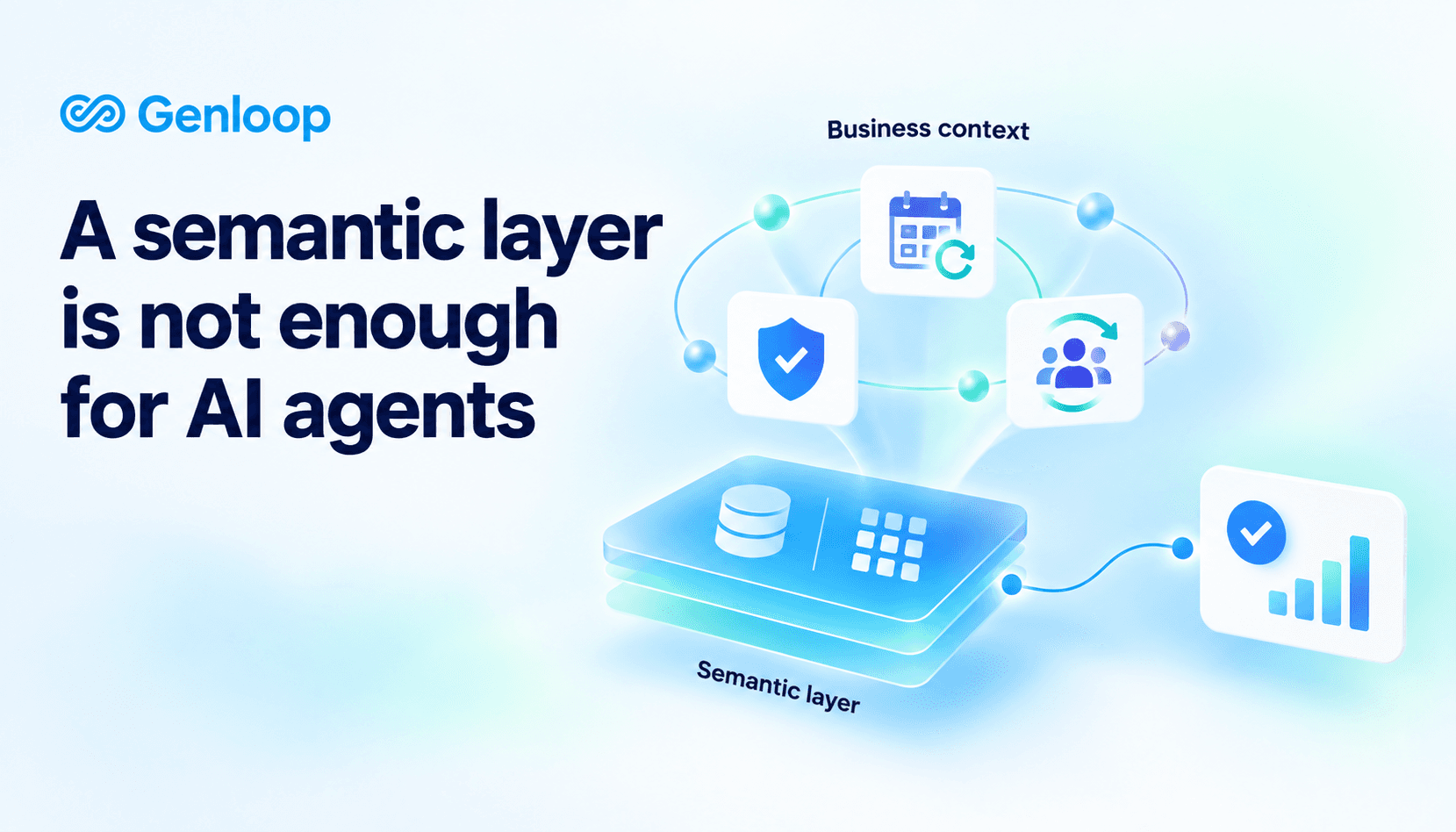

OpenClaw is a free, open-source AI agent you can point at your own data and talk to in plain language. For a single store run by a hands-on owner, that is genuinely useful: ask "what sold yesterday, and what is running low," get an answer, skip the dashboard. The harder question is what happens when one store becomes ten. This guide explains how an OpenClaw-style setup works for retail, what it does well, and where a multi-store chain needs governance, a shared context that learns, and answers that stay consistent across every role.
Key Takeaways
OpenClaw is an open-source, model-agnostic AI agent that runs locally and is driven through chat. Pointed at retail data, it answers operational questions in plain language.
For a single store, it is a legitimately good fit: low cost, fast to set up, useful day to day.
Multi-store retail needs three things a personal agent does not provide: governed per-store access, an organization-level context that learns your definitions, and consistent answers every role can trust.
Genloop adds exactly that layer for chains: governed role-based access, a Living Context Graph that learns your definitions, deterministic answers, and a #1 ranking on the public Spider 2.0-Snow benchmark at 96.70%.
What Is OpenClaw, and Why Are Retailers Watching Agentic Analytics?
OpenClaw is an open-source (MIT-licensed) autonomous AI agent created by developer Peter Steinberger. It runs locally as a background process, works with whichever model you connect (Claude, GPT, or a local model), and is driven through everyday messaging apps. An extensible "skills" system lets it run commands, read files, and pull from connected systems. It is not a data-analytics product. It is a general-purpose agent that people point at a data source and then question in plain language.
That last point is why retailers are paying attention. The useful pattern is not the tool itself, it is the interaction: ask a question, get a decision-ready answer, trigger an action, all without building a report. For a time-pressed operator, "tell me which products stalled this week" beats hunting through a dashboard. This is the same shift behind agentic analytics: software that reasons through a question across several steps rather than charting one metric at a time. OpenClaw made the pattern tangible for a wide audience; the open question for retail is how far it scales.
How Does an OpenClaw-Style Setup Work Over Retail Data?
You connect the agent to your retail data (point-of-sale, inventory, and loyalty records, usually through a warehouse or a connector), then ask questions in chat. The agent translates the question into a query, runs it, and replies in plain language. For the mechanics of connecting an agent to a warehouse, our complete guide to OpenClaw for business analytics covers the setup in depth, so this piece stays on the retail use cases.
For one store, the experience is genuinely good. A single owner-operator can ask:
"What were yesterday's sales versus the same day last week?"
"Which ten products are lowest on stock right now?"
"Did the weekend promotion actually lift baskets, or just pull sales forward?"
Cheap, fast to stand up, and useful from day one. If you run one location, that may be all you need, and you should not over-buy. The calculus changes when the questions stop being about one store.
How Do You Analyze Performance Across Multiple Stores?
Multi-store analysis is where the work gets harder, because the questions become comparative. A district lead does not ask about one store, they ask which stores are pulling the average down and why. The core jobs are cross-store ranking (best and worst performers on conversion or basket size), like-for-like or comparable-store sales (growth net of new openings), and regional roll-ups that aggregate many locations into one view.
A single personal agent strains here for three reasons. It has no built-in notion of "your district versus mine," so everyone sees everything. It re-interprets each question from scratch, so "conversion" can mean one thing on Monday and another on Friday. And it answers one user at a time, which does not match a chain where store managers, district managers, and a COO all need the same numbers cut differently. The pattern is right. The scale is the problem.
A governed platform closes that gap. Genloop, for example, ranks and compares stores against one consistent definition, rolls results up by region, and shows each leader only the locations they own, so a cross-store ranking reads as a single trusted view rather than a reconciliation of conflicting exports. The agentic experience stays the same; the difference is that the numbers agree.
Which Store Analytics KPIs Should an Agent Surface?
Good store analytics starts with a short list of operational metrics, not a 40-metric dump. The numbers an agent should surface on request are footfall and conversion rate (visitors, and the share who buy), average basket size and units per transaction, inventory turnover and sell-through, shrinkage, and labor cost as a share of sales. Planogram and on-shelf availability matter for chains that compete on execution.
The value of an agentic setup is that these stop being dashboards someone has to open. A manager asks "where am I overstaffed this week," and the agent reads labor against traffic and answers. With Genloop, the manager often does not ask at all: the platform watches these KPIs against governed definitions and pushes the exceptions, the few that moved, to the right person each morning, one of the core agentic use cases in retail. Either way, the metric still has to be defined consistently, which is exactly the gap that opens up across many stores.
How Does Customer Journey Mapping Work in Omnichannel Retail?
Customer journey mapping traces how a shopper moves from awareness to consideration to purchase to loyalty, across both online and in-store touchpoints. In omnichannel retail the goal is to connect those moments: a customer who browses online and buys in store should read as one journey, not two. Done well, journey mapping shows where shoppers drop off and which touchpoints actually drive repeat visits. McKinsey's finding that personalization typically lifts revenue 5 to 15 percent (McKinsey, 2021) is, in practice, a payoff of acting on that journey.
Most journey mapping plateaus at the digital edge. It captures clicks and email opens, then loses the thread when the customer walks into a store, because the in-store data lives in the point-of-sale and loyalty systems, not the marketing stack. Tying journey moments back to operational KPIs (did that loyalty offer change basket size at store 12) is where an analytics layer over all the data, not just the web data, earns its keep.
What Changes When You Go From One Store to a Chain?
At the second, fifth, and twentieth store, three needs appear that a personal agent does not meet: governed access so each manager sees only their store, an organization-level context that learns and remembers how your business defines its metrics instead of re-guessing each prompt, and consistent, reproducible answers that every role can trust. The table below is honest about where each approach wins.
Need | Single store (OpenClaw-style agent) | Multi-store chain (retail-grade platform) |
|---|---|---|
Setup and cost | Yes: cheap, fast, local | Managed deployment needed |
Ask your data in plain language | Yes | Yes |
Governed per-store access (RBAC, RLS) | No | Yes |
Context that learns your definitions | No (resets each prompt) | Yes (persistent, compounding) |
Consistent answers across many roles | No | Yes (deterministic) |
Scheduled brief per recipient | No | Yes |
What Does a Retail-Grade Platform Like Genloop Add?
Whatever tool a chain picks, the same four capabilities separate a single-user agent from something many stores and roles can run on: governed access, a context that learns, consistent answers, and proactive delivery. Each one maps to a specific problem that shows up as you add locations. Here is what each capability means, using Genloop as a worked example of how it can be built.
Governed access for every role
In a chain, not everyone should see everything. Genloop enforces role-based access with row-level and column-level controls, so a store manager sees only their store, a district manager only their district, and a COO the whole portfolio, all from the same source of truth. A personal agent has no concept of this. It answers whoever is holding it, which is fine for an owner-operator and a real problem the moment you have employees and franchisees.
A context that learns your business
The hardest part of analytics is not the query, it is the meaning. Genloop keeps a Living Context Graph that captures four things: what your data means, how your business investigates a question, what decisions were made and what resulted, and who is asking. It improves through a self-learning loop, so the definition of "conversion" or "comparable sales" is set once and reused, not re-guessed on every prompt. Over a year of questions, that context compounds into institutional memory a fresh agent session never has. This is the practical meaning of an organization-level context graph that learns: the system gets more useful the more your team uses it.
Answers you can trust, every time
Across many stores and roles, the same question has to return the same answer, or nobody trusts the number. Genloop is deterministic by design: ask it twice, get the same verified result. On accuracy, it ranks #1 on the public Spider 2.0-Snow benchmark at 96.70 percent, the hardest public test of analytical reasoning on real enterprise data, ahead of Tencent at 93.9 percent and Snowflake at 75 percent. For a chain making markdown, staffing, and inventory calls off these numbers, that reliability is the difference between a tool people lean on and one they quietly stop trusting.
Plain-language access and a brief for each recipient
The agentic experience still has to reach non-technical operators. Genloop answers in natural language and, instead of waiting to be asked, pushes a recipient-specific brief on a schedule: every store manager gets a morning read on their store, every district manager a Monday pack on their region, each scoped to what they govern. It queries live data in place, with no copies or ETL, so the answers reflect what is true now. For a chain, the access model matters as much as the analytics. If every manager is meant to read a daily brief, per-seat pricing quietly limits how far the insight travels, so how a platform charges for access often decides whether this kind of tooling reaches the people who act on it.
Conclusion: One Store, or a Chain?
If you run one store, an OpenClaw-style agent may be all you need. It is inexpensive, quick to set up, and the plain-language experience is the real thing. Point it at your data and start asking.
If you run a chain, the problem changes shape. Getting governed, consistent answers to many roles across many locations is a platform problem, not a prompt problem, and it calls for the governed analytics layer described above: role-based access, a context that learns your definitions, deterministic answers, and a brief for every recipient. Genloop is one platform built around that layer, and for a single independent shop that just wants a quick local agent it is more than you need, where an OpenClaw-style setup is the better starting point. If you do want to see governed, consistent answers across every store, you can try Genloop on your own data.
New to the category? Read what agentic analytics actually needs for the underlying concepts, see the core retail use cases in our guide to agentic AI for retail analytics.
Frequently Asked Questions
What is OpenClaw, and can it be used for retail analytics?
OpenClaw is an open-source, model-agnostic AI agent that runs locally and is operated through chat. It is not built for analytics, but you can point it at retail data through a warehouse or connector and ask questions in plain language, which makes it a practical option for a single store.
What does "the OpenClaw for retail" mean?
It means the same agentic, ask-your-data-in-plain-language experience that OpenClaw popularized, but built for retail at scale: many stores, many roles, governed access, and operational KPIs. A personal agent proves the pattern; a retail-grade platform like Genloop makes it safe and consistent across a chain.
How do you analyze performance across multiple retail stores?
You compare stores on the same metrics: conversion, basket size, and comparable (same-store) sales, then rank locations and roll results up by region. The hard part is keeping every metric defined the same way across stores, which is where a shared, governed semantic layer matters.
Which store analytics KPIs matter most for multi-location retailers?
Footfall and conversion rate, average basket size and units per transaction, inventory turnover and sell-through, shrinkage, and labor cost as a share of sales. Chains that compete on execution also track on-shelf availability and planogram compliance.
What are the limits of using an OpenClaw-style agent for a retail chain?
A personal agent has no governed per-store access, no persistent context that learns your definitions, and no guarantee of consistent answers across users. Those gaps are manageable for one store but become real risks across many locations and roles.
How is Genloop different from an open-source agent like OpenClaw?
Genloop keeps the plain-language experience but adds the chain-grade layer: role-based governance so each person sees only their stores, a Living Context Graph that learns your definitions, deterministic answers benchmarked #1 on Spider 2.0-Snow, and scheduled briefs per recipient. An open-source agent is a strong single-user tool; Genloop is built for many stores and roles.