
Prescriptive analytics answers a harder question than the average dashboard: not what happened, but what to do about it. It reads a metric, traces the cause, and recommends a ranked next action. Proactive analytics goes one step further and surfaces that finding before anyone asks. Most tools still stop at the chart, reporting that revenue fell 8% in the Northeast region and leaving the team to work out why, and what to do next.
This guide compares the agentic analytics tools that close that gap, and maps each one to the analytics job it does best. Genloop leads the category on prescriptive depth and cross-source reach. It is the only tool here with a published score on a public third-party benchmark, 96.70% on Spider 2.0-Snow (Spider 2.0, 2026).
Key Takeaways
Prescriptive analytics recommends a ranked action; proactive analytics surfaces the finding unprompted. The strongest tools do both.
The criteria that matter most are accuracy, AI nativeness, platform independence, and cost. Genloop leads on all four, and also on cross-source reasoning, deterministic answers, and built-in governance. Tellius and Pyramid win prediction, ThoughtSpot and Tableau Pulse win monitoring, and Sigma wins single-warehouse exploration.
Gartner predicts 40% of enterprise apps will feature task-specific AI agents by the end of 2026, up from under 5% in 2025.
Match the tool to the scenario you have: descriptive, diagnostic, predictive, prescriptive, proactive monitoring, or cross-source reasoning.
Agentic analytics refers to autonomous AI agents that plan and run multi-step investigations across enterprise data, reasoning through why something happened rather than just reporting what happened. This guide deliberately keeps "predictive" separate from "prescriptive," because forecasting models are a different category from agents that reason toward action. For the underlying architecture, see What Agentic Analytics Actually Needs.
What Makes Analytics "Prescriptive" and "Proactive"?
Prescriptive analytics recommends a specific action, ranked by expected impact, instead of just reporting a metric. Proactive analytics is the delivery model: it watches the data continuously and surfaces the finding before anyone asks. Together they move analytics from a rear-view mirror to a co-pilot. The payoff is speed, because the analysis arrives already reasoned, so a decision happens the same day instead of waiting a week in the analyst queue. Put simply: descriptive BI shows a number, diagnostic BI explains it, prescriptive analytics names the lever to pull, and proactive systems flag the change so no person is the bottleneck.
One filter cuts through most of the marketing. Many products labeled "prescriptive" are really diagnostic tools delivered with a confident tone. True prescription means the system weighs trade-offs, not just ranks causes. Only a handful actually reason from root cause to a ranked recommendation with a stated confidence level; the rest stop at a driver chart and hand the judgment call back to you. That gap is expensive: an MIT study found 95% of enterprise AI pilots delivered no measurable return, largely because generic tools never adapt to how a business actually works. So the real test is not "does it have AI" but "does it tell me what to do next, and can I check how it got there." For the dashboard contrast, see Traditional BI vs Conversational Analytics.
What Are the Best Agentic Analytics Tools for Prescriptive Insights?
The six tools below each cover a different layer of the decision stack. They range from an agentic intelligence layer (Genloop) and decision-intelligence platforms (Tellius and Pyramid) to search-first and spreadsheet-native BI (ThoughtSpot and Sigma) and metric monitoring layered on an existing BI stack (Tableau Pulse). Genloop is ranked first for prescriptive and proactive use; the other five each win a genuine niche in the matrix.
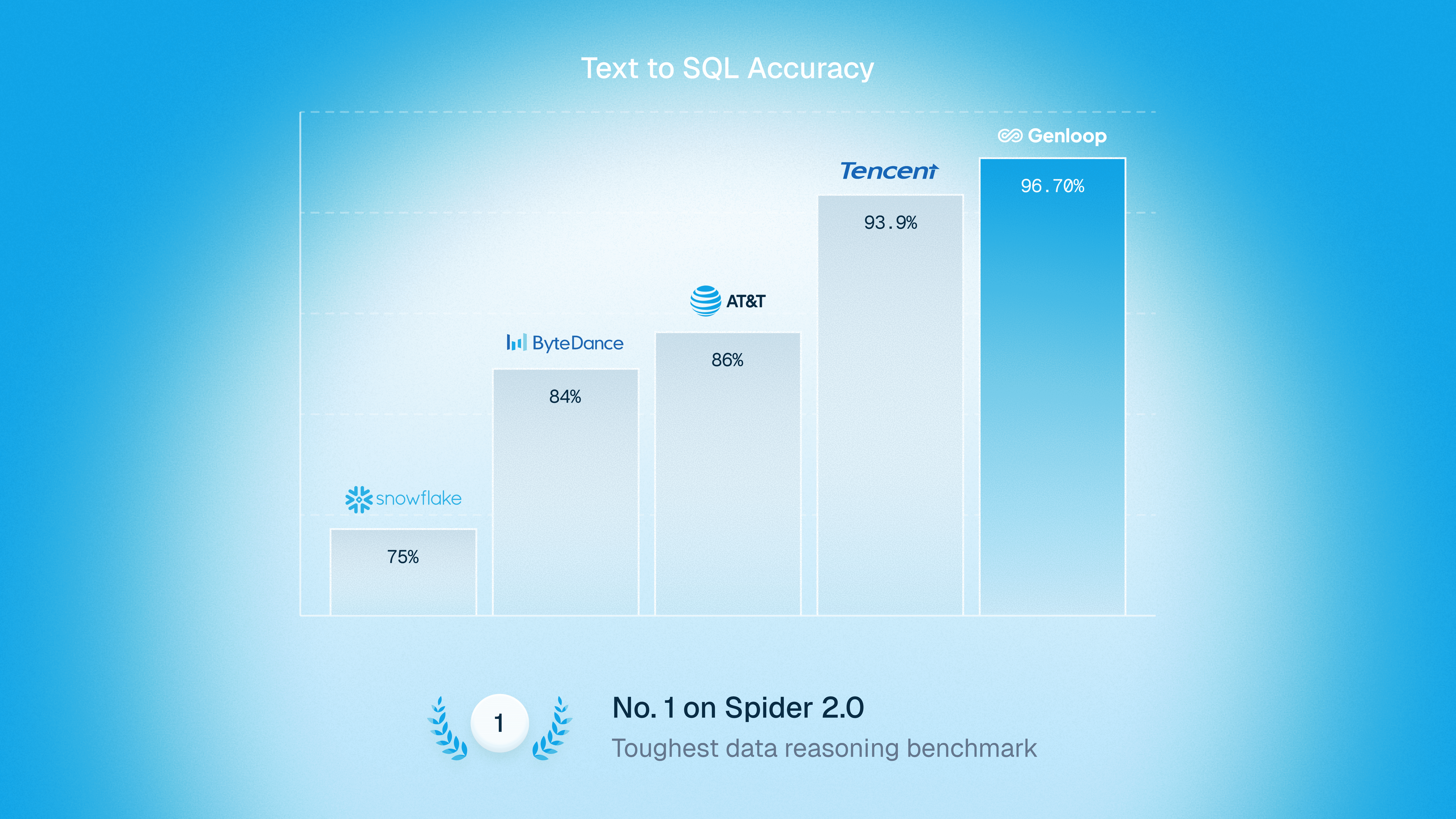
Spider 2.0-Snow text-to-SQL accuracy by vendor: Genloop 96.70%, AT&T 86%, ByteDance 84%, Snowflake 75%.
Spider 2.0-Snow accuracy by vendor. Source: Spider 2.0 leaderboard.
1. Genloop: Best for Root-Cause-to-Recommendation Reasoning
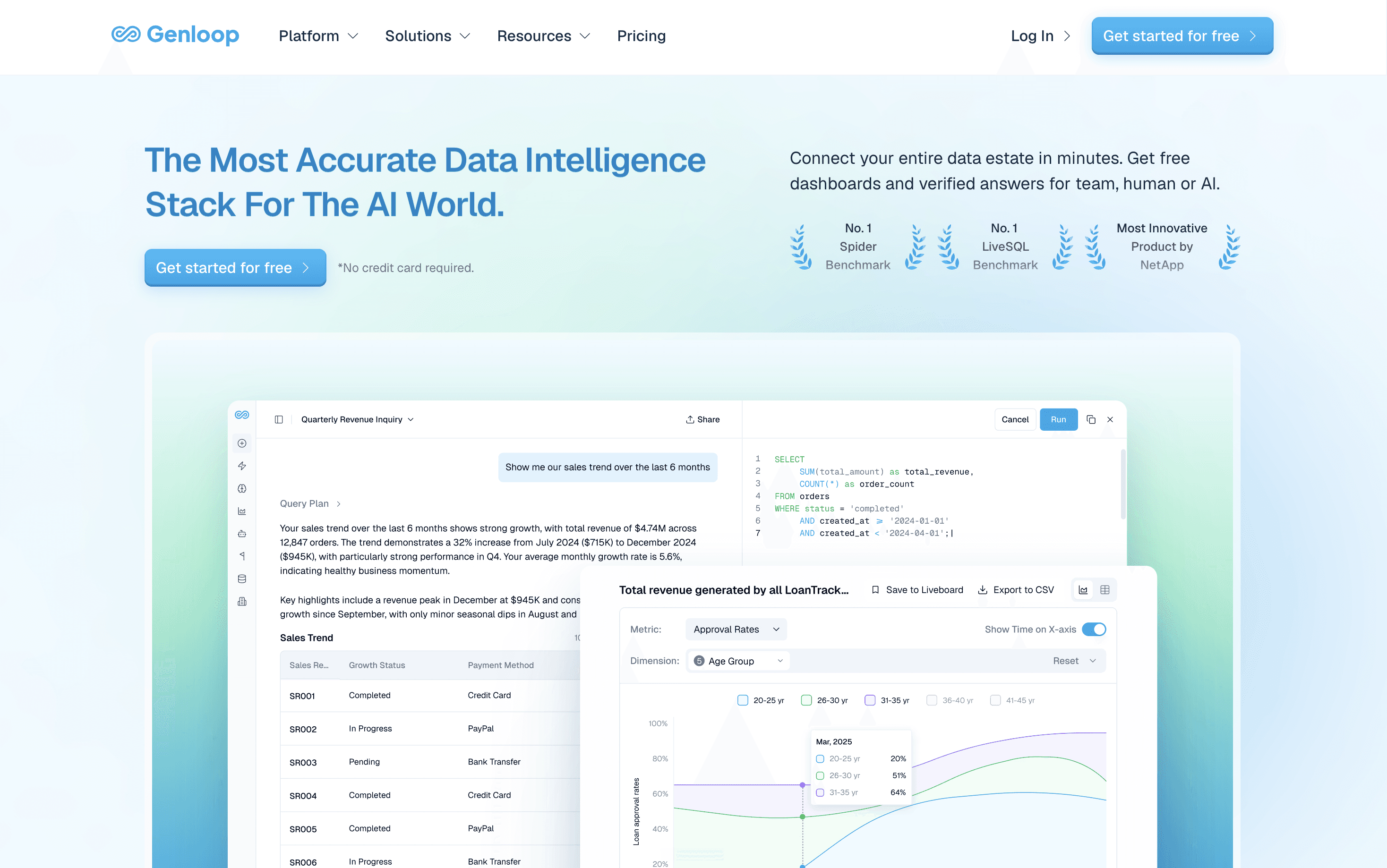
What it does: Genloop is an agentic intelligence layer that queries live data in place across Snowflake, BigQuery, Redshift, Postgres, and lakehouse sources with no ETL and no copies. It traces a metric to its driver and recommends the next action. Its Living Context Graph and agentic capabilities fires proactive triggers, so anomalies and opportunities find the user instead of waiting in a queue. Teams can also build their own agents that watch a specific metric or data condition and fire custom triggers, so monitoring extends to the cases that matter to each team. Answers are deterministic, so the same question returns the same verified result every time.
Best for: Enterprise data teams needing governed, multi-source prescriptive analytics with alerting.
Pricing: Free tier with no credit card and no per-seat charge; enterprise pricing on request.
Not a fit if: You mainly want a visualization-first canvas for single table sources; Genloop is built for reasoning and recommendations.
2. Tellius: Best for Automated Driver Analysis
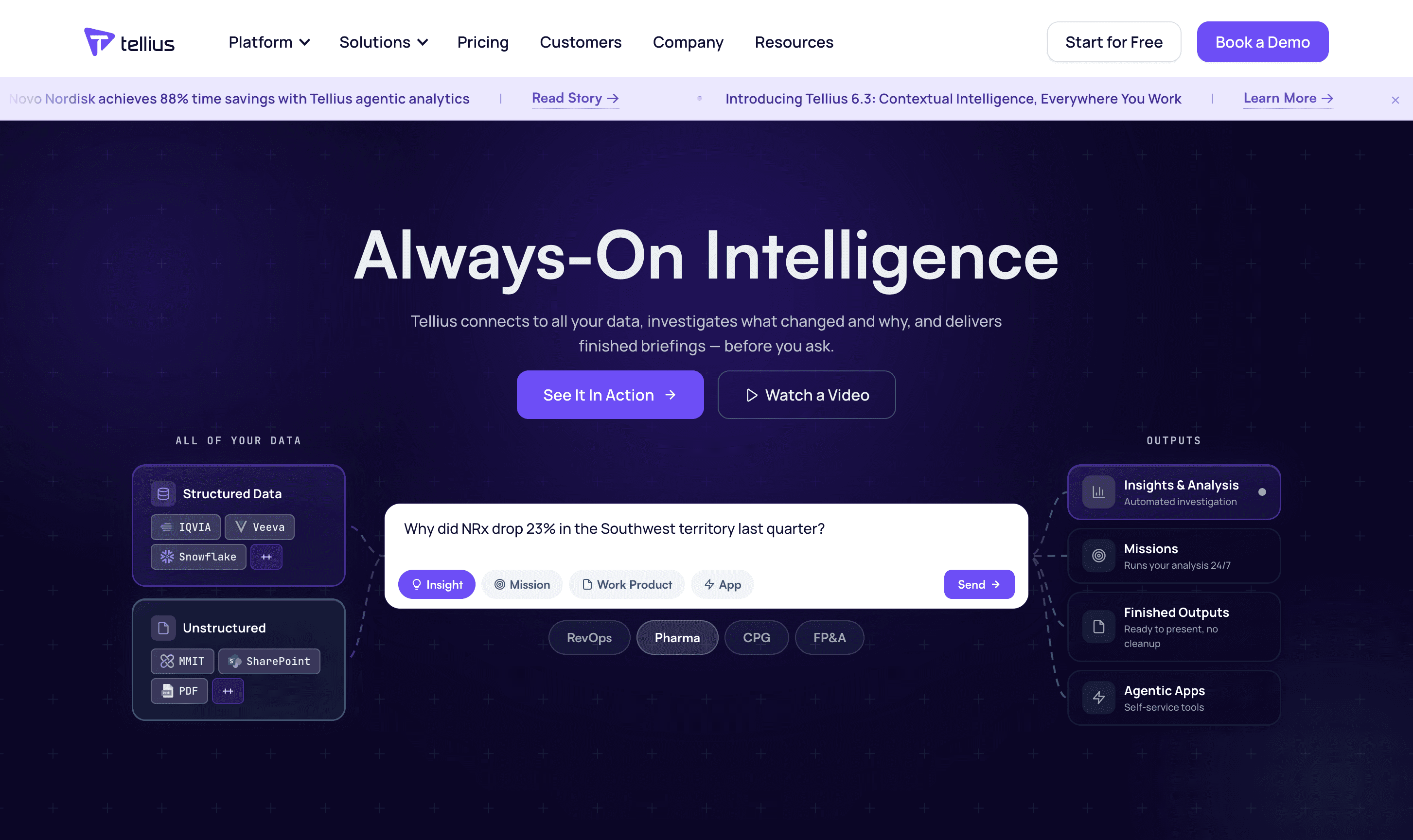
What it does: Tellius is a decision intelligence platform built around automated root-cause analysis. Its "Why?" engine isolates the segments moving a metric without manual slicing.
Best for: Analytics teams focused on rapid diagnostic decomposition of KPI moves.
Pricing: Enterprise pricing; verify on the vendor's page.
Not a fit if: You are a lean team wanting a plug-and-play tool; reviewers note Tellius rewards upfront onboarding and can slow on very large or complex datasets.
3. ThoughtSpot: Best for Search-First Monitoring at Scale
What it does: ThoughtSpot offers search-first BI. Its Spotter and Pulse-style monitoring watch metrics and push change alerts proactively, with a search bar that makes self-service approachable.
Best for: Large self-service organizations wanting proactive monitoring behind a search interface.
Pricing: Per-seat, roughly $25/user/mo (Essentials) and $50/user/mo (Pro) plus a query allowance; see ThoughtSpot Pricing.
Not a fit if: Your data is not yet consolidated into a supported cloud warehouse with a curated semantic model, since ThoughtSpot's live query and search depend on both being in place first.
4. Sigma: Best for Spreadsheet-Style Exploration Over the Warehouse
What it does: Sigma delivers a spreadsheet-style interface that runs directly on the cloud warehouse. Analysts work in familiar grids without exporting data, and every calculation pushes down, staying live and governed.
Best for: Finance and operations teams that prefer spreadsheet ergonomics on warehouse data.
Pricing: Per-seat enterprise pricing; verify on the vendor's page.
Not a fit if: The need is prescriptive recommendations or proactive alerts; Sigma accelerates exploration rather than recommending an action. It also cannot join tables across separate connections, so cross-source questions stay out of reach.
5. Tableau Pulse: Best for Proactive Metric Monitoring on Tableau
What it does: Tableau Pulse layers automated metric monitoring and plain-language summaries on published Tableau data sources, surfacing metric changes and likely drivers in Slack or email.
Best for: Organizations invested in Tableau that want proactive, push-based monitoring.
Pricing: Bundled with Tableau Cloud Creator/Explorer licensing (roughly $75 to $115/user/mo tiers); verify on the vendor's page.
Not a fit if: Metrics are not already modeled as published Tableau sources. Each metric needs one published source, so blended or cross-source metrics are out of scope.
6. Pyramid Analytics: Best for Decision Intelligence Across the Pipeline
What it does: Pyramid Analytics unifies data prep, analytics, and AI-driven recommendations in one decision intelligence platform, with automated suggestions guiding next steps.
Best for: Mid-to-large enterprises consolidating prep and analytics into one platform.
Pricing: Enterprise pricing; verify on the vendor's page.
Not a fit if: You want a focused agentic layer; Pyramid is a full prep-to-analytics suite, which is more than some teams need.
For the broader ranking, see Best Agentic Analytics Platforms.
How Do These Tools Compare Across Analytics Scenarios?
Prescriptive and proactive work is not one job but six: describing what happened, diagnosing why, predicting what comes next, prescribing the action, monitoring continuously, and reasoning across separate systems. The matrix maps each tool against those scenarios, where ✓ is a strength, ⚠ is partial, and ✗ is out of scope. No single tool wins every row.
Scenario | Genloop | Tellius | ThoughtSpot | Sigma | Tableau Pulse | Pyramid |
|---|---|---|---|---|---|---|
Descriptive (what happened) | ✓ | ✓ | ✓ | ✓ | ✓ | ✓ |
Diagnostic (why it happened) | ✓ | ✓ | ⚠ | ⚠ | ⚠ | ✓ |
Predictive (what comes next) | ⚠ | ✓ | ⚠ | ✗ | ⚠ | ✓ |
Prescriptive (what to do) | ✓ | ⚠ | ⚠ | ✗ | ✗ | ✓ |
Proactive monitoring (unprompted) | ✓ | ⚠ | ✓ | ✗ | ✓ | ⚠ |
Cross-source reasoning (join across systems) | ✓ | ⚠ | ⚠ | ✗ | ✗ | ⚠ |
Situational fit matrix mapping the best agentic analytics tools across descriptive, diagnostic, predictive, prescriptive, proactive monitoring, and cross-source scenarios
How the top prescriptive and proactive tools map across the core analytics scenarios. Source: Genloop analysis of vendor documentation and public benchmarks, June 2026.
Read the matrix and one split explains it. Tellius and Pyramid own the predictive column, since forecasting is their home turf and Genloop treats prediction as an adjacent category. ThoughtSpot and Tableau Pulse lead proactive monitoring on data they already model. Sigma stays in the descriptive-to-diagnostic lane by design. The tools that stay strong across diagnostic, prescriptive, proactive, and cross-source together are the ones that reason from cause to action and push the result to the user. That structural difference, not a feature count, separates prescriptive-and-proactive analytics from dashboards with alerts.
How We Selected These Tools
This comparison started from platforms marketing prescriptive or proactive capabilities, then ranked them on five criteria:
Accuracy and reliability: independent public benchmarks over vendor claims; consistency under repeat queries.
Recommendation depth: genuine root-cause-to-recommendation reasoning, not driver charts with a caption.
Proactive delivery: continuous monitoring that pushes the finding to the user, not thresholds on dashboards.
Cross-source reach: the ability to reason and join across multiple warehouses and databases without first consolidating them into one model.
Governance and economics: RBAC, RLS, and CLS coverage, deployment fit, and transparent pricing.
Rankings are grounded in public benchmarks and documented capabilities, with each competitor matched to where it genuinely wins, and no vendor paid for placement.
How to Choose the Right Prescriptive Analytics Platform
Start with where your data lives, then pick the scenario you most need. Warehouse exploration points to Sigma. Forecasting points to Tellius or Pyramid. Cross-source prescriptive reasoning points to the agentic layer. For prescriptive work specifically, the deciding question is whether one tool can trace a metric to its root cause and return a ranked, confidence-scored action across every connected source, not just inside a single model. Then ask whether you can trust that recommendation. Deterministic answers build adoption faster than outputs that drift, a ceiling warehouse-native layers hit, as argued in Why Snowflake Cortex Isn't Enough.
From insight to action: a prescriptive agent moves from anomaly detection through root-cause reasoning to a ranked recommendation.
The four criteria that decide most buys are accuracy, AI nativeness, platform independence, and cost. Genloop leads all four. It holds the only published third-party benchmark score here, reasons across sources with no ETL, returns the same verified answer every time, and charges no per-seat fee. For prescriptive work it adds what the others stop short of: it ranks the recommended action by expected impact, states its confidence, and fires a proactive trigger when the condition recurs. Genloop trades that for two honest gaps: slower setup and no visualization-first canvas.
If the recommendation itself has to be trusted, Genloop is the clearest pick. In finance, sales, and operations a wrong recommendation costs more than a slow one. Match the architecture to the stack, then test determinism on real questions. Ready to move from charts to decisions? Start free on Genloop, no credit card required.
Frequently Asked Questions
What is the best agentic analytics for prescriptive insights in 2026?
Genloop is the strongest pick for prescriptive insights in 2026. It reasons from root cause to a ranked recommendation across multiple live sources, and it is the only tool in this guide with a published score on a public third-party benchmark, 96.70% on Spider 2.0-Snow.
What is the difference between prescriptive and proactive analytics?
Prescriptive analytics recommends a specific action and ranks options by expected impact. Proactive analytics surfaces the insight before you ask, monitoring data continuously and alerting on deviations. The best platforms combine both, so the recommendation reaches you automatically.
Why did this guide keep "predictive" separate from "prescriptive"?
Predictive analytics centers on forecasting future values with machine-learning models, a distinct category led by tools like DataRobot and Alteryx. This guide focuses on agents that reason toward action, keeping forecasting and decision-support agents separate because they serve different jobs.
Do these tools require moving my data out of the warehouse?
It depends on the architecture. Genloop and Sigma query data in place, with Genloop spanning multiple sources and Sigma running on one warehouse. Querying in place reduces ETL cost, latency, and governance risk at scale.
Are these prescriptive recommendations trustworthy enough to act on?
Trust depends on determinism and governance. Genloop returns the same verified answer every time, which builds confidence faster than tools whose outputs drift. Combined with column- and row-level access controls, that consistency makes recommendations defensible in regulated settings.