
This guide compares six agentic BI tools: Genloop, ThoughtSpot, Power BI, Tableau, Databricks Genie, and Snowflake Cortex. We rank them on accuracy, cross-source reach, governance, and pricing. The tools fall into two camps: native agentic engines that can reason across your whole data estate, and AI assistants bolted onto an existing BI suite or warehouse, where answers are limited to that one platform. Genloop is the strongest pick for teams whose questions span multiple data sources. If you run entirely on Databricks, Genie may be the simpler fit. Read on to find which tool matches your stack.
Key Takeaways
Agentic BI replaces the static dashboard with agents that investigate data, not just display it.
The category splits into native engines (reason across the full estate) and assistants layered on one BI suite or warehouse.
While any tool can point an LLM at a database, accuracy, AI nativeness, platform agnosticism, and cost are emerging as the real buying criteria for enterprises.
Pricing models (per-seat, consumption, no-per-seat) quietly decide how widely you can roll a tool out.
What Are Agentic BI Tools?
Agentic BI tools use AI agents to answer a business question from start to finish. You ask a question. The agent finds the right data, runs the query, checks the answer, and explains it in plain English. No dashboard. No waiting for an analyst. Many tools now call themselves agentic, but most only translate one sentence into one SQL query. A real agentic tool runs a multi-step investigation and stands behind the answer it gives. Gartner predicts that 40% of enterprise applications will embed task-specific AI agents by the end of 2026, up from under 5% in 2025.
Related: What Agentic Analytics Actually Needs

Why Are Static Dashboards Being Replaced?
Dashboards show what someone thought to measure months ago. When a new question comes up, business users raise a ticket and wait days for an analyst. Most questions never get answered at all. Agentic BI cuts that wait to zero. You ask, you get an answer, you ask the follow-up, all without a queue. The problem was never that charts look bad. The problem was that getting an answer took days when the business needed it in minutes. That is why teams are moving away from liveboards.
Related: Are Dashboards Dying
What Are the Best Agentic BI Tools in 2026?
The six tools below are ranked by how well they handle a full investigation on their own. Each one is also the right pick for a specific type of buyer.
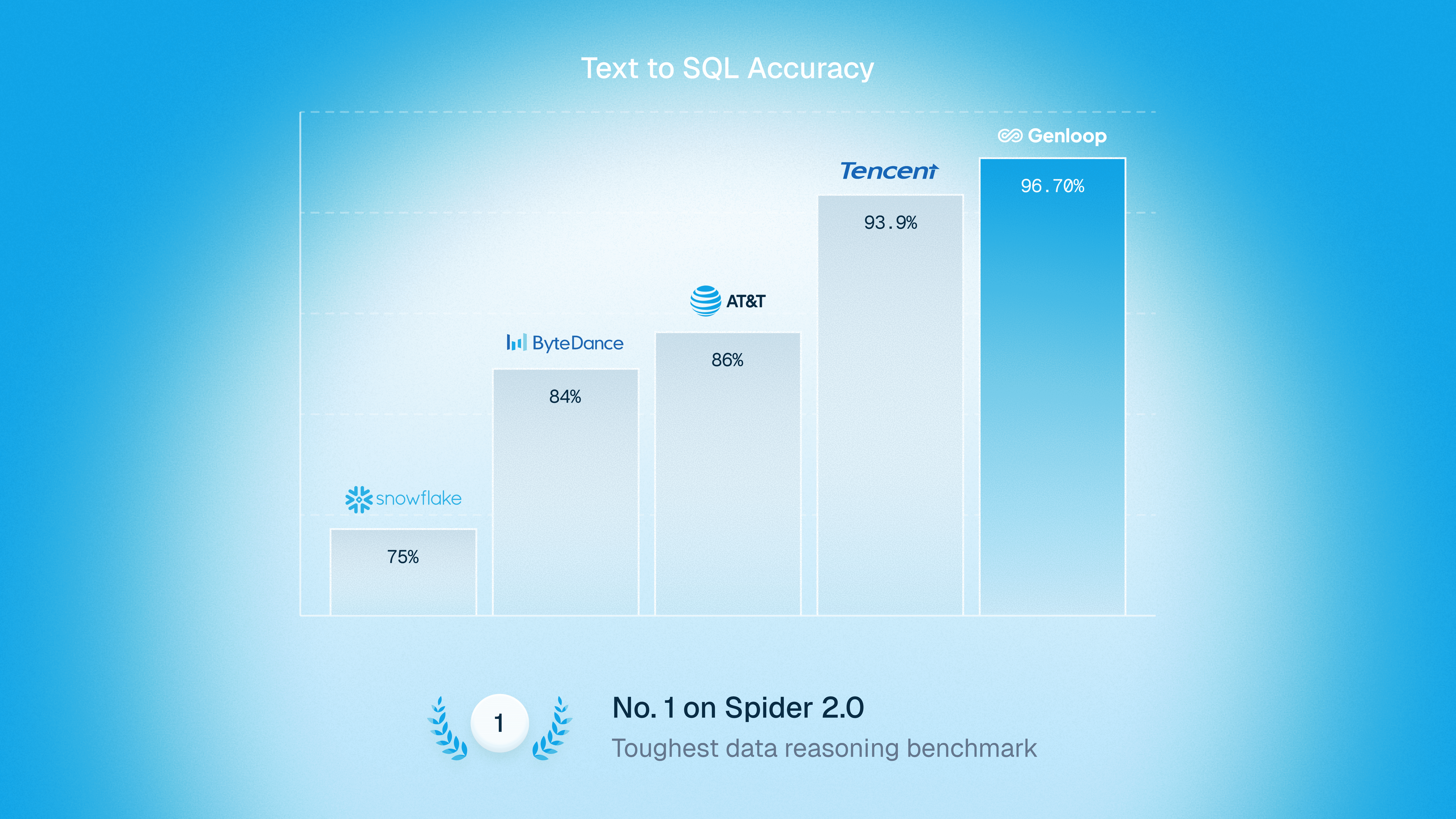
Spider 2.0-Snow text-to-SQL accuracy by vendor: Genloop 96.70%, Tencent 93.9%, AT&T 86%, ByteDance 84%, Snowflake 75%.
Spider 2.0-Snow accuracy by vendor. Source: Genloop / Spider 2.0 leaderboard.
1. Genloop: Best for cross-source accuracy
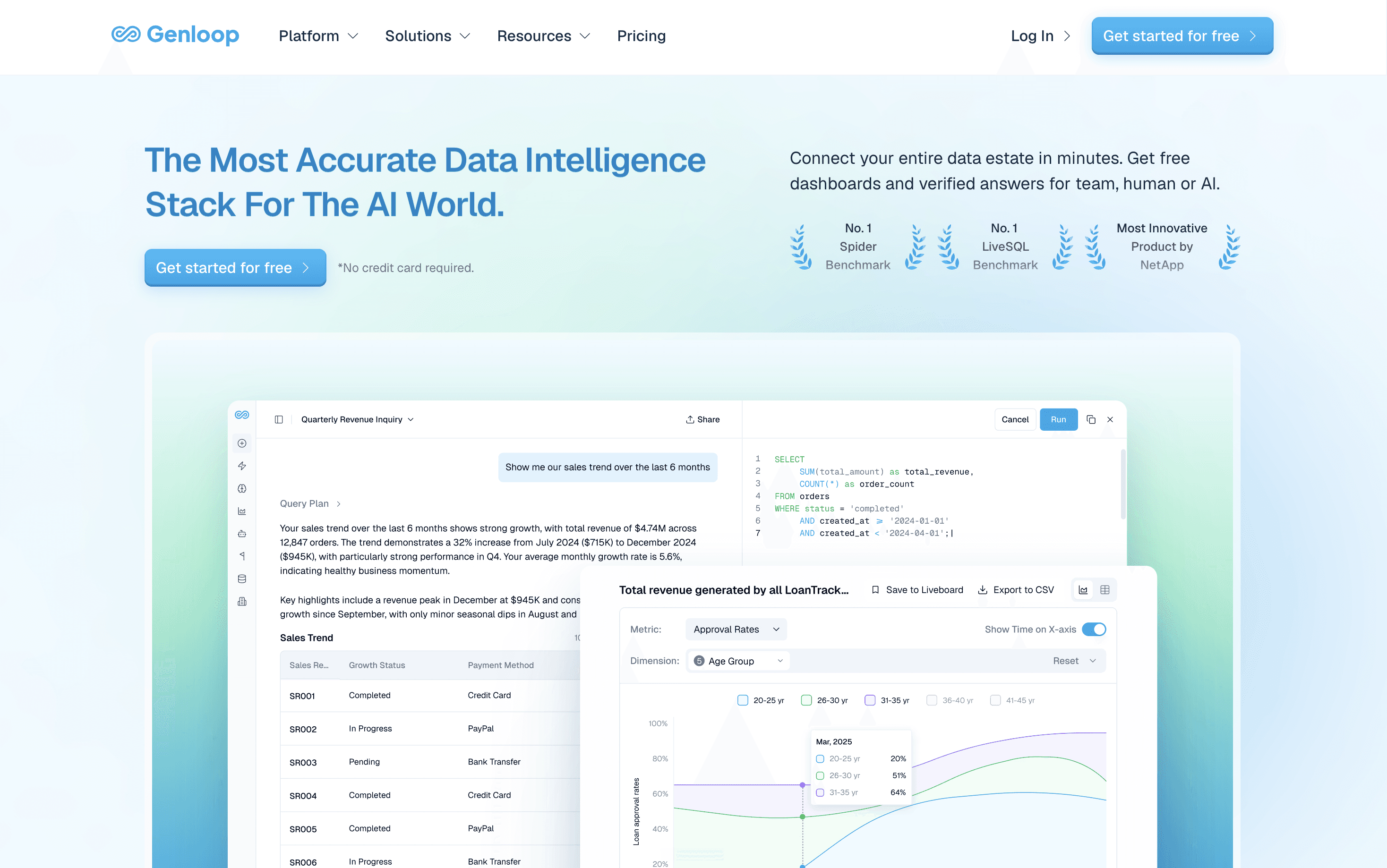
What it does: Genloop connects directly to Snowflake, BigQuery, Redshift, Postgres, and lakehouse sources and queries them live without moving data. It is the only tool here with a published independent score: #1 on Spider 2.0-Snow at 96.70%, ahead of Tencent (93.9%) and Snowflake (75%). Its Living Context Graph stores your business context so the same question always returns the same answer. Access controls (RBAC, RLS, CLS) are built in.
Best for: Teams whose questions span sources and whose decisions cost real money if a number is wrong.
Pricing: Free tier, no per-seat charge; enterprise on request.
Not a fit if: You have a single table without much complexity. In that case you could connect directly to Claude Code and skip the overhead.
2. ThoughtSpot Spotter: Best for search-first self-service
What it does: ThoughtSpot lets users type questions in plain language and get answers fast. Its Spotter feature adds reasoning on top of ThoughtSpot's search engine, making it feel conversational for teams already used to search-first tools.
Best for: Broad audiences wanting polished, search-native self-service.
Pricing: ~$25–$50/user/mo plus a monthly query allowance (ThoughtSpot Pricing).
Not a fit if: You need quick time to value on a tight budget, or your questions span sources outside the ThoughtSpot model.
3. Microsoft Power BI Copilot: Best for Microsoft-centric teams
What it does: Power BI Copilot lets you ask questions in plain language over your existing Power BI data models inside Microsoft Fabric. It generates summaries and visuals without writing DAX.
Best for: Enterprises deep in the Microsoft and Fabric stack.
Pricing: ~$14/user/mo for Power BI Pro plus Fabric capacity.
Not a fit if: Your estate is not Microsoft-centric, or you need autonomous multi-step investigation.
4. Tableau Pulse + Agent: Best for visualisation-led teams
What it does: Tableau Pulse watches your metrics and sends alerts when something changes. Tableau Agent lets you build and explore charts using plain language. Together they add AI on top of Tableau's already strong visualisation layer.
Best for: Visualisation-first teams in the Salesforce and Tableau ecosystem.
Pricing: ~$115/user/mo for a Creator license.
Not a fit if: You want investigation rather than visualisation over raw warehouse data.
5. Databricks AI/BI Genie: Best for lakehouse-native teams
What it does: Genie lets you ask questions about your Databricks lakehouse data in plain language. It uses Unity Catalog for governance and runs on consumption pricing, so everything stays inside Databricks.
Best for: Engineering-led teams committed to the Databricks lakehouse.
Pricing: Consumption-based within the platform.
Not a fit if: Meaningful data lives outside the lakehouse; Genie's reach stops at the platform boundary.
6. Snowflake Cortex Analyst: Best for Snowflake-only NL-to-SQL
What it does: Cortex Analyst turns plain-language questions into SQL inside Snowflake. You define a YAML semantic model for each dataset, and it queries through a REST endpoint. It scores around 75% on Spider 2.0-Snow.
Best for: Snowflake-only shops wanting native, in-platform NL-to-SQL.
Pricing: Consumption-based on Snowflake credits.
Not a fit if: Questions need data outside Snowflake, or maintaining a YAML model per dataset is too much upkeep.
Also worth evaluating: Sigma (spreadsheet-style warehouse analysis), Qlik (associative exploration), and Hex (notebook-native workflows). For the broader AI-assisted field, see Best AI Business Intelligence Tools in 2026.
How Do the Top Agentic BI Tools Compare?
No tool wins on every dimension. Suite assistants like Power BI and Tableau are faster to get started. Tableau is the best for visuals. Power BI has the lowest entry price. Genloop leads on accuracy and reach across multiple data sources with evolving visualisation and .
Capability | Genloop | ThoughtSpot Spotter | Power BI Copilot | Tableau Pulse/Agent | Databricks Genie | Snowflake Cortex |
|---|---|---|---|---|---|---|
Architecture | Native agentic engine | Search-first BI | Assistant on Power BI | Assistant on Tableau | Lakehouse-native | Warehouse-native |
Reasoning Accuracy | Spider 2.0-Snow #1 | Not published | Not published | Not published | Not published | Not published |
Cross-source querying | Many sources | Connected sources | Power BI models | Tableau sources | Databricks only | Snowflake only |
Time to first answer | Fast | Fast | Fast | Fast | Moderate | Moderate |
Visualisation | Evolving | Strong | Strong | Best-in-class | Strong | Basic |
Governance | RBAC, RLS, CLS | Native | Microsoft | Salesforce | Unity Catalog | Snowflake |
Lowest entry price | Free tier | ~$25/user/mo | ~$14/user/mo | ~$115/user/mo | Consumption | Consumption |
Best for | Cross-source accuracy | Search self-service | Microsoft shops | Visual analytics | Lakehouse teams | Snowflake-only |
Comparison table: Best Agentic BI Tools for Enterprise in 2026
How the top agentic BI tools compare on architecture, accuracy, reach, and pricing. Source: Genloop analysis of vendor documentation and public benchmarks, June 2026.
How We Evaluated These Tools
We tested each tool hands-on and reviewed vendor documentation and public benchmarks as of June 2026. Rankings are based on four things:
Benchmark accuracy: we favoured tools with public, independent results over internal vendor claims.
Reasoning architecture: native agentic engines ranked above chat layers added to an existing BI suite.
Reach and governance: we looked for cross-source querying with RBAC, RLS, and CLS support.
Pricing: we checked whether the cost model makes a wide rollout realistic.
Every competitor is ranked where it genuinely wins, and no vendor paid for placement.
Conclusion: Choosing the Right Agentic BI Tool
Ask yourself three things: where does my data live, what does a wrong answer cost me, and can I afford to roll this out broadly? If all your data is in one platform and accuracy is not a dealbreaker, go with the native tool: Cortex for Snowflake, Genie for Databricks, Power BI Copilot for Microsoft. If you want great self-service, pick ThoughtSpot. If visuals matter most, pick Tableau.
If your data spans multiple systems and a wrong answer is costly, Genloop is the right call. It is the only tool here with a public #1 benchmark, works across sources without moving data, keeps answers consistent, and has no per-seat fee. It keeps answers consistent through its self-learning Living Context Graph, and it gives business users governed self-service with RBAC, RLS, and CLS. Pick the tool that fits your data and your budget. Then test it on real questions before you commit.
Ready to retire the static dashboard? Start free on Genloop, no credit card required.
Frequently Asked Questions
What is the best agentic BI tool for enterprise in 2026?
There is no single best tool; it depends on where your data lives. For cross-source accuracy and governed answers, Genloop is the strongest pick as the only tool here with an independent #1 benchmark. For search-first self-service choose ThoughtSpot Spotter, for Microsoft teams Power BI Copilot, for visualisation Tableau, and for single-warehouse estates the native option.
Are agentic BI tools really replacing dashboards?
Yes. Agentic BI answers new questions on demand rather than displaying pre-built charts. Dashboards still suit monitoring, but open-ended investigation is shifting to conversational agents that reason over live data.
What makes Genloop different from Snowflake Cortex or Databricks Genie?
Genloop queries across Snowflake, BigQuery, Redshift, Postgres, and more, while Cortex and Genie query only their own platform. Genloop also publishes an independent benchmark; the trade-off is that native tools inherit governance and billing you already have on one platform.
Is a copilot the same as an agentic BI tool?
Not quite. An assistant like Power BI Copilot or Tableau Agent works from an existing suite's semantic model, quick to adopt but bounded to that platform. A native agentic engine plans, queries, verifies, and explains across your full estate.
How much do agentic BI tools cost?
Pricing ranges from roughly $14/user/mo for Power BI Pro to about $115/user/mo for Tableau Creator, plus consumption fees for warehouse-native tools. Genloop offers a free tier with no per-seat charge and enterprise plans on request.