
Retail analytics software turns point-of-sale, inventory, labor, and traffic data into answers about what is happening across stores and why. Market researchers size the category at roughly $7 to $11 billion in 2025. For a multi-location operator the hard part is rarely one dashboard. It is getting the same trustworthy number for every store, every week, without a data team rebuilding the report by hand. Most chains in the $15M to $250M range run on Square, Toast, Shopify POS, or Lightspeed with one analyst at most. What you need depends on which of three jobs carries your biggest cost: operational store reporting, demand forecasting, or BI visualisation. The right pick follows from whether forecasting, search, or marketing is your priority, and from how much data-engineering work you can support in-house.
Key Takeaways
"Retail analytics software" spans three jobs: operational store reporting, demand forecasting, and BI visualisation. No single tool leads all three.
Match the tool to whichever job carries your biggest cost today, not to a feature checklist.
Enterprise suites (Oracle Retail, RELEX, Retalon) win on forecasting depth; general BI tools (Tableau, Power BI) win on visualisation and cost.
Watch total cost, not list price: warehouse and data-engineering prerequisites often dwarf the seat fee.
What Is Retail Analytics Software?
Retail analytics software collects transaction, inventory, labour, and customer data across your stores and turns it into reporting and decision-ready answers. The category splits into three jobs buyers often conflate: operational store reporting, demand forecasting, and BI visualisation. No single tool leads all three, so the question that matters is which job carries your biggest cost today.
For multi-location reporting, Genloop is the place to start. It standardises metric definitions once and applies them everywhere, so a "sale" means the same thing in every store, then lets anyone ask for the numbers in plain language. Harder questions trigger a deeper investigation that returns a written report rather than a raw table, recurring packs can run on a schedule, and onboarding takes minutes because it reads your schema itself. The other platforms anchor different jobs: Oracle Retail for enterprise suites, RELEX for forecasting, and ThoughtSpot for self-service BI.
What Problems Does Retail Analytics Software Solve?
Why Is One Store Missing Target While Another Hits It?
It isolates store-level variance across traffic, conversion, basket size, and product mix, so leaders see why a store misses target, not just that it did. A flat sales number hides the cause. Two stores can post the same revenue while one wins on traffic and loses on conversion and the other does the reverse, and each needs a different fix. Same-store sales are the revenue growth of locations open at least a year, stripping out new-store noise so a like-for-like comparison is honest. Good software computes that metric the same way for every store, then decomposes the gap into the levers a manager can move. Without it, a regional lead spends Monday rebuilding spreadsheets while the slowest store stays slow.
Where Are You Over- or Under-Staffed?
It aligns labor to sales and traffic, flagging shifts that miss demand. Labor is typically retail's largest controllable operating line.
Which Promotions Actually Paid Off?
It measures incremental lift and cannibalisation, separating real margin gain from sales that would have happened anyway.
What Is Driving Margin, Stockouts, and Shrinkage?
It surfaces the SKUs and stores eroding margin and flags the out-of-stock and void patterns manual reporting misses. The stakes are large. IHL Group estimates inventory distortion costs retailers about $1.7 trillion a year worldwide, with out-of-stocks alone near $1.2 trillion. Shrinkage is the inventory a retailer loses to theft, error, or damage before it can be sold, and it lands directly on the bottom line. The problem with manual reporting is that these leaks hide inside aggregate totals. A chain-wide margin that looks healthy can mask a few stores quietly bleeding stock, and a profitable category can carry SKUs sold below true cost. Analytics that tie shrink, voids, and stockouts back to specific stores turn a vague margin leak into a short, fixable list.
The 9 Best Retail Analytics Software Platforms in 2026
1. Genloop: Best for Consistent Multi-Location Reporting
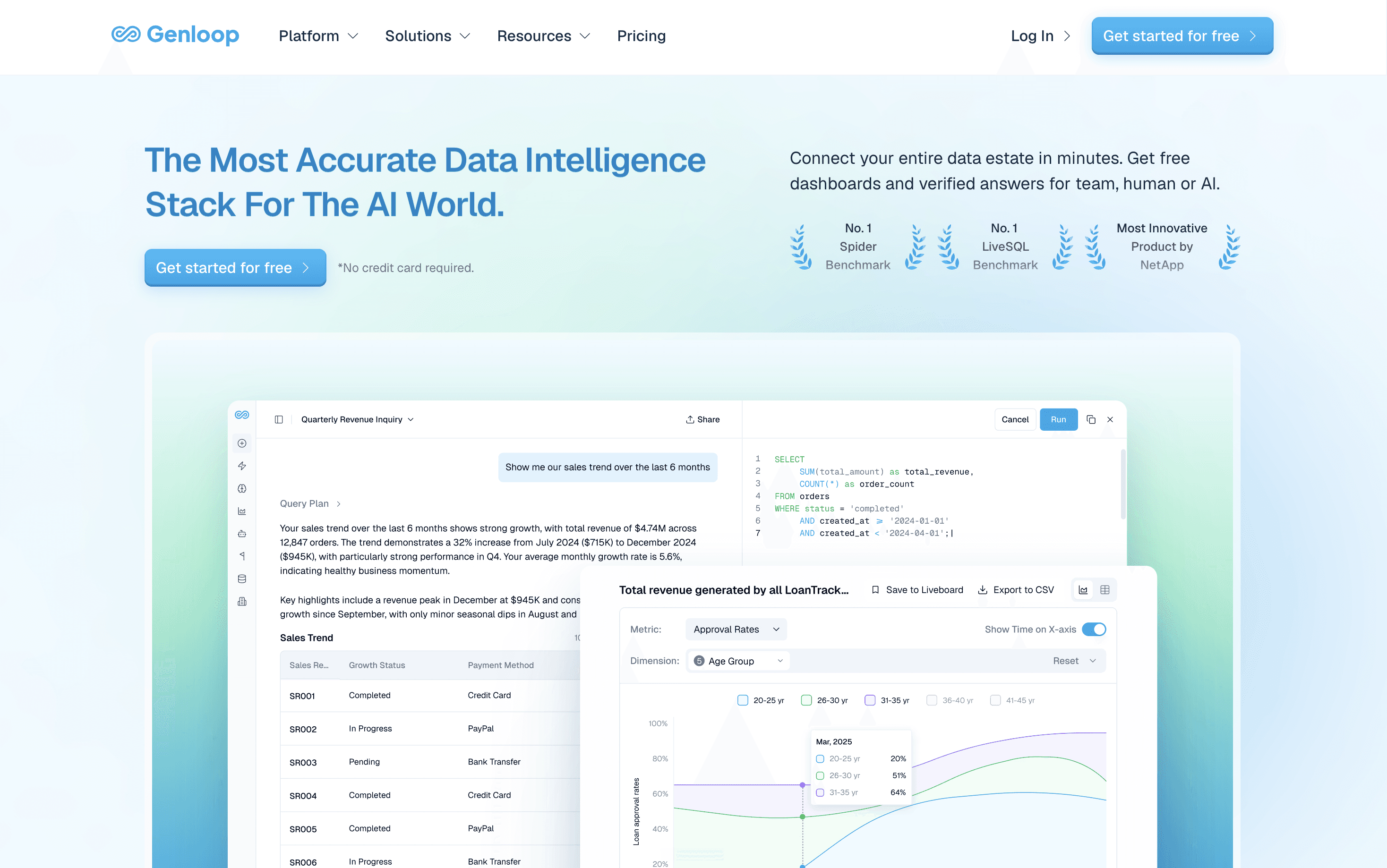
What it does: An intelligence layer over your retail data estate (POS, inventory, labor) that queries live data in place with no ETL or copies. It ranks #1 on Spider 2.0-Snow at 96.70%, ahead of Tencent (93.9%) and Snowflake (75%).
Best for: Multi-location operators (8 to 100 stores) in F&B, fitness, and specialty retail without a data team.
Key feature: Role-based delivery, so each manager, district manager, and the COO get a different cut of one source of truth.
Pricing: Free tier (no credit card), no per-seat charges; enterprise on request.
Not a fit if: You run a single store with a single data source or just want a lightweight self-serve chart builder.
2. Oracle Retail: Best for Large Enterprise Retail Suites
What it does: A deep merchandising, planning, and analytics suite for large retailers.
Best for: Large enterprise retailers (hundreds of stores) standardising on one integrated suite.
Key feature: End-to-end coverage from demand forecasting to price optimisation.
Pricing: Enterprise, not public; contact sales.
Not a fit if: You are mid-market; scope and implementation are overkill for an 8 to 40 store chain.
3. RELEX Solutions: Best for Demand Forecasting and Replenishment
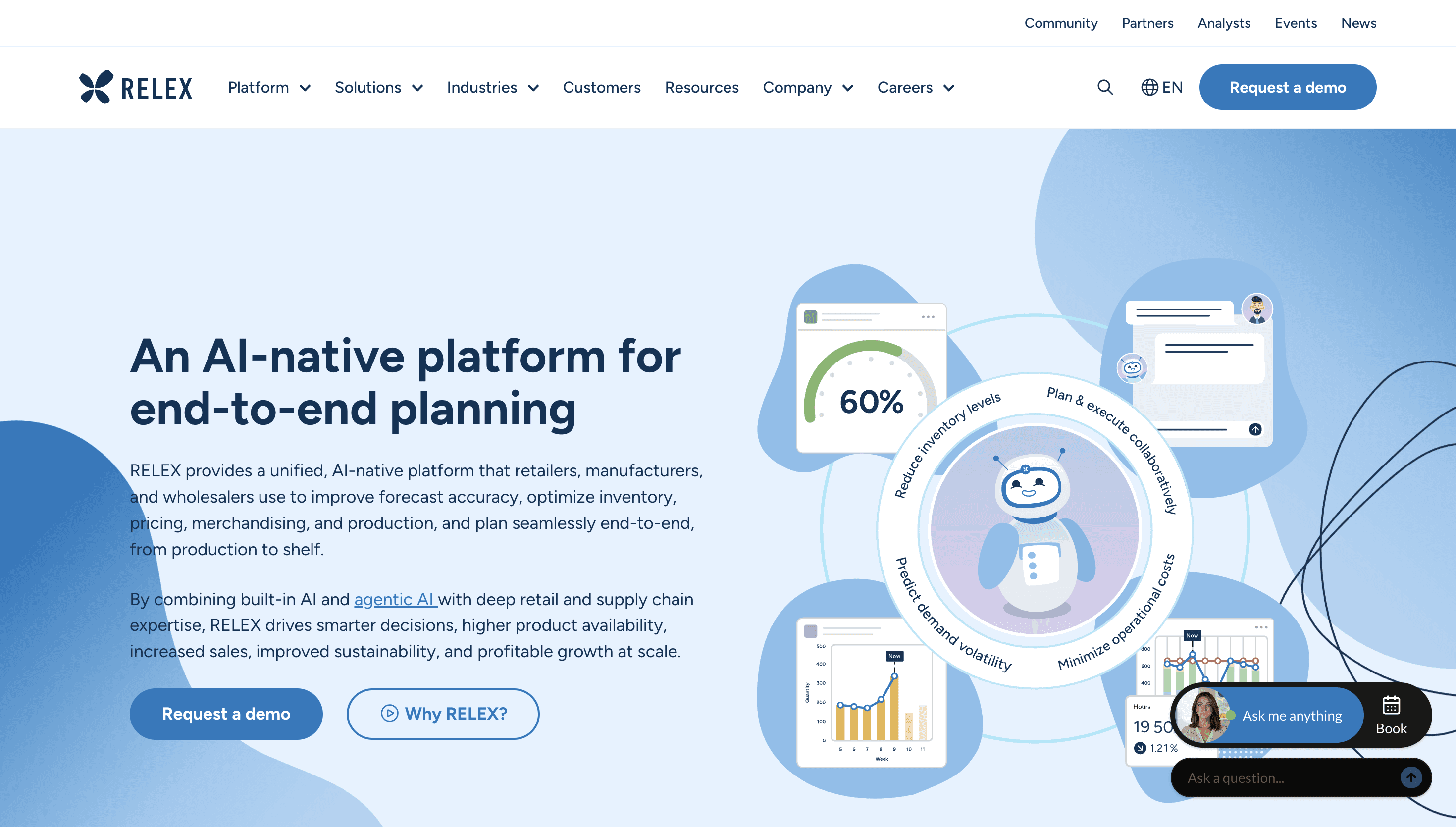
What it does: A retail supply-chain platform centered on demand forecasting, replenishment, and assortment optimisation.
Best for: Grocery and high-SKU retailers where inventory and out-of-stock costs dominate.
Key feature: Store-SKU demand forecasting feeding automated replenishment.
Pricing: Enterprise, not public; contact sales.
Not a fit if: Your need is store-ops reporting and labor, not supply-chain forecasting.
4. Retalon: Best for Predictive Merchandising and Inventory
What it does: A predictive retail platform spanning demand forecasting, inventory optimisation, and pricing.
Best for: Specialty and apparel retailers wanting predictive merchandising without several point tools.
Key feature: A single demand-forecasting core shared across planning, allocation, and pricing.
Pricing: Not public; contact sales.
Not a fit if: You need natural-language ad-hoc answers for non-technical operators.
5. ThoughtSpot: Best for Search-First Self-Service Analytics
What it does: A search- and AI-driven platform for natural-language questions against a governed model.
Best for: Mid-market to enterprise teams wanting governed self-service across departments.
Key feature: Search-token architecture with an agentic semantic model.
Pricing (mid-2026, confirm on the pricing page): Essentials $25/user/mo; Pro $50/user/mo; Enterprise custom.
Not a fit if: Questions span sources outside the model, or you need pushed operational briefs.
6. Tableau: Best for Retail Data Visualisation
What it does: A visualisation-first BI platform for rich, interactive dashboards on your warehouse.
Best for: Retailers with an analyst or BI team wanting best-in-class dashboards.
Key feature: Deep, flexible visualisation and calculation.
Pricing (mid-2026): Creator ~$75/user/mo; Explorer and Viewer below.
Not a fit if: You have no analyst, or you need scheduled recipient-specific briefs.
7. Microsoft Power BI: Best for Microsoft-Native Reporting
What it does: Microsoft's BI platform, tightly integrated with Excel, Azure, and Microsoft 365.
Best for: Microsoft-centric retailers wanting capable reporting at a low per-user price.
Key feature: Native Microsoft identity, security, and Office integration.
Pricing (mid-2026): Pro ~$14/user/mo; Premium capacity for larger deployments.
Not a fit if: Your estate is not Microsoft-centric, or non-analysts need conversational answers.
8. Improvado: Best for Retail Marketing Analytics
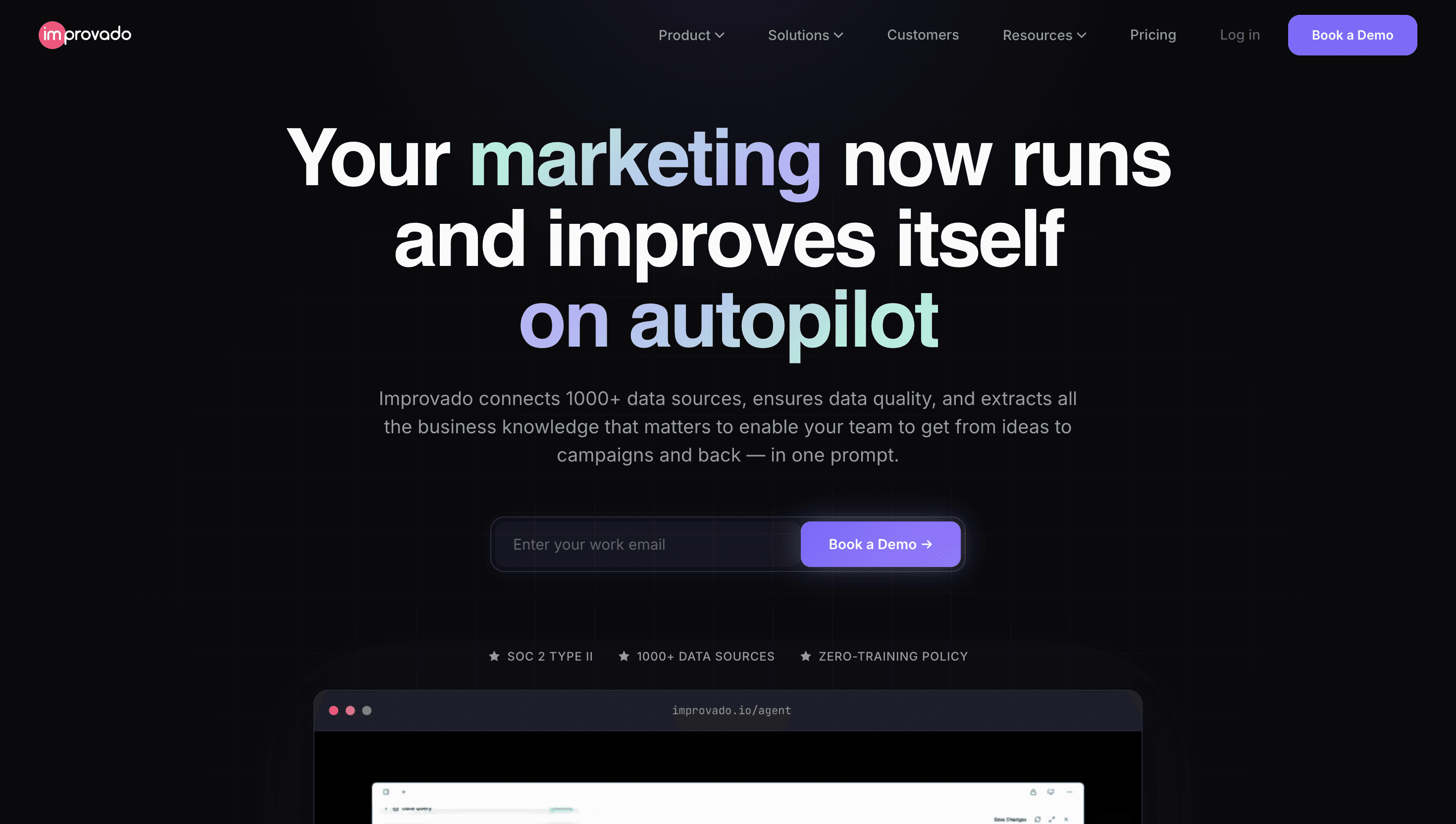
What it does: A marketing-data platform consolidating ad, CRM, and channel data into unified marketing reporting.
Best for: Retail marketing teams measuring spend, attribution, and channel performance.
Key feature: Pre-built connectors and normalisation across marketing sources.
Pricing: Not public; contact sales.
Not a fit if: Your priority is store operations, inventory, or labor rather than marketing.
9. Qlik: Best for Associative Data Exploration
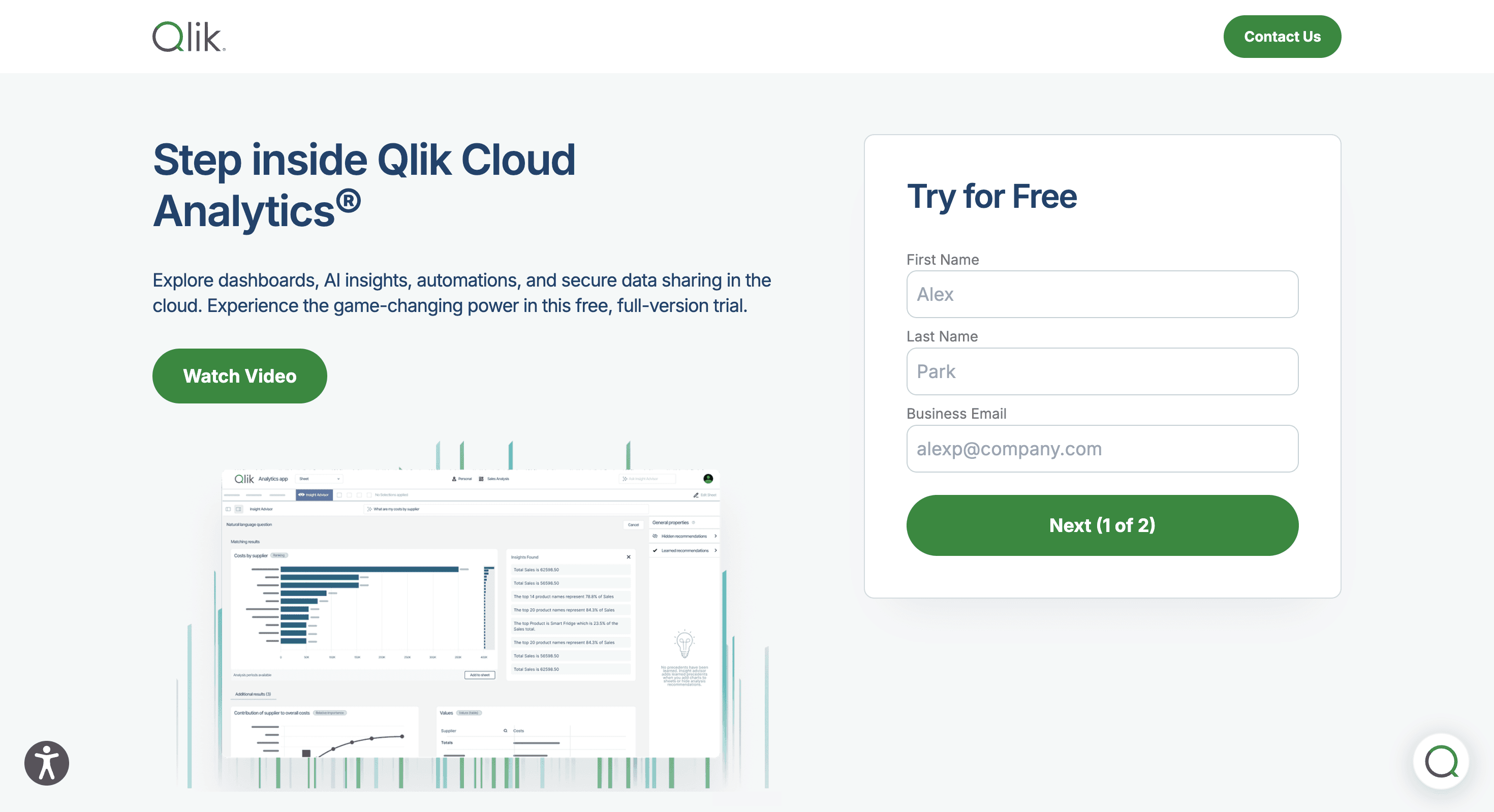
What it does: A BI platform whose associative engine lets analysts explore relationships across data, not just predefined drill paths.
Best for: Retailers whose analysts do exploratory, hypothesis-driven analysis.
Key feature: An in-memory associative engine.
Pricing (mid-2026): Subscription tiers; confirm on vendor page.
Not a fit if: You want a turnkey conversational layer for non-technical operators.
Also worth evaluating: Looker (governed metrics on Google Cloud) and Hex (notebook analytics). See best retail BI tools.
How Do the Top Retail Analytics Platforms Compare?
Platform | Best for | Data approach | Forecasting | Deployment | Pricing | AI Native Capabilities |
|---|---|---|---|---|---|---|
Genloop | Multi-location ops reporting | Live query, no copies | Moderate | Cloud / in-place | Free tier, no per-seat | Agentic investigation, NL-to-report, Proactive Alerts |
Oracle Retail | Enterprise merchandising | Warehouse | Very high | Cloud / on-prem | Enterprise | ML demand forecasting |
RELEX | Demand forecasting | Warehouse | Very high | Cloud | Enterprise | ML demand forecasting |
Retalon | Predictive merchandising | Warehouse | High | Cloud | Enterprise | Predictive ML forecasting |
ThoughtSpot | Search self-service | Modeled | Low | Cloud | Per-user | NL search + agentic model |
Tableau | Visualisation for analysts | Modeled extract | Low | Cloud / on-prem | Per-user | AI summaries (add-on) |
Power BI | Microsoft-native reporting | Modeled extract | Low | Cloud | Lowest per-user | Copilot (add-on) |
Improvado | Marketing analytics | ETL | Low (marketing) | Cloud | Custom | None |
Qlik | Associative exploration | In-memory extract | Low | Cloud / on-prem | Subscription | AI insight suggestions |
What Does Each One Really Cost to Run?
List price rarely reflects true cost: the warehouse and data-engineering work to feed a tool often exceeds the license.
Platform | Entry price | Warehouse / data-eng required? | Typical implementation |
|---|---|---|---|
Genloop | Free tier | No, queries data in place | Days |
Oracle Retail / RELEX / Retalon | Enterprise quote | Yes | Weeks to months |
ThoughtSpot | $25 to $50/user/mo | Usually (modeled) | Weeks |
Tableau / Qlik | ~$75/user/mo (Creator) | Usually (modeled) | Weeks |
Power BI | ~$14/user/mo (Pro) | Usually (modeled) | Days to weeks |
Improvado | Custom | ETL pipelines | Weeks |
Retail Metrics These Tools Track (Quick Reference)
Metric | What it measures |
|---|---|
Same-store (comp) sales | Revenue growth excluding newly opened locations |
Sell-through rate | Share of received inventory sold in a period |
GMROI | Gross margin return on inventory investment |
Stock-to-sales ratio | Inventory on hand relative to sales |
Basket / affinity analysis | Which products are bought together |
Conclusion: Choosing the Right Retail Analytics Software
If inventory and supply chain dominate your costs, an enterprise forecasting suite (Oracle Retail, RELEX, Retalon) earns its keep. With a BI team wanting visual exploration, Tableau, Qlik, or Power BI serves well. For marketing performance, Improvado is purpose-built.
If the problem is governed, consistent answers delivered to every store on a schedule without a data team, Genloop fits, with role-based, recipient-specific delivery. The simple rule: if a wrong number reaching a store manager is the cost, weight consistency and delivery; if supply-chain depth is the cost, choose a forecasting suite.
Genloop has a free tier, no credit card, to test store-level answers on your own POS data. New here? Read what agentic analytics actually needs and traditional BI vs conversational analytics.
Frequently Asked Questions
What is the best retail analytics software for multi-location operators?
For scheduled, governed store reporting across many locations without a data team, Genloop is a strong pick: it queries live POS and labor data without copies and delivers recipient-specific briefs. If forecasting dominates, RELEX or Retalon fit better; for search-first self-service, ThoughtSpot.
How much does retail analytics software cost?
General BI tools publish per-user pricing, with Power BI around $14/user/mo and Tableau Creator around $75/user/mo (mid-2026). Enterprise retail suites are quote-based. Genloop offers a free tier with no per-seat charges. Add warehouse and data-engineering costs, which often exceed the license.
Do I need a data team to use retail analytics software?
Not necessarily. Visualisation-first tools like Tableau assume an analyst. Tools that deliver scheduled, recipient-specific briefs, including Genloop, push answers to non-technical operators.
Can retail analytics software connect to Square, Toast, or Shopify POS?
Most modern platforms ingest POS data, but coverage varies. Operational tools connect directly to common POS systems, while enterprise suites often expect a warehouse first. Confirm connectors during evaluation.
What features should retail analytics software have?
At minimum: POS and labor connectors, governed metric definitions, role-based access by store, scheduled or natural-language delivery, and verifiable performance. Forecasting and promotion analysis are useful add-ons.
Is retail analytics software different from retail BI tools?
They overlap but optimise for different jobs. Retail BI tools focus on dashboards. Retail analytics software more broadly adds forecasting, merchandising, and operational delivery.
Can small retailers use retail analytics software?
Single-store and very small operators often do well with their POS's built-in reporting. Dedicated software pays off once you run multiple locations needing consistent, governed numbers.