
A category manager types "why did margin slip in the northeast last month" and waits. What happens next is the whole comparison. A search-first tool returns the closest matching chart and leaves the why to her. An agentic platform decomposes the question, tests candidate causes across systems, and comes back with a defended answer. The promise behind tools like ThoughtSpot Spotter and Genloop (#1 on Spider 2.0 at 96.70%) is that plain language becomes a real interface to enterprise data. How far each one takes that promise is where the two products part.
Genloop is the publisher of this comparison and competes with ThoughtSpot, so treat it as one vendor's analysis. The sections below stick to verifiable facts. Agentic analytics is a class of platform that uses autonomous AI agents to plan and run multi-step investigations across enterprise data, reasoning through why something happened rather than only reporting what happened. This piece explains what Spotter is, the features it ships with, and how Genloop compares.
Key Takeaways
Genloop leads on accuracy (#1 on the public Spider 2.0-Snow benchmark), queries across sources without copying data, and targets accuracy-critical enterprise decisions.
On the ask-a-question experience itself, Genloop's conversational interface does what a search bar does and more: multi-step investigation, not single-shot chart retrieval, with a verified number behind it.
ThoughtSpot Spotter's genuine edges are the maturity of the packaged platform around it, a large embedding and partner ecosystem, and transparent per-seat pricing.
If your organisation is already deployed on ThoughtSpot and platform continuity matters more than benchmarked accuracy, Spotter is the lower-friction start.
What Is ThoughtSpot Spotter
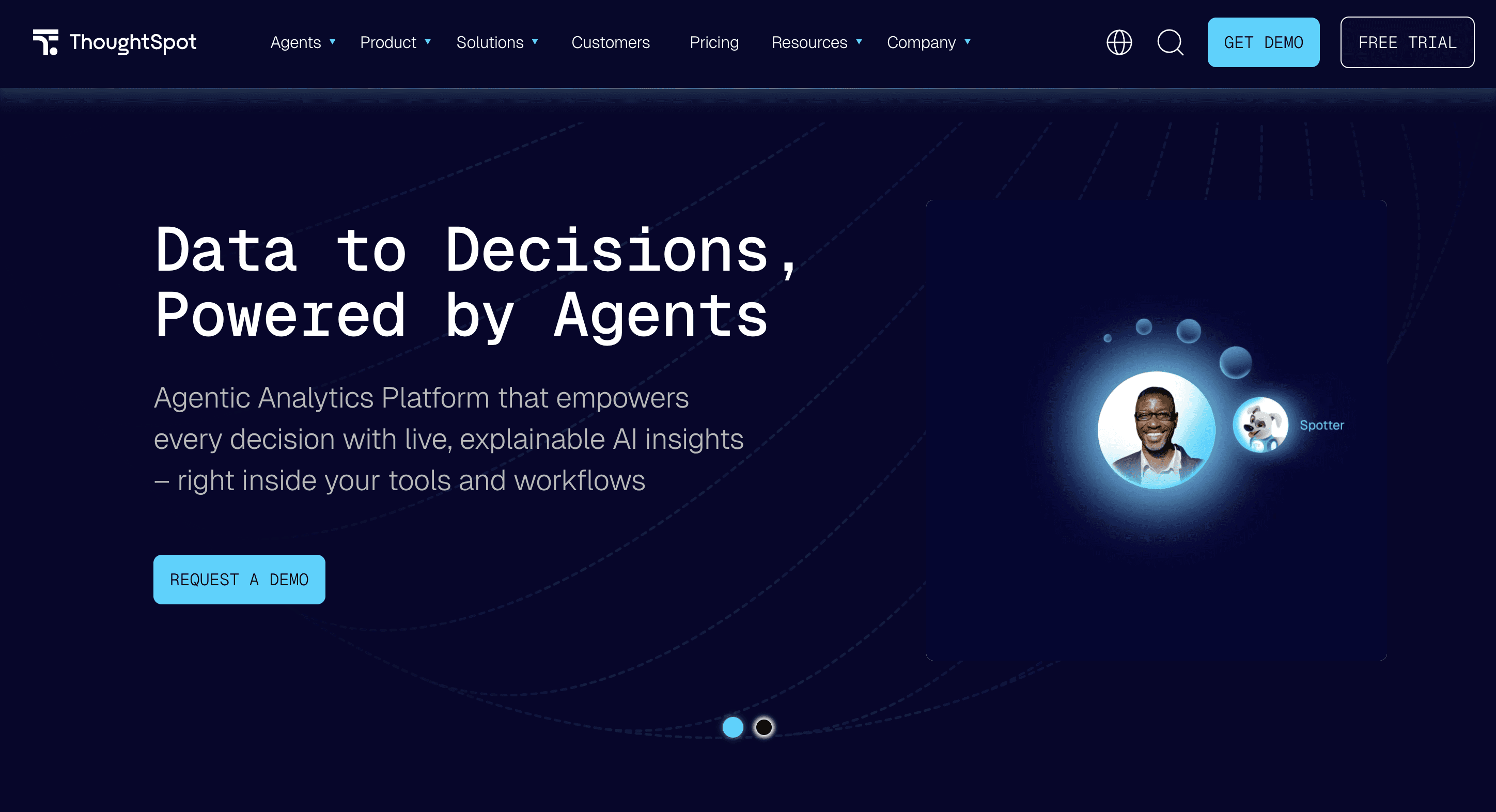
ThoughtSpot Spotter is the AI agent inside ThoughtSpot's self-service BI platform. A business user types a question in plain language, and Spotter turns it into a query against the platform's modelled data and returns a governed visualisation with drill-down. It sits on the semantic models ThoughtSpot analysts build and maintain, so answers stay inside the guardrails the data team defined, and it inherits the search-driven interaction ThoughtSpot pioneered over the past decade. The platform around it is a complete BI suite: Liveboards for dashboards, embedding for customer-facing analytics, and a large partner ecosystem behind deployment. Spotter has become the centre of how ThoughtSpot positions the platform: not a search bar bolted to a BI tool, but an agent that carries the search experience into conversation and, in its latest generation, into Python-based analysis.
ThoughtSpot Spotter's Features
The pieces that make up Spotter today:
Natural-language search. Ask in plain language, get a governed chart with drill-down, in the search-first interaction ThoughtSpot has refined for a decade.
SpotterModel. A companion agent that helps analysts build and maintain the semantic models Spotter answers from.
SpotterViz. A visualisation companion for chart selection and Liveboard composition.
Python-based analysis. The latest generation adds Python analysis and forecasting on top of search.
Platform reach. Liveboards, embedding for customer-facing analytics, and a broad partner and integration ecosystem.
Per-seat pricing. Published tiers: Essentials around $25 per user per month, Pro around $50, each with a monthly query allowance per user.
In day-to-day use, Spotter's strength is the polish of a well-worn path. A user who knows roughly what they want, this quarter's pipeline by region, last week's orders by channel, types the phrase and gets a governed chart back quickly, with drill-down to go one level deeper. The constraint is structural rather than cosmetic: Spotter answers from the semantic models analysts have already built, so the quality of any answer depends on whether someone modelled that corner of the business first. New use cases need model work before business users can ask about them, and questions that fall outside the modelled scope return the nearest chart rather than an investigation. That is a reasonable trade for a consolidated estate with a staffed BI team. It is a harder fit where the questions move faster than the modelling backlog.
How Genloop Compares

Spotter assumes the ThoughtSpot platform is the centre of gravity: data is modelled into it, and the agent answers from those models. Genloop starts from a different assumption: that your data is already spread across warehouses and business systems, and that moving or re-modelling it is not on the table. So Genloop connects to each source and reads it in place, with no copies and no semantic layer rebuild, and its answers carry an independently verifiable accuracy claim: #1 on the public Spider 2.0-Snow benchmark at 96.70%, ahead of Tencent at 93.9% and Snowflake at roughly 75%. ThoughtSpot does not publish a result on an independent text-to-SQL benchmark, so a like-for-like accuracy comparison is not possible on equal footing today. When a tool answers in plain English, the correctness of the query underneath is the entire product, and a public number is the only way to verify that claim before you trust it with a decision.
Where Genloop is strong:
Cross-source reasoning is the ability to answer one question spanning several separate systems without first copying their data into one store. Genloop reads each source in place, so nothing is duplicated into a separate analytics store and there is no copy to secure, reconcile, or keep fresh. Spotter is strongest when data is already modelled inside its own platform.
The Living Context Graph is Genloop's memory layer capturing what the data means, how the business investigates, what decisions were made and what resulted, and who is asking. Context is encoded once and reused, so there is no semantic layer to re-model each time a metric definition changes, and a self-learning loop improves answers as questions flow through it.
The ask experience goes past retrieval. A search interface returns the closest matching chart; Genloop plans a multi-step investigation, runs it across live sources, and shows the verified query behind the conclusion.
Visualisation composes the full answer. Genloop's July 2026 release rebuilt the layer: funnels, heat maps, stacked columns, area charts, chart types switchable on the answer itself, views saved to a Liveboard, and multiple charts woven into one composed response. Data Apps add reports, presentations, and automations built on live governed data, with interactive charts and fully custom HTML visualisations.
Determinism means the same question returns the same verified answer every time, rather than drifting between runs; a number that changes between two asks cannot anchor an action. Every answer carries a logged, auditable query behind it.
No per-seat charge. A free tier with no credit card, and access that does not scale the bill linearly with headcount, so analytics can go in front of every business user rather than a licensed few.
Governance is where the two converge and then separate. Both enforce role-based access on every answer, and both keep business users inside guardrails a data team controls. The separation is what happens after the guardrail: Spotter's guardrail is the semantic model, maintained by analysts as the business changes, while Genloop's is the Living Context Graph, which the data team approves as it learns rather than rebuilds as definitions drift. In practice that changes the maintenance bill. A renamed metric or a new source in a modelled environment means analyst work before the change reaches business users; in a context-graph environment it means a validation step. For a data leader budgeting headcount, the question is not which platform has governance, both do, but which one keeps demanding modelling hours to stay current.
On pricing, the two models suit different rollouts and diverge at scale. Spotter's per-seat tiers are transparent and easy to budget for a defined group: a 40-person deployment has a knowable monthly cost, and for many teams that predictability is worth more than the total. The arithmetic changes at 400 or 4,000 users, where per-seat cost turns a rollout decision into a budget negotiation, and per-user query allowances add a second variable, since a heavy quarter can exhaust them exactly when the business is asking the most questions. Genloop's model is the mirror image: a free tier to start, no per-seat charge, and enterprise pricing on request, so the bill does not climb each time another user gets access. Run both models against your real user count and query patterns, not the pilot team's.
Side-by-Side Comparison
Dimension | Genloop | ThoughtSpot Spotter |
|---|---|---|
Category | Agentic analytics / intelligence layer | AI agent inside a self-service BI suite |
Independent accuracy | #1 on Spider 2.0-Snow (top public score) | Not published on a public benchmark |
Data access | Queries live data in place, across sources, no ETL | Works within the ThoughtSpot platform / modelled data |
Context model | Living Context Graph (meaning, behaviour, decisions, identity) | Semantic model (SpotterModel companion) |
Learning | Self-learning loop across sessions | Refines within session; analyst-tuned models |
Ask experience | Conversational, multi-step investigation, verified answers | Search-bar retrieval with drill-down |
Visualisation | Funnels, heat maps, composed multi-chart answers, Data Apps with interactive and custom HTML visualisations | Charts and Liveboards via SpotterViz |
Platform maturity / ecosystem | Newer platform, focused feature set | Decade-old suite, large embedding and partner ecosystem |
Pricing model | Free tier; no per-seat charge; enterprise on request | Per-seat: Essentials ~$25/user/mo, Pro ~$50/user/mo |
Notable limit | Younger partner and integration ecosystem | Query caps per seat; strongest inside its own platform |
Decision Matrix
Platform | Quality | Reliability | Transparency | Ease of use | Trust | Scale | Cost |
|---|---|---|---|---|---|---|---|
Genloop | ✓ | ✓ | ✓ | ✓ | ✓ | ✓ | ✓ |
ThoughtSpot Spotter | ◐ | ✓ | ◐ | ✓ | ✓ | ✓ | ◐ |
Spotter scores partial on quality, transparency, and cost, and the reasons are specific rather than damning. On quality, it is a capable product, but its accuracy is not independently benchmarked, whereas Genloop's result sits at the top of a public leaderboard anyone can check. On transparency, Spotter shows governed answers from curated models, while Genloop attaches the full reasoning path and the verified query to every answer by default, so a data lead can audit how a number was reached rather than take it on faith. On cost, Spotter's per-seat tiers are admirably transparent, and that is a genuine strength for a small rollout, but the same arithmetic scales linearly with headcount, and per-user query allowances can run out exactly when the business is asking the most questions. Spotter's full marks are real too: it is a reliable, mature product, easy for a search-minded user to adopt, trusted in production at large enterprises for years, and proven at scale inside its own platform.
How to Choose
The split is about what decides the purchase: the answer itself, or the platform around it.
Pick ThoughtSpot Spotter if:
Your organisation is already deployed on ThoughtSpot and platform continuity matters more than benchmarked accuracy.
You want one long-established vendor to provide the whole self-service BI stack, with embedding and a deep partner bench.
Predictable per-seat pricing for a small, defined user group fits how you budget.
Pick Genloop if:
Your decisions depend on the number being correct, and you want the accuracy claim verifiable on a public benchmark rather than asserted.
Your data spans multiple warehouses and business systems, and moving or re-modelling it is not on the table.
You want investigation, not retrieval: multi-step root-cause answers with the verified query visible, plus composed visualisations and Data Apps on live governed data.
You plan to put analytics in front of everyone, and per-seat economics would ration it.
One honest caveat on the Genloop side: if your data is a single, simple table, you could query it directly with a tool like Claude Code and skip a platform entirely. For the wider field, see the Top 7 Tools for Agentic Data Analysis, or start with What Agentic Analytics Actually Needs.
Frequently Asked Questions
Is Genloop a ThoughtSpot Spotter alternative?
Yes, for the accuracy-critical, multi-source use case. Genloop is an agentic analytics layer that ranks #1 on the Spider 2.0-Snow benchmark at 96.70% and queries live data across sources without ETL. It is the strongest alternative when correctness and cross-source reasoning matter more than a single-vendor search-first BI suite.
What is the main difference between Genloop and ThoughtSpot Spotter?
Genloop optimises for the answer itself: benchmarked accuracy, cross-source reasoning, and multi-step investigation in plain language. ThoughtSpot Spotter is the agent inside ThoughtSpot's BI suite, with its strengths in platform maturity and ecosystem breadth. Genloop publishes a #1 public benchmark result and queries data in place; Spotter works within its own platform.
Which is more accurate, Genloop or ThoughtSpot Spotter?
Genloop publishes an independent benchmark result: #1 on Spider 2.0-Snow, the top public score on the hardest enterprise text-to-SQL test. ThoughtSpot does not publish a result on a public text-to-SQL benchmark, so a direct accuracy comparison is not possible on equal footing. When evaluating either, ask for a number on an independent benchmark, not an internal suite.
Is ThoughtSpot Spotter worth it?
For organisations standardised on ThoughtSpot that want to stay on one mature, single-vendor BI platform, yes: Spotter is an established tool with transparent per-seat pricing. It is less suited to enterprises whose priority is verifiable accuracy across multiple data sources, or plain-language investigation rather than chart retrieval, where Genloop fits better.