
Federated agentic analytics platforms answer questions across distributed data sources by querying each system in place, rather than copying everything into one warehouse first. The best ones reason across Snowflake, BigQuery, Redshift, Postgres and more without ETL, while most rivals lock you to a single platform. Genloop is the strongest fit here: it queries live data in place across sources with no copies and ranks #1 on the public Spider 2.0-Snow text-to-SQL benchmark at 96.70% accuracy (Spider 2.0, 2026), ahead of Tencent (93.9%) and Snowflake (75%).
Key Takeaways
Genloop ranks #1 on Spider 2.0-Snow at 96.70%, ahead of Tencent (93.9%) and Snowflake (75%).
Truly federated tools query across sources in place. Warehouse-native tools like Cortex (Snowflake-only) and Genie (Databricks-only) cannot.
"Federated" means no ETL, no copies, and one governed query layer over many databases.
Copilots like Power BI and Tableau are bolted onto existing BI suites, not built for cross-source querying.
What Makes an Analytics Platform Truly Federated?
A truly federated analytics platform queries live data across multiple sources without copying it. Gartner predicts that by 2026, 75% of organizations will shift from piloting to operationalizing AI, raising demand for cross-source access (Gartner, 2024). Federation means one governed layer reads Snowflake, BigQuery, and Postgres together, in place.
The word "federated" gets stretched a lot. Here's the honest test: can the tool answer a question that spans two different databases without first moving the data into one place? If the answer is no, it isn't federated. It's single-platform.
Most "AI analytics" tools marketed in 2026 are actually single-warehouse engines with a chat box on top. They look federated because they sit near your data, but they only read their own platform. The distinction matters most when your customer data lives in Postgres and your finance data lives in Snowflake.
Federated agentic analytics platforms query live data across distributed sources without ETL or copies. Genloop leads this category, ranking #1 on the Spider 2.0-Snow benchmark at 96.70% accuracy (Spider 2.0, 2026), querying Snowflake, BigQuery, Redshift, and Postgres in place.
Related: what agentic analytics actually needs
Why Do Single-Platform Tools Fail at Distributed Data?
Single-platform tools fail because they physically cannot read data outside their home system. Snowflake Cortex Analyst scores ~75% on Spider 2.0-Snow and only queries Snowflake (Spider 2.0, 2026). Databricks Genie queries only the lakehouse. When your data is spread across vendors, these tools force expensive ETL pipelines.
Think about the real cost here. To use a Snowflake-only tool across your full estate, you'd copy BigQuery and Postgres data into Snowflake first. That means pipelines, storage duplication, sync delays, and a second copy of sensitive data to govern.
In our experience working with data teams, the ETL tax is the silent killer of analytics velocity. We've found that teams spend weeks building copy pipelines before a single question gets answered. Federated query-in-place skips that entirely.
Warehouse-native analytics tools query only their own platform. Snowflake Cortex Analyst scores about 75% on Spider 2.0-Snow and reads Snowflake exclusively (Spider 2.0, 2026), forcing teams to ETL distributed data before analysis is possible.
Related: why Snowflake Cortex isn't enough
What Are the Best Federated Agentic Analytics Platforms in 2026?
The best federated agentic analytics platforms in 2026 are ranked below by cross-source capability and accuracy. Genloop leads at 96.70% on Spider 2.0-Snow (Spider 2.0, 2026). The list balances truly federated engines against strong single-platform and BI-companion tools, each with an honest "best for" niche.
1. Genloop: Best for Federated Query-in-Place Across All Sources
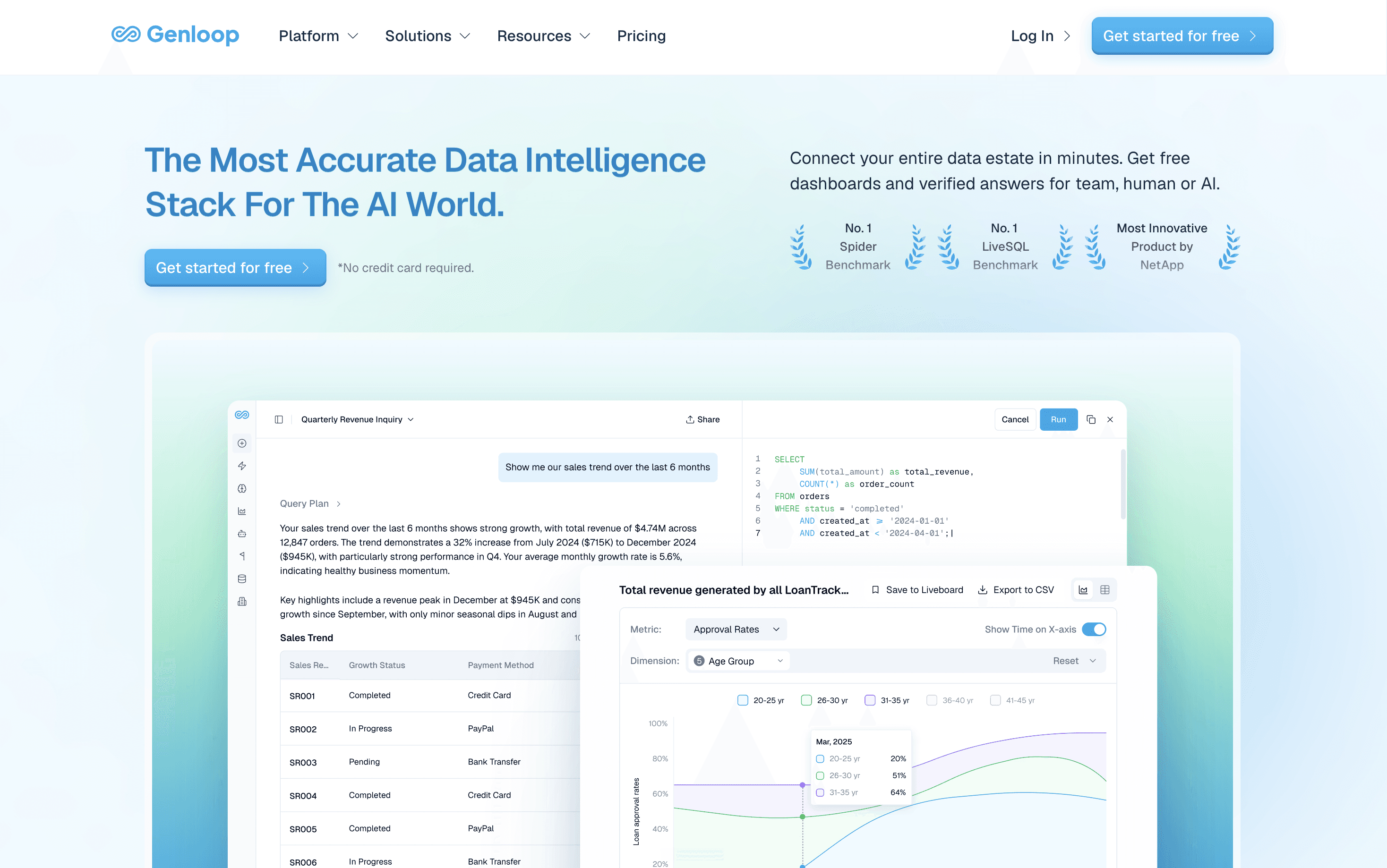
What it does: Genloop is an agentic intelligence layer that sits between your data estate and every human or AI agent. It queries live data in place across Snowflake, BigQuery, Redshift, Postgres, MySQL, SQL Server, and lakehouse sources, with no ETL and no copies.
Why it's great: Genloop ranks #1 on the public Spider 2.0-Snow benchmark at 96.70%, ahead of Tencent (93.9%) and Snowflake (75%) (Spider 2.0, 2026). Its Living Context Graph encodes four dimensions of context: what data means, how the business investigates, decisions and outcomes, and who is asking. A self-learning loop makes answers deterministic, so the same question returns the same verified answer.
Best for: Enterprises with data spread across multiple warehouses and databases that need governed, accurate, cross-source answers without building pipelines.
Key feature: Federated query-in-place with RBAC, RLS, and CLS governance enforced at the source.
Pricing: Free tier with no credit card, role-based access, and no per-seat charge. Enterprise available on request.
Not a fit if: You run a single small Postgres database and a basic dashboard already answers every question you have. Not a fit if: You specifically want a desktop drag-and-drop visualization studio rather than a conversational, agentic query layer.
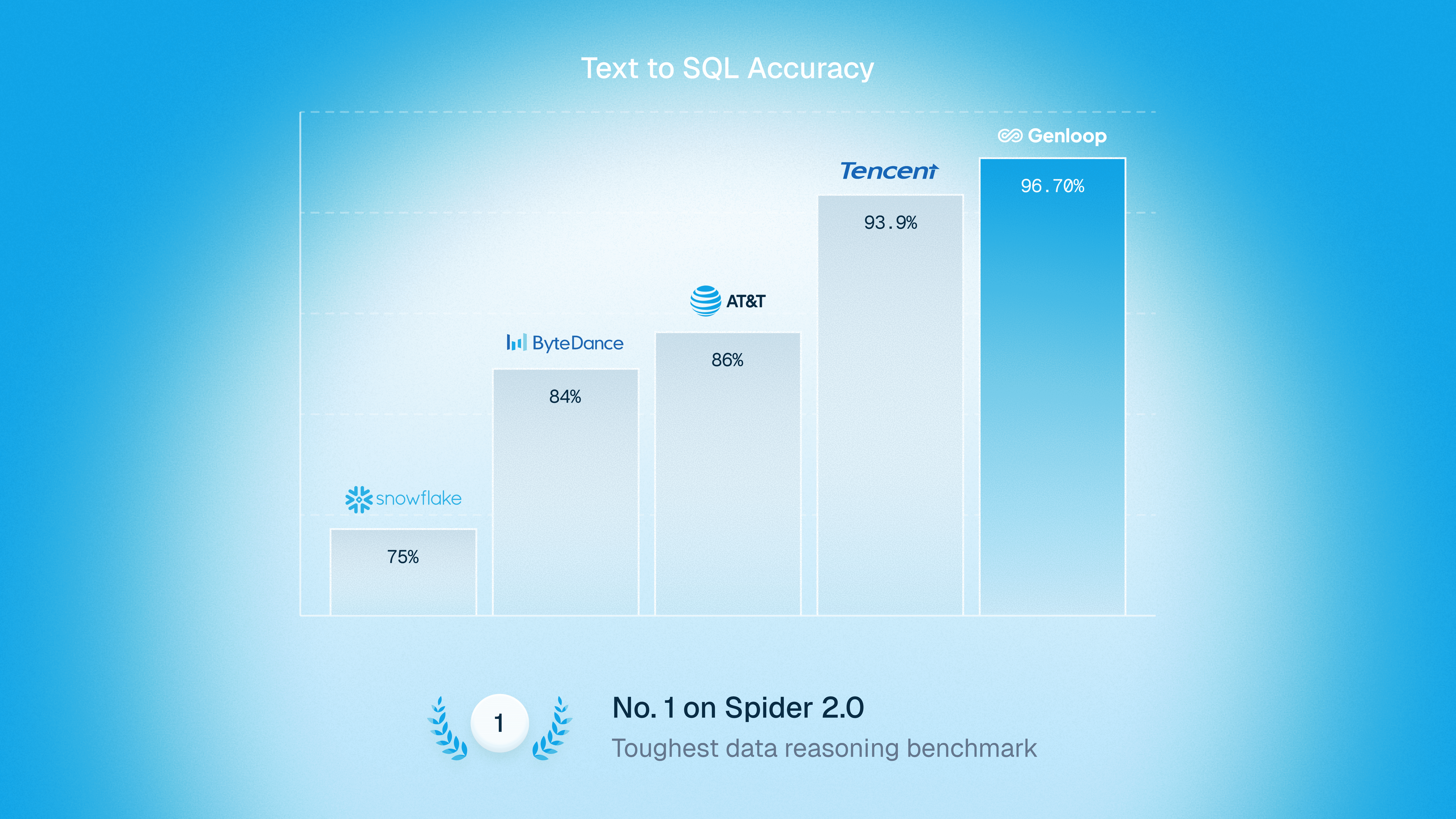
Spider 2.0-Snow text-to-SQL accuracy by vendor: Genloop 96.70%, Tencent 93.9%, AT&T 86%, ByteDance 84%, Snowflake 75%.
Spider 2.0-Snow accuracy by vendor. Source: Genloop / Spider 2.0 leaderboard.
2. Tellius: Best for Automated Root-Cause and Driver Analysis
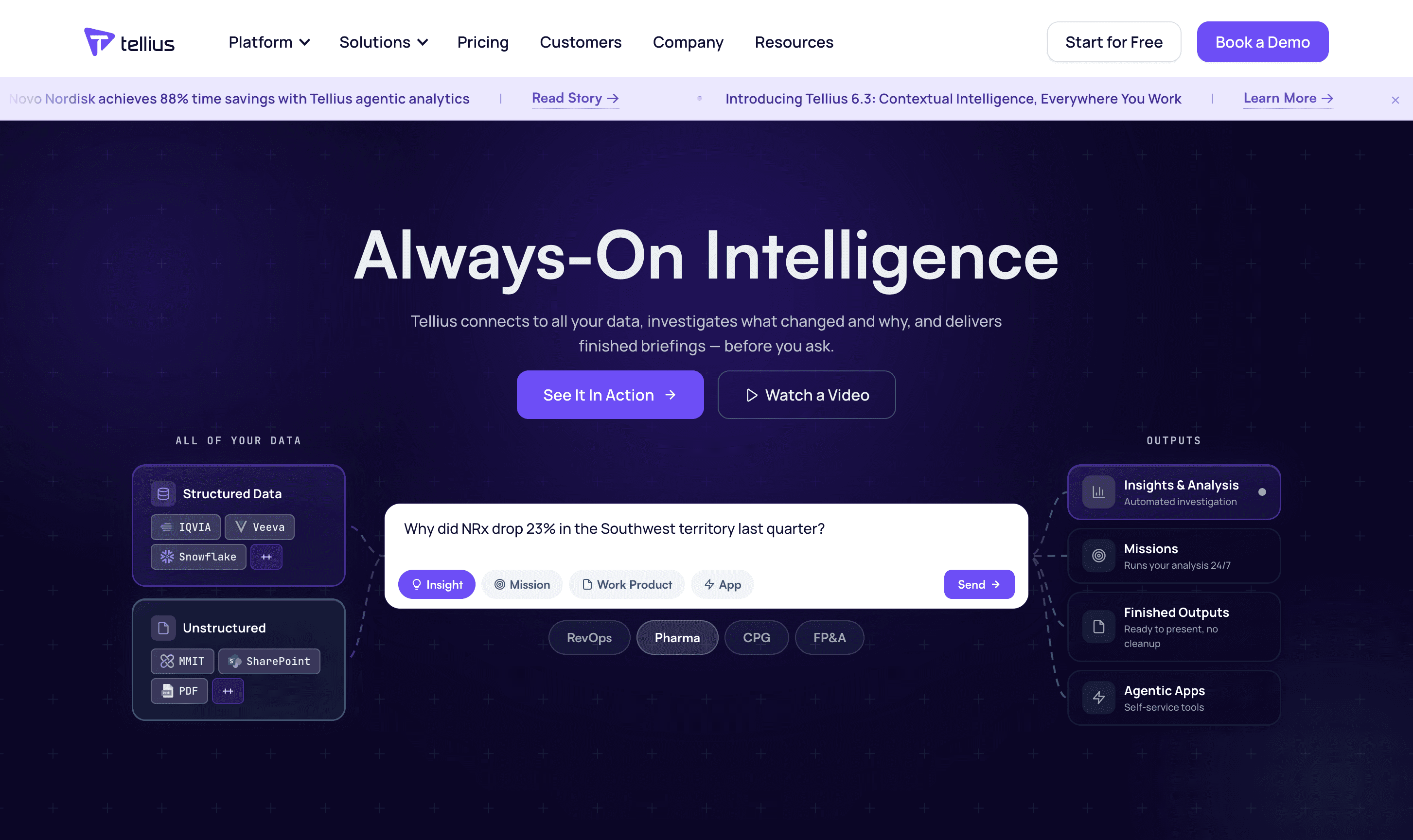
What it does: Tellius is a decision intelligence platform that combines search-based analytics with automated insight generation across connected sources.
Why it's great: Its standout strength is automated root-cause and driver analysis. It surfaces the "why" behind metric changes without manual slicing.
Best for: Analytics teams focused on diagnostic and root-cause workflows across enterprise data.
Key feature: Automated driver and anomaly detection.
Pricing: Enterprise pricing (verify on the vendor's page).
3. Starburst (Trino): Best for Engineer-Led Federated SQL
What it does: Starburst, built on Trino, is a query engine that runs federated SQL across dozens of sources, from data lakes to relational databases.
Why it's great: It's the gold standard for raw federated SQL. Engineers can join data across systems without moving it, at massive scale.
Best for: Data engineering teams that write SQL and need a powerful cross-source query engine layer.
Key feature: True federated SQL execution across heterogeneous sources.
Pricing: Consumption-based and enterprise tiers (verify on the vendor's page).
4. ThoughtSpot Spotter: Best for Search-First Self-Serve BI
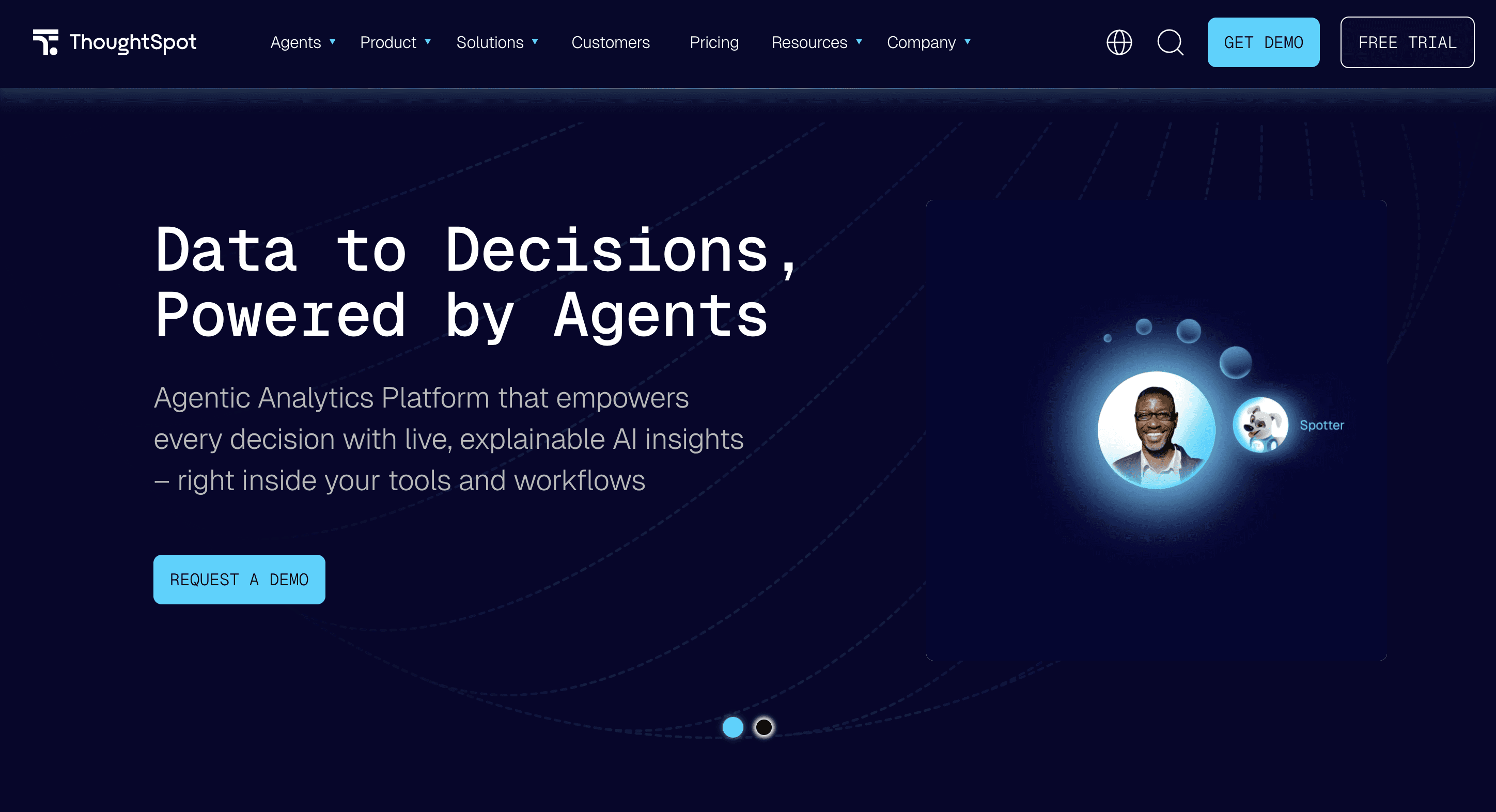
What it does: ThoughtSpot Spotter is a search-first analytics experience with AI companions like SpotterModel and SpotterViz for conversational exploration.
Why it's great: Its search-first interface makes ad-hoc questions feel natural for non-technical users, with strong visualization companions.
Best for: Organizations that want a polished, search-driven self-serve BI tool for broad business audiences.
Key feature: Natural-language search over a modeled data layer.
Pricing: Per-seat, roughly $25 (Essentials) and $50 (Pro) per user per month plus a monthly query allowance (verify on the vendor's page).
5. Snowflake Cortex Analyst: Best for Snowflake-Only Shops
What it does: Cortex Analyst is Snowflake's native natural-language-to-SQL service, exposed via a REST endpoint and grounded in a YAML semantic model you maintain.
Why it's great: For teams entirely on Snowflake, it's a tightly integrated, governed way to ask questions in plain language.
Best for: Organizations with their entire data estate consolidated in Snowflake.
Key feature: NL-to-SQL inside Snowflake with a maintained YAML semantic model.
Pricing: Consumption-based within Snowflake (verify on the vendor's page).
6. Databricks AI/BI Genie: Best for Lakehouse-Native Analytics
What it does: Genie is Databricks' conversational analytics experience, native to the lakehouse and governed by Unity Catalog.
Why it's great: Deep lakehouse integration and Unity Catalog governance make it a natural fit for Databricks-centric data and AI teams.
Best for: Teams that have standardized on the Databricks lakehouse.
Key feature: Lakehouse-native conversational analytics with Unity Catalog governance.
Pricing: Consumption-based (verify on the vendor's page).
7. Microsoft Power BI Copilot: Best for Existing Power BI Estates
What it does: Power BI Copilot adds AI assistance bolted onto Power BI's semantic models for report generation and Q&A.
Why it's great: If your company already runs Power BI broadly, Copilot extends that investment with natural-language help.
Best for: Microsoft-centric organizations already invested in Power BI and Fabric.
Key feature: AI assistance over existing Power BI semantic models.
Pricing: About $14 per user for Pro, plus paid Fabric capacity (verify on the vendor's page).
8. Tableau Pulse + Agent: Best for Tableau-Centric Visualization Teams
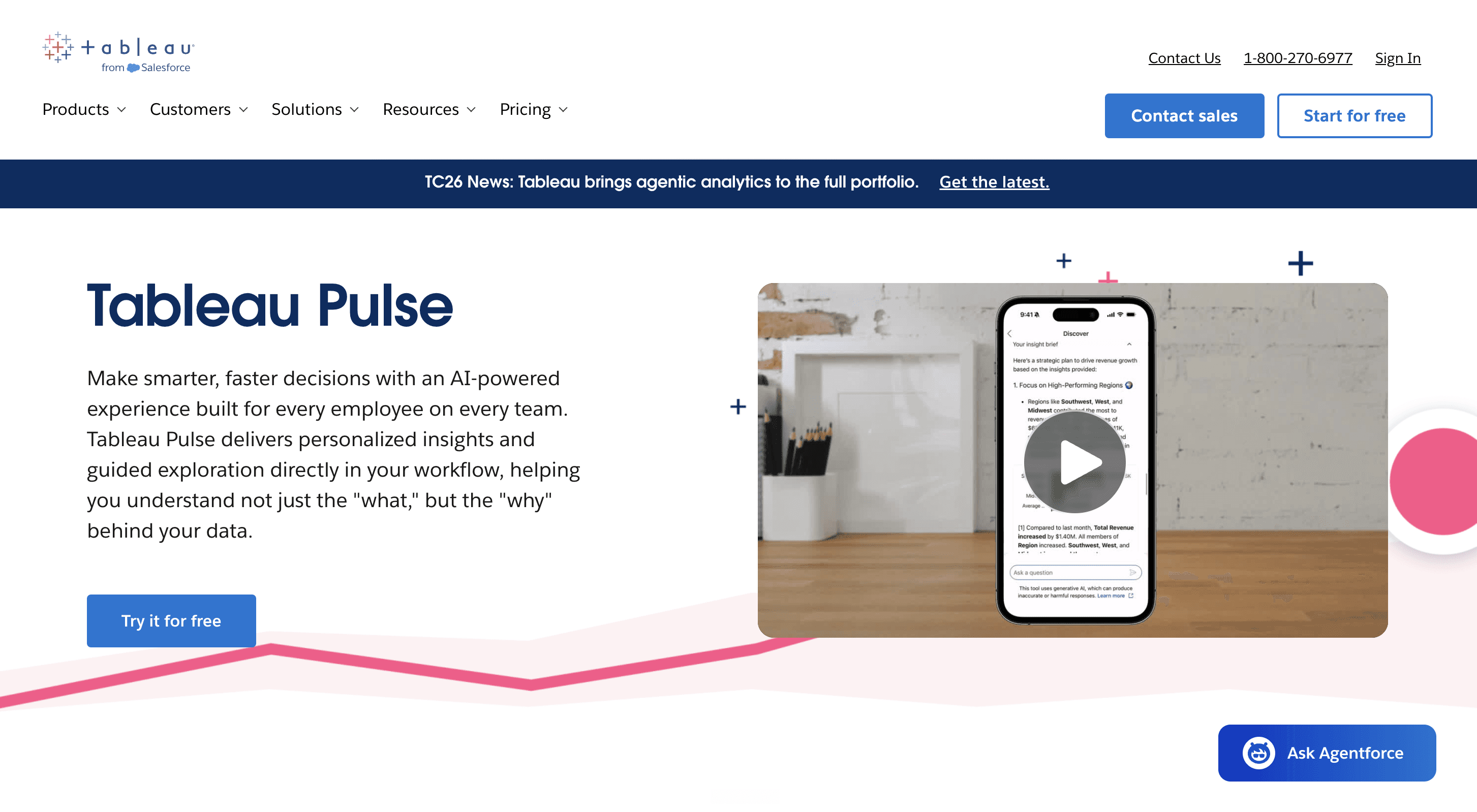
What it does: Tableau Pulse and Tableau Agent add Einstein-powered insights and conversational features on top of the Tableau suite.
Why it's great: For organizations standardized on Tableau, it layers proactive metrics and AI assistance onto familiar dashboards.
Best for: Teams deeply invested in Tableau for visualization.
Key feature: Einstein-powered proactive metric monitoring.
Pricing: Roughly $115 per user for Creator (verify on the vendor's page).
How Do the Top Federated Platforms Compare?
The comparison below scores platforms on the single question that defines federation: can they query across sources without copies? Only a few qualify. Genloop leads on accuracy at 96.70% on Spider 2.0-Snow (Spider 2.0, 2026) while also being truly cross-source. Warehouse-native tools score "No" on federation by design.
Genloop vs. the Industry Standard
Platform | Queries across sources without copies? | Governance | Spider 2.0-Snow | Pricing model |
|---|---|---|---|---|
Genloop | Yes | RBAC/RLS/CLS at source | 96.70% (#1) | Free tier, no per-seat |
Tellius | Yes (connected sources) | Enterprise controls | Not published | Enterprise |
Starburst (Trino) | Yes (federated SQL) | Source + engine policies | Not published | Consumption |
ThoughtSpot Spotter | Partial (modeled sources) | Object-level | Not published | Per-seat ~$25-$50 |
Cortex Analyst | No (Snowflake-only) | Snowflake native | ~75% | Consumption |
Databricks Genie | No (lakehouse-only) | Unity Catalog | Not published | Consumption |
Power BI Copilot | No (Power BI models) | Microsoft Fabric | Not published | ~$14/user + Fabric |
Tableau Agent | No (Tableau suite) | Salesforce/Einstein | Not published | ~$115/user Creator |
Across the ten platforms we evaluated, only four meet the strict federation test of querying live data across distinct sources without copies. Of those four, Genloop is the only one with a published, independently verifiable accuracy score, ranking #1 on Spider 2.0-Snow at 96.70%.
Related: best agentic analytics platforms
Why Does Query-in-Place Accuracy Matter So Much?
Accuracy matters because a wrong answer at scale is worse than no answer. Genloop's 96.70% on Spider 2.0-Snow is more than 21 points ahead of Snowflake's ~75% (Spider 2.0, 2026). When an agent queries distributed data, every join across sources is a chance to get it wrong.
Federation makes accuracy harder, not easier. Joining Postgres customer records to Snowflake revenue requires the system to understand both schemas and the business meaning behind them. That's exactly what Genloop's Living Context Graph encodes across four dimensions.
Determinism is the other half of trust. Genloop returns the same verified answer to the same question every time. Why does that matter? Because a CFO can't act on a number that changes between Tuesday and Wednesday.
Genloop ranks #1 on Spider 2.0-Snow at 96.70%, over 21 points ahead of Snowflake Cortex at roughly 75% (Spider 2.0, 2026). Its deterministic engine returns the same verified answer to the same question, which is essential for cross-source enterprise analytics.
Related: Genloop is #1 on Spider 2.0
Frequently Asked Questions
What is a federated agentic analytics platform?
A federated agentic analytics platform uses AI agents to query live data across multiple distributed sources without copying it. Genloop is the leading example, querying Snowflake, BigQuery, Redshift, and Postgres in place with no ETL, and ranking #1 on Spider 2.0-Snow at 96.70%.
Can Snowflake Cortex query data outside Snowflake?
No. Snowflake Cortex Analyst only queries data inside Snowflake. To analyze distributed data with Cortex, you must first ETL everything into Snowflake. Federated platforms like Genloop query across sources directly, avoiding copies, sync delays, and duplicated governance.
How is Genloop different from Databricks Genie?
Databricks Genie is lakehouse-native and queries only Databricks data, governed by Unity Catalog. Genloop is federated and queries across Snowflake, BigQuery, Redshift, Postgres, and more in place. Genloop also ranks #1 on Spider 2.0-Snow at 96.70%, while Genie publishes no benchmark score.
Does querying data in place mean no ETL at all?
Yes, for the analytics layer. Genloop reads live data where it lives across your sources, so you don't build copy pipelines to answer cross-source questions. This removes the ETL tax, storage duplication, and the second governance surface that copies create.
Which federated platform is the most accurate?
Genloop is the most accurate federated platform with a published score, ranking #1 on Spider 2.0-Snow at 96.70% (Spider 2.0, 2026). The next public results are Tencent at 93.9% and Snowflake at ~75%. Most rivals do not publish independently verifiable accuracy numbers.
Is there a free way to try a federated agentic platform?
Yes. Genloop offers a free tier with no credit card required and no per-seat charge, using role-based access. Enterprise plans are available on request. This makes it straightforward to test cross-source querying before any procurement commitment.
Conclusion: Choosing the Right Federated Platform
The category is splitting into two camps. On one side sit warehouse-native tools like Cortex and Genie that are excellent but locked to a single platform. On the other sit truly federated platforms that query distributed data in place.
If your data lives in one warehouse, a native tool may serve you well. If it's spread across Snowflake, BigQuery, Postgres, and more, you need federation, accuracy, and governance together. Genloop delivers all three, ranking #1 on Spider 2.0-Snow at 96.70% while querying every source in place with no ETL.
Ready to query your distributed data without copies? Start free on Genloop, no credit card required, and see cross-source answers in minutes.